Archives For Stewardship

       In the earlier parts of this series, I explained how you should calculate how much income you’ll need in retirement, how much you’ll need to retire, and how much you already have saved for retirement. I’ll be honest. After looking at the second article and realizing what I would have to include in this one, the whole thing was too complicated.

       I want you to actually do this. I want people to have an accurate way to calculate their retirement needs and how much they should save. So I’ve put a lot of work into creating the calculator I’ve included with this post. It doesn’t assume you’ll get the same return every year in the stock market. I’ve used Monte Carlo simulations to account for the fact that stock market returns are variable. Also, it assumes you’ll invest in a diversified portfolio that becomes more conservative as you get older. I’ll explain exactly how you should invest for retirement in an upcoming series of posts.

       Since this calculator simplifies what you need to do, I’m revamping the steps you need to take to calculate how much you should save for retirement. You’re still going to have to do some work, but if you want a good answer you can’t get around doing a little work. Here are the steps followed by the calculator:

1. Figure Out How Much Income You’ll Need in Retirement.

       The first thing you need to know is exactly how much income you’ll need in retirement. This calculator assumes you’ve calculated your retirement income needs in a specific way. To calculate that number, follow the instructions in the first post of this series.

2. Enter Your Current Age.

       Straightforward if you ask me…

3. Enter Your Retirement Age.

       Again, pretty straightforward. Enter the age you’ll be when you want to retire (or think you’ll want to retire).

4. Estimate Your Life Expectancy.

       I realize you don’t know exactly when you’re going to die, but to plan for retirement you need to estimate something. The best way I’ve found to estimate your life expectancy is to use the free life expectancy calculator at Living to 100. This calculator considers your family health history and your own habits to estimate your life expectancy. You’ll also receive tips on how to increase your life expectancy by changing your habits.

       If you’re married, both you and your spouse should use the life expectancy calculator. Then, use the longer of your two life expectancies. Make sure that the difference between the life expectancy you use and the retirement age you used covers the entire time period you or your spouse will be drawing on your retirement portfolio. (For example, you’re 30 and your spouse is 25. You want to retire when you’re 65 and your spouse is 60. Your life expectancy is 85 and your spouse’s is 90. You’ll only need your retirement assets for 20 years, but your spouse will need them for 30 years. Since your spouse will be drawing on your retirement assets for 30 years, you should use a life expectancy of 95 – your retirement age of 65 plus the 30 years your spouse will be alive.)

5. Calculate Your Current Savings after Accounting for Taxes.

       You’ll also need to know how much you’ve already saved up before you can determine how much you should be saving every year for retirement. This is where we’ll account for your taxes. Because we don’t know exactly what changes will happen to the tax structure, we’ll have to estimate this as well. Here’s how to add up each of your accounts (taking taxes into consideration):

  • Tax-free Accounts – If you have a Roth IRA or Roth 401(k), you don’t need to worry about taxes. You can include the full value of these accounts in calculating your current retirement savings.
  •  

  • Tax-deferred Accounts – Withdrawals from a Traditional IRA, 401(k), 403(b), 457, or similar accounts will be taxed in retirement. For our purposes, you’ll need to account for the taxes you’ll pay on these accounts. Given our current tax structure, you can plan on paying about 20-25% in federal and state income taxes on these accounts. To figure out how much you should include when adding up your savings, use 75-80% of the account value. If you have $100,000 in your Traditional IRA, you should only use $75,000-80,000 when you’re adding up your savings.
  •  

  • Taxable Accounts – This category includes all your taxable accounts you’re using to save for retirement. It’s a little more difficult to account for taxes in these accounts. You’ll be taxed only on the gain in these accounts. How much of your withdrawals will be taxed depends on your cost basis in these accounts. Since we don’t know exactly what your cost basis will be, we’ll estimate that taxes will be about 15-20% on these accounts. If you know you’ll have a high cost basis, you can adjust accordingly. (If you don’t know what I’m talking about, you probably shouldn’t be investing in a taxable account.) So you’ll want to use 80-85% of the account value when adding up your savings.

       Here’s a quick example. Let’s say you have $25,000 saved in a Roth IRA, $20,000 in your 401(k) at work, and no taxable accounts. You’ll include the full $25,000 in the Roth IRA and 75% of your 401(k), or $15,000. This gives you a total savings of $40,000.

6. Use This Calculator.

       If you’ve followed those first five steps, you’ll have everything you need to use this calculator. After you’ve entered how much income you’ll need in retirement, your current age, your retirement age, your life expectancy, and your current savings, you’ll get an amount you should save this year. Then, increase your annual savings by inflation each year.

*Note: Click the ‘Click to Edit’ button to use the calculator with your own numbers.

       To get a usable answer from this calculator, make sure you’ve followed my instructions. The reason this calculator is so simple is because I’ve built in the assumption that you’ve followed my instructions for calculating everything. So if you think something’s wrong with the calculation, make sure you’ve followed the instructions. (especially on calculating how much income you’ll need in retirement)

       Disclaimer: No guarantee is made that you’ll definitely reach your retirement goals by following the recommendations of this calculator or my articles. This calculator bases its return calculations on the historical risk and return of a diversified portfolio of index funds using Monte Carlo simulations to emulate the variability of the stock market. Past performance is no guarantee of future results, but without a crystal ball it’s the best we have to go on. This information is for education purposes only and does not represent investment advice or an offer of any security for sale.

6. Repeat Every 3-5 Years.

       This calculator works best when you come back every 3 to 5 years, go through the process once again, and get a new number for how much you should save. The reason this is important is because it will consider the changes in your account value that the calculator couldn’t possibly know. So if you have really good results in the stock market, you can save a little less. If not, you might need to save a little more. Just be sure to come back to this calculator every few years until you retire.

Feel Free to Share and Stay Tuned!

       If you’ve found this calculator helpful, feel free to share it with your friends. If you want to learn how to invest for retirement and make sure your asset allocation is correct, sign up for free updates to Provident Planning!


Is Debt a Sin?

Corey —  September 8, 2009

Chain by Ella's Dad on Flickr       No. Debt is not a sin. It’s not always a wise choice, but it’s not a sin either. The Bible never says you are sinning if you are in debt. God does warn against the dangers of debt and explains why it is not prudent. Here are the main verses where the Bible discusses the nature of debt.
Debt Is Slavery

       Debt is slavery. If you owe someone money, you must continue paying them back until you owe no more or you risk going to court. The obligation you’ve made to repay puts you under the same bonds as slavery. You’re not free to choose whether you’ll pay them back, which also means you’re not free to choose to work for pay or do something else. You are required to keep sending those payments. You have no freedom.

       This is God’s strongest warning against debt:

       The rich rules over the poor, and the borrower is the slave of the lender.

Proverbs 22:7 (WEB)

       The borrower is slave to the lender. God doesn’t say that those who borrow are sinners. But He does warn that when you borrow you put yourself under the yoke of slavery to your lender. God doesn’t want us to serve anyone or anything but Him. In fact, Jesus warned us that we can’t serve Money and God. We have to choose one. When you put yourself in debt, you are making yourself a slave to your lender – which requires you to do whatever you can to get the Money you need to repay him.

       You know that’s the truth. If you stopped paying your mortgage or auto loan or any other loan, what would happen? You’d have those things taken away from you or you’d eventually be forced to file for bankruptcy. Until you’ve paid those loans off, you do not own the things you bought with borrowed money. You’re not a homeowner if you have a mortgage. You’re a bank’s slave. You must continue working to repay them, or they will take your home and ruin your credit.

What Will Happen If You Can’t Repay?

       Knowing that the things you’ve put up as security for your debts can be taken if you don’t repay should alert you that it could be foolish to borrow money. If you lose your job and can’t pay your mortgage, what will happen? Your home will be taken from you. The very place you sleep will be pulled out from under you.

       26 Be not one of those who give pledges, who put up security for debts. 27 If you have nothing with which to pay, why should your bed be taken from under you?

Proverbs 22:26-27 (WEB)

       Is it worth borrowing money if you’ll risk losing the very things you’re working for? When the bank takes your home, you risk losing most or all of the equity you managed to build up. Your ability to repay a loan is not completely in your control. A job loss or illness can easily throw you into a bad situation which causes you to lose everything. That’s why God asks you if going into debt is worth the risk. You’re better off to save and pay cash.

Debt Is Foolish

       The problem with debt is not that it’s a sin. The problem is that it can be just plain dumb. As I mentioned before, you can be forced into a bad situation because of things completely out of your control. Being in debt only makes that bad situation worse. God doesn’t want debt to put that extra strain on you when you’re going through a tough time. That’s why He cautions:

       One who lacks sense gives a pledge and puts up security in the presence of his neighbor.

Proverbs 17:18 (WEB)

       Putting yourself in debt shows a lack of wisdom. Forget those who try to tell you that the mathematically better choice is to get a loan and pay it off over time because you can earn more in the stock market. God tells us plain and simple that debt is foolish. It’s not a good choice. Just looking at the difference in returns (between investing or paying off debt) doesn’t account for God’s wisdom, the problems that occur when you can’t repay, or the fact that debt is slavery. In the case of debt, you don’t need mathematical calculations to show that it’s a bad decision. God has plainly told us that it’s not a good thing, and He’d rather we stayed away from it.

Owe No One Anything Except Love

       Finally, Paul gave us good advice in Romans:

       Owe no one anything, except to love each other, for the one who loves another has fulfilled the law.

Romans 13:8 (WEB)

       The only debt we should owe anyone is the debt to love. In its context, this verse means that we should pay whatever we owe. This idea is also reflected in Psalm 37:21, where it says that the wicked borrow and do not pay back but the righteous are generous and give. We need to focus our time and energy on showing God’s love to the world rather than repaying the debts we’ve taken on foolishly. Our goal should be to get out of debt and avoid it as much as possible so we can devote ourselves to love more and more. A life free of debt is free to love at all times. You are no longer bound by the chains of debt. You are free to use your time showing love rather than working to repay your debts.

       None of this means that debt does not have its proper place in our finances. But foolish debt – to buy things we can’t really afford – is not going to glorify God. Christians should only be going into debt when they are reasonably sure they can repay the loan and they are not using the debt for foolish or sinful purposes. This is why Christians and bankruptcy can be a bad mix. Setting an example of consumerism and following it up with not paying debts we owe will leave people wondering about God’s love working in our lives.

       So no. Debt is not a sin. But it’s not always a good choice, and it’s a poor master. Free yourself from being anyone’s slave except Christ’s. For He has bought us with His blood, and by choosing Him we are choosing to have no other master but God.

You Need an Emergency Fund

Corey —  September 4, 2009

       If you have an unexpected expense of $1,000 today, where will you get the money? If your answer doesn’t involve credit cards, payday lenders, or any other form of borrowing money, you can skip the rest of this post. However, if the only way you could pay such an expense would be to borrow from someone (including family), you need to learn about an emergency fund.

What Is an Emergency Fund?

       An emergency fund is an easily accessible stash of money that you use only for emergencies. It’s not used to pay for your vacation. It’s not used to buy a new car. It’s not used to buy pizza on Friday night. It’s money that you use only when you have a true emergency.

What Counts As an Emergency?

       Before establishing an emergency fund, you need to decide what will qualify as an emergency and what will not. This will help you determine exactly how much you should save up, and it will ensure that you don’t spend your emergency fund unwisely. Anything that does not qualify as an emergency (in your definition) but comes up irregularly should have it’s own savings fund. One example of an irregular, but expected, expenses is your auto insurance. Here are a few examples of emergencies:

  • Unemployment
  • Unexpected medical bills
  • Car repairs
  • An appliance breaks (stove, refrigerator, etc.)
  • Storm damage to your home that’s less than your deductible
  • Mistakes – forgotten bills, taxes that you didn’t account for, etc
  •        You can adjust this list for your situation, but this is a good place to start. Obviously, if you have an old car or old appliances, you’ll want to set aside money in a special savings fund to replace those things if necessary.

    What If You Can’t Afford to Save Up for an Emergency Fund?

           Can you really afford not to have an emergency fund? If things are so tight for you already that you can’t begin saving $10, $20, or $50 a month for emergencies, then what are you going to do when your car needs a repair that costs $400? You’ll only put yourself in a worse position by not having an emergency fund.

           I’m not saying you need to save up $5,000 in the next two months. It will take time to get your emergency fund as big as it needs to be. You’ll want to get the first $1,000 saved up as quickly as you can to protect from any imminent emergencies, but you can save up the rest over time.

    Do I Need an Emergency Fund If I’m Paying Off Debts?

           Yes! You probably need an emergency fund more than anyone. You’ve recognized you need to get out of debt, and you’re working hard to accomplish that goal. But an unexpected emergency could set you back quite a ways because you’ll have to borrow to cover the costs. By having an emergency fund, you can protect all the hard work you’ve put into paying off your debts so far.

           Again, you don’t need a full six months of your expenses as an emergency fund if you’re trying to pay off your debts right now. Save up that first $1,000 or $2,000 as fast as you can, then focus on paying off your debt as fast as you can. If you have an emergency, replenish your emergency fund and then get back to tackling those debts. Once you’ve conquered your debts, continue saving in your emergency fund until you have met your goal.

    Stay Tuned!

           We’ll discuss many more aspects of emergency funds in later posts like how much you should have saved up, where you should keep it, how to build it up, and when you should use it. Stay tuned by signing up for free updates to Provident Planning!

       Once you’ve determined how much income you’ll need in retirement, the next step is to figure out how much you’ll need to have saved up by retirement. Don’t worry. I’m not going to make you do complicated math. If you can multiply, you can figure this out. First, we need to determine how long you’ll be retired.

How Long Are You Going to Live?

       Let’s pull out your crystal ball and figure out how old you’ll be when you die. If you don’t have one, then you’re already aware that we’re only estimating here. There’s no way to know for certain when you’ll take your last breath, but you can plan by taking your health and family history into consideration.

       You can use the free life expectancy calculator over at Living to 100 to estimate how long you’ll live. You’ll even get some tips on changes you can make to live a healthier, longer life. If you’re married, use the longer life expectancy between the two of you.

How Many Years Will You Spend in Retirement?

       Once you’ve estimated your life expectancy, all you need to do is subtract your retirement age from your life expectancy. If you expect to live to age 90 and you want to retire at age 65, you’ll spend 25 years in retirement. Remember that number. You’ll need it in the next step.

How Much Will You Need to Have Saved by Retirement?

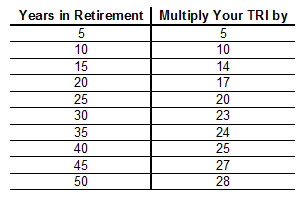
       Now for that multiplication I warned you about before. First, you need to know your target retirement income (TRI) from Part 1. Then, using the table below, figure out what number you should multiply by to determine your target retirement savings (TRS). For example, if you’ve determined you need $40,000/year (your TRI) and you’ll be in retirement for 25 years, just multiply by 20 to determine your target retirement savings. In this case, $40,000 x 20 would mean you need to have $800,000 (in today’s dollars) saved by the time you want to retire.

TRI Factor

       As I mentioned before, using this chart will tell you how much you need to have saved by retirement in today’s dollars. This isn’t the actual number of dollars you’ll need to have in your account because of inflation, but that doesn’t matter. If you continue to use this process once a year, you can be sure you’re saving enough. Make sure you write down your TRS number. You’ll need it for Part 3 so you can figure out how much you should save each year until retirement.

How Much Have You Already Saved?

       You’ll also need to know how much you’ve already saved up before you can determine how much you should be saving every year for retirement. This is also the part where we’ll account for your taxes. Because we don’t know exactly what changes will happen to the tax structure, we’ll have to estimate this as well. Here’s how to add up each of your accounts (taking taxes into consideration):

  • Tax-free Accounts – If you have a Roth IRA or Roth 401(k), you don’t need to worry about taxes. You can include the full value of these accounts in calculating your current retirement savings.
  •  

  • Tax-deferred Accounts – Withdrawals from a Traditional IRA, 401(k), 403(b), 457, or similar accounts will be taxed in retirement. For our purposes, you’ll need to account for the taxes you’ll pay on these accounts. Given our current tax structure, you can plan on paying about 20-25% in federal and state income taxes on these accounts. To figure out how much you should include when adding up your savings, use 75-80% of the account value. If you have $100,000 in your Traditional IRA, you should only use $75,000-80,000 when you’re adding up your savings.
  •  

  • Taxable Accounts – This category includes all your taxable accounts you’re using to save for retirement. It’s a little more difficult to account for taxes in these accounts. You’ll be taxed only on the gain in these accounts. How much of your withdrawals will be taxed depends on your cost basis in these accounts. We’ll estimate that taxes will be about 15-20% on these accounts. So you’ll want to use 80-85% of the account value when adding up your savings.

       Here’s a quick example. Let’s say you have $25,000 saved in a Roth IRA, $20,000 in your 401(k) at work, and no taxable accounts. You’ll include the full $25,000 in the Roth IRA and 75% of your 401(k), or $15,000. This gives you a total savings of $40,000.

       After you’ve figured out how much you’ve saved, you need to determine how much that is as a percentage of your TRS. In the example above, we determined you’d need $800,000 to retire. If you’ve saved $40,000 already, you’ve saved up 5% of your target retirement savings (TRS). (That is, $40,000/$800,000 is 0.05 or 5%.)

       To figure out how much you’ll need to save every year, you need to know your target retirement savings (TRS) and how much you’ve saved already as a percentage of your TRS. In Part 3, we’ll continue to use the example above with a TRS of $800,000 and having 5% of that number already saved up.

       Here’s a quick recap of what you’ve done already:

  • 1. Figure out how much income you’ll need in retirement (your TRI).
  • 2. Figure out how many years you’ll spend in retirement.
  • 3. Multiply your TRI by the appropriate number from the chart above to determine how much you’ll need to have saved for retirement (your target retirement savings or TRS).
  • 4. Add up your current savings after accounting for taxes. Then figure out how much that number is as a percentage of your TRS (divide current savings by your TRS).

       In our working example, we decided we need $40,000/year in retirement. We also figure we’ll spend 25 years in retirement. Then, we multiplied our TRI ($40,000) by the number in the chart for 25 years in retirement, which was 20. That gave us a target retirement savings (TRS) of $800,000. Finally, we figured out we have saved up $40,000, or 5% of our TRS, after accounting for taxes.

       To make sure you know what to do next, sign up for free updates to Provident Planning!

The first step in figuring out how much you need to save for retirement is to determine how much income you’ll need in retirement. This number will affect how much you need to have saved up on the day you retire. While you won’t know exactly how much you’ll be spending when you’re retired, you need to come up with the best estimate possible.

Step One: Forget the 70%, 80%, 90%, 95%, or any other % Rule

Any rule that says you’ll need a certain percent of your pre-retirement income is complete nonsense. Everyone’s situation is different. Some people will need only 40% of their pre-retirement income, while others may want 120%. Your retirement income needs strongly depend upon your personal situation. By using one of the many percent rules, you’ll be shooting for a much higher income than you actually need – or worse, you won’t save enough. So forget all these rules, and let’s look at your personal situation.

Step Two: Look at Your Current Spending

If you haven’t already been tracking your expenses, now is the time to start. Trying to predict your future expenses is going to be extremely difficult if you don’t even know what you’re spending right now. There are plenty of ways to track your expenses, some easy and others more time-consuming. I’ll let you choose the method you like best. It doesn’t really matter as long as you can get a fairly accurate picture of where your money is going.

It’s also important to have a clear understanding of your health insurance. There a number of different plans available, but a good amount of research is absolutely crucial before going through with any of them. Depending on your plan, you may have access to prescription drugs. This becomes increasingly important as you become older. Thankfully, you can still order your medications via online pharmacy. Not only is this less expensive than buying medication at a drug store, but it is also much more convenient, as everything goes straight to your home.

Step Three: Figure Out Which Categories Are Likely to Change

The next thing you’ll want to do is determine which parts of your budget are likely to change when you’re retired. Figure all of this stuff in today’s dollars (what it would cost today). Inflation will be accounted for later. Here are a few possibilities:

    • Housing – If you have a mortgage now but you won’t in retirement, make sure you take that out of your retirement income needs. You’ll still have property taxes, utilities, maintenance costs, and homeowner’s insurance. If you’re going to sell your home and rent in retirement, don’t forget to account for that. If you rent now, will you own a home by the time you retire? If so, estimate those costs by talking with people who live in homes similar to one you’d like to buy. If not, figure on still paying rent and renter’s insurance during retirement.


    • Kids – If your children will be on their own by the time you retire, you can cut out any related costs when figuring your retirement income needs. You may even be able to plan on downsizing your home after your kids have moved out – saving you more on housing.


    • Job – If you won’t be working, forget the commute, business clothes, and any meals you bought with co-workers or clients. If you’ll be working part-time, estimate what your related costs will be.


    • Savings – If you’re retired, you most likely won’t be saving for retirement. You’ll still want to set aside some money for emergencies and other goals, but you can cut this spending category way down if you’re currently saving a lot.


    • Insurance – Life and disability insurance are designed to cover the risk of premature death while you’re working. If you don’t need to work during retirement, you can cut out these costs as well (unless you need the life insurance for estate taxes). Health insurance may go up or down depending on your current situation. Medicare Part B costs about $1,200 a year right now with a $135/year deductible and 20% coinsurance after that. If you’ll have 40 quarters of covered employment, you won’t pay Part A premiums. Medicare Part D (prescription coverage) currently costs about $360/year in its basic form and about $760/year if you want some gap coverage. Any Medigap policy premiums will depend on the coverage you buy.


    • Health Care – If you have or develop a chronic illness, your health care costs may go up quite a bit in retirement. Medicare will cover most of the basic stuff, but if you have specific conditions you’ll either need to pay for related costs out of your own pocket or cover them with a Medigap policy. If you’re healthy now, you may not need to account for increased health care costs in retirement. This should be additional motivation to start living healthy now before it’s too late! You’ll save a lot of money and enjoy life more.


    • Senior Discounts – Some of your current costs may go down in retirement because of senior discounts. Golf may be cheaper, dining out may cost a little less, and public transportation may provide discounts as well. You might also be able to get lower rates on insurance policies. Don’t get too caught up trying to figure these things out. It largely depends on what you’ll be doing in retirement and whether or not a discount will be available.


    • Travel – Will you travel more or less in retirement? Many people travel a lot in the first few years of retirement, but return to their regular habits after that. Don’t forget the senior discounts that may apply and the fact that you can travel at off-peak times to save even more money. You’re not in a hurry either, so maybe you’ll drive instead of flying.


    • New Hobbies/Activities – Will you be taking up any new past-times in retirement? How much do you think they’ll cost? Will you stop doing some of the things you do now, and how much will that save you? Maybe you’re planning on volunteering a lot, which means you’ll have some transportation costs to account for. If you’ll be planning missionary trips, include those here or in the travel category.


  • Income Taxes – Don’t include your income taxes (federal, state, or local) in your required retirement income. We’ll account for some of those in step four and the rest in Part 2 of this series.

This list is not all-inclusive. Some of these categories won’t apply to you, and I’ve missed some that probably do. You’ll need to consider your own situation and adjust accordingly. Once you’ve figured out what will likely change for you in retirement, come up with an annual retirement income need.

Step Four: Deduct Any Income Sources

Next, you’ll want to add up all your income sources in retirement. If you’re close to retirement, you might be able to include Social Security – younger people would do best not to count on Social Security yet because of the uncertainty. Pensions, business income that will continue, and any part-time employment are all possible sources of income in retirement. Take your annual retirement income need and subtract your after-tax retirement income. This will give you your target retirement income (TRI), which we’ll use in Parts 2 and 3 of this series to determine how much you should be saving for retirement.

Stay tuned for Parts 2 and 3 of this series to figure out how much you should be saving for retirement. The best way to make sure you don’t miss a thing is to sign up for free updates to Provident Planning.

       Mike at Oblivious Investor recently discussed some low-cost socially responsible mutual funds. His article prompted me to write about the issue of faith-based or socially responsible investing, which has been on my mind for quite some time now.

       The idea of socially responsible investing has been around for quite some time now, and faith-based investing has seen a lot of growth in the last ten years as well. Investors are showing increasing interest in the concept and many religious teachers are touting the benefits, and alluding to the necessity, of faith-based investing. However, I have found many misconceptions in the arguments of those who support these investing ideas. Personally, I see it as another attempt to pursue righteousness through works and find little Biblical basis for such legalistic views. Here are a few of the reasons proponents give for faith-based and socially responsible investing:

1. When You Invest in a Company, You Help It.

       The idea that you’re helping a company because you’re investing in it is completely flawed. The only time this matters is when a company makes a public offering of its stock. In that case, the money raised from selling the stock does go directly to the company. But if you’re buying the stock on the stock exchange, your money does not go to the company whose stock you’re buying. It goes to the investor who owned the shares you just purchased. From the company’s point of view nothing has really changed except the name on the stock certificate.

       “But if everyone sells a company’s stock its share price will go down. That’ll show them!” It’s true that if a company’s stock price goes down, it will probably affect the company’s ability to borrow money and will impact those employees (mostly officers) who own stock or stock options. However, the idea that you can affect the stock price of a company is absolutely ridiculous. Which brings us to point #2…

2. You Vote with Your Investment Dollars. (Sell the company’s stock, and you’ll show them you don’t support them.)

       Even if all the Christians in the world refused to buy the stock of “sinful” companies, we would see no change in the corporate world at all. If anything, these companies could become even more “sinful” because no Christians would have an ownership voice in how the companies are run. For every Christian that sells a company’s stock, there will be a non-Christian who will buy it up (especially if it is a good value). And we haven’t even looked at the fact that most stock price movements are caused by institutional investors – not individuals with $50,000, $300,000, or even $1,000,000 portfolios. The “big guys” are trading billions of dollars and your investment choices will have little impact on them or the stock market.

3. If You Invest in Companies That Sin, You’re Investing in Sin!

       This claim is absurd for two reasons. First, it relies on the validity of #1 (above). Second, it has no merit even on its own – your investment in a specific company is not causing any more or less sin than if you don’t invest in it. This idea also alludes to the conception that you have control over how your money is spent. This is true only until you spend it – whether on something “holy” or something “sinful”. After that, however, you have no idea how the next person will use it. They may spend it in an even more righteous way than you did (maybe they’ll actually feed the hungry with it…) or they may use it in the most sinful way you can imagine.

       If the proponents of faith-based investing actually followed this argument to its full end, they’d never watch television again. You do more harm by supporting sinful television shows through your viewing habits than you do by investing in sinful companies. First, the television networks raise advertising money because you watch their shows, which leads them to produce more of the same types of shows. And second, these shows can actually affect your conscience and beliefs and tempt you to sin in ways that investing in a specific company cannot. I’m not saying you should seek out sinful business to invest in. But if your portfolio holds 1.3% of Exxon because you invest in index funds, you’re not going to be more likely to sin because of it. But if you pollute your mind with shows that do not glorify God, you’re giving Satan a much easier way to tempt you.

4. Faith-based or Socially Responsible Investing Is Good Stewardship of Your (God’s) Money.

       Take a moment to consider the prudence of investing in faith-based mutual funds where you pay 5% up front as a “sales load” (commission to broker) plus annual expenses of 1.45%. The fees for righteous investing are outrageous, and there’s no way I can consider it good stewardship to spend that extra money on something that has negligible benefits for actually improving the world. And don’t think that you’ll get better stock selection because you’re using these highly paid professionals “with a conscience”. Take a look at the actual holdings of some of these faith-based mutual funds and you’ll find some of the same companies you would in an index fund. For example, the MMA Praxis Value Index Fund holds Time Warner, which owns HBO, which in turn shows adult entertainment. I’m sure there are many examples from a variety of faith-based funds, but this one highlights an important reason you shouldn’t get so focused on this idea. The corporate world is so convoluted and full of subsidiaries of subsidiaries that it’s difficult to really know what a company is involved in.

       It doesn’t get much better if you decide you’re going to buy individual stocks you’ve researched for their righteous actions (or at least non-sinful actions). First, you’re going to need to buy “round lots” (multiples of 100 shares) to avoid paying an artificially inflated price. Then, you’ll need to buy at least 30 different stocks in different sectors to create your diversified portfolio. Also, don’t forget your trade commissions – at least $7 per trade, probably more if you don’t shop around. And we’re just talking about U.S. stocks…the transaction costs for international companies can be much more, not to mention the difficulty in obtaining accurate research about their business practices.

       The only socially responsible fund that comes close to having the same low fees as an index fund is Vanguard’s FTSE Social Index at an expense ratio of 0.31%. But it’s still likely that some of the companies in that fund will violate your personal morals, so you’re still back where you started.

5. Can You Own Those Companies with a Clean Conscience?

       This is the only valid argument on the side of faith-based or socially responsible investing. If the Holy Spirit convicts you about owning specific companies, then there is no reason you should own those companies. But do not try to further justify your reasons by using the claims above – they are illogical and have no factual support. And do not place the burden on other Christians by preaching that they should do the same. God has provided no clear teaching on the matter in the Bible, and adding legalistic rules to faith in Jesus does not glorify Him at all. If you still feel compelled to invest according to these “faith principles”, that is fine. But do not condemn or judge others because they do not follow your opinions in such trivial matters.

       The Holy Spirit has revealed nothing to me about investing in index funds as being evil. If anything, we’d be better off spending our time focusing on showing God’s love and sharing the news about Jesus rather than worrying about how our money is invested (especially when it doesn’t really affect the world). The whole concept of faith-based investing reminds me of when Jesus blasted the Pharisees for straining out a gnat but swallowing a camel. We are still finding ways to emulate the Pharisees today – using legalistic rules to justify ourselves as righteous while neglecting the things God really cares about. We worry about investing in sinful companies, but we’re fine with planing for an early retirement or a second home when people (including Christians) are starving and homeless. Which do you think God cares more about?

Where Does Your Righteousness Come From?

       Just as Paul asked the Galatians to remember how they became righteous, I ask those who preach faith-based investing the same question. Did your investing habits condemn you or save you from your sin? Do you claim your righteousness and holiness based on how you choose to invest your money? Let’s not forget that we place our faith in Jesus Christ – knowing that it is by grace we have been saved through Christ’s death.

       Nowhere does Christ preach such a legalistic faith as the one faith-based investors would like us to follow. What did He teach us? To love God and to love each other. His teaching focused not on the possible actions of others, but on our own actions and our own thoughts. Which is the more loving act? To invest in companies that will make us feel better about getting rich, or to give generously to those in need while remembering the gift of Jesus?

       If you want to see real change in the world that will glorify God, then do the things you support. Give your time and money to causes that promote your values. And instead of relying on your investment dollars to change people, spread the Gospel. It’s the only force that will effect any lasting and truly good change in the world.