Archives For Stewardship

How Much House Do You Really Need?

Corey —  October 20, 2009

A. H. Allyn Mansion by cliff1066TM on Flickr
       The median size of a new home in America has grown from 1,200 square feet in 1940 to over 2,200 square feet in 2008. And it’s not because our families are getting bigger – the average household size has shrunk from 3.7 to 2.6 in that same time period. Discontentment has fueled the false need for more space. Larger families thrived in smaller homes in the old days. And most families around the world live in small homes today. It’s not that we need all this extra space. We just want it.

       The problem with our imaginary need for bigger houses is that it artificially inflates home and land prices. These increased prices and our “need” for bigger homes stretches our finances far beyond the amount we can afford.

But It’s a Good Investment!

       The myth of a home as a good investment has also led us to believe that more is better. First, look at the costs. What other “investment” can you buy that has maintenance costs of 1-3% a year, is taxed every year, needs to be insured, and needs to be filled with furniture all while appreciating at about the rate of inflation? Yes, mortgage interest and real estate taxes are tax deductible, but the deduction is not as good as you think. Homes have the highest costs for some of the lowest returns of any investment option out there.

       Second, for a home to really be an “investment” you have to be able to get your money back out of it. Otherwise, it doesn’t really matter how much it has appreciated – that growth does you no good if you can’t touch it. So let’s look at your options. You can sell your home and downsize, you can get a home equity line of credit, or you could get a reverse mortgage (if you qualify). The HELOC and reverse mortgage are terrible ideas and only detract from the idea of your home being a good investment. The costs for those options far outweigh any benefits of owning a home as an investment.

       As for the other option, how many people do you know that have actually sold their home and downsized to access the growth of their “investment”? Some do, but most people look at that option as constricting and undesirable. They’ve built their life around that home and created many memories there. They don’t want to leave if they don’t absolutely have to.

       The truth is we only think of a home as a good investment because we fail to track all the costs accurately. If we kept good records, most of us would probably find that it’s pretty much a wash. A home is not an investment. It’s a liability and expense. You’ll save yourself a ton of money if you learn to look at it that way.

The Issue of Space

       Once we can stop looking at a home as an “investment” (and stop using that as an excuse to buy more house), the next thing we need to consider is just how much space we really need. If you’re struggling to figure out how you can afford to buy a house, going through this thought process could help you determine that a smaller house would meet your needs just as well.

       My wife and I rent a house with about 1,500 square feet of livable space. Based on how we’re using this space, I know we could live in 1,000 square feet or less quite easily. Yes, the extra space is nice, but we don’t need it. If we needed to make cuts in our budget, we could try moving to a smaller place. (Though it would be difficult to find anything for much less than what we’re paying to rent this place!)

       Consider your actual space needs before deciding you must have a certain house. Take bedrooms for example. How much time will you actually spend using your bedroom while you’re awake? Unless it’s extremely cramped, you’re not going to care much about how big your bedroom is while you’re sleeping in there. If you have children, can they share a room? Although most kids in our culture today have their own room, it’s not a necessity.

       If you feel like you need more space because you have so much stuff you need to store, consider selling or donating the things you don’t really use. The extra space you free up can help you downsize or just give you extra space you can do something useful with.

       I’m not saying you should make yourself miserable, but you should carefully consider your needs before stretching yourself to buy more house than you can afford. Just because a bank is willing to loan you a certain amount of money doesn’t mean you should use all of it to buy your house. Just because a Realtor suggests that you can afford a bigger house doesn’t mean you should believe them. They have a conflict of interest in convincing you to buy more house than you really need.

       The point is this – don’t convince yourself or let someone else convince you that you need to buy a bigger house than you really need. If you’re going to be pushing the limits of your budget, back off for a bit and consider your true needs. Reevaluate your situation and see if a smaller house would do just as well. Then look for the house that matches your needs rather than the house that’s just under the maximum amount you can borrow.

       Housing is by far the biggest cost in most budgets. If you can save a good chunk of money in this one area, you’ll have a much easier time staying on top of your finances and reaching your goals.

Selfish or Selfless?

Corey —  October 13, 2009

       Jesus did not call His followers to lead selfish lives. He taught about selfless living. He told us to forgive an unlimited number of times. He told us to give generously to the needy from our own abundance. He told us to love our enemies. He told us to repay evil with good. In every case of justified judging, keeping what we deserve and earned, hating, and revenge, Jesus taught us to choose love instead.

       Why does this matter for our personal finances? Jesus spoke often about wealth and the dangers of loving money. In every case, he told us we must not submit ourselves to the service of money or the lusts of riches. If we do, we cannot serve God. He did not leave us a middle ground. Jesus told us to sell what we have and give it to the poor. He didn’t say keep some extra wealth back for yourself to enjoy because you worked so hard for it. He called us to lovingly give to the needy out of our abundance.

       What’s an abundance? It’s having much more than we need. Not the kind of “I need a million dollar home” need. These are the basics we need for a comfortable (not luxurious) life. Jesus calls His followers to live simply so they can meet the needs of the poor and so they will not become slaves to money.

       Jesus didn’t tell us we should not work to meet our needs. But He did call us to avoid seeking wealth as our main pursuit in life. He told us that we should instead seek the Kingdom of God. Those who choose to follow Jesus must give up the selfish life and seek the selfless life.

       But how well are we doing this? American Christians as a whole (including me) have done a terrible job of following Jesus’ teachings about wealth and giving. We choose to satisfy our selfish desires (early retirement, vacation homes, frivolous luxuries, and other unnecessary wants) instead of meeting the basic needs of the millions of starving, homeless, hurting, and sick around the world. And it’s not that we just do these things once or twice in our lives. We have made an entire lifestyle – developed an entire culture – around it.

       As Christians we often try to justify it by saying we tithe or give to this charity or that mission. Or we claim that God has blessed us, so He must want us to enjoy at least some of it. But I’ve never found any justification for our selfish behavior anywhere in Jesus’ teaching at all. If I’m wrong, please show me.

       Jesus called us to live generously and sacrificially. He told us to put our desires and rights aside and put the needs of others first. I cannot see how Jesus could want me to buy a big screen TV when people are starving. I cannot see how it is loving of me to want a fancier house when people will sleep out in the rain tonight. I am blessed by God with everything I need to enjoy each day and do His work. I have not completely mastered these ideas – I still struggle with similar choices all the time. But God is opening my heart to the needs of others and showing me just how greatly blessed I really am.

       We have found too many reasons to push Jesus’ words aside to justify our own selfishness. We claim to follow Him, but we don’t do what He taught. Instead, we work so hard to get all the things we want (and don’t need). We are blind to how Satan has gained control of our hearts through our culture and money. We are not serving God when we spend on our extravagant wants. We are serving money (and Satan).

       There’s no secret to living a selfless life. There’s no formula. And I can’t set guidelines for what you should and shouldn’t do. You must choose to look at Jesus’ life for your example. You must choose to listen to His teaching for guidance. You must love Him, and He will teach you what it means to love others.

       Are we really willing to follow Jesus’ teaching? Are we ready to forsake the world, set aside our desires, and give generously to the needy in the name of Jesus? Are we going to take up His cross? Or are we going to close our eyes and shut our ears to the needs of the poor while we justify our selfish actions?

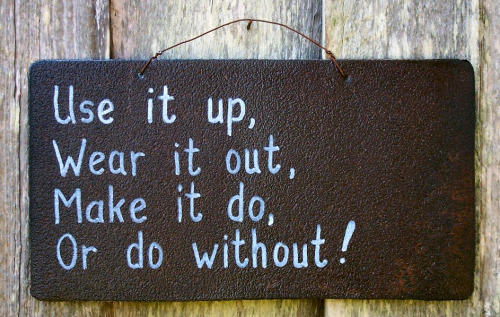
Use it up, wear it out, make it do, or do without!
       “Use it up, wear it out, make it do, or do without!” This saying from the Great Depression shows the way to true frugality. If you want to get the most out of your money, follow the steps outlined in this little rhyme.

Use It Up

       Don’t let anything go to waste. Before you throw something out ask yourself if there’s anything else you could use it for. Many frugality tips revolve around repurposing materials for new uses. Bread bags can be cut in half to use as sandwich bags. Old towels can be cut into washcloths. With a little thought and creativity, you can reuse the things you’ve bought and save yourself from buying again.

       I’d also apply to this to food. Don’t let your leftovers go to waste. Plan your meals well so you use up leftovers before fixing another meal. Or create a new meal from your leftovers. Many leftover items can be combined to make a soup, stew, or casserole with just a few additions.

       On your next trip to the trash can, ask yourself, “What else could I do with this?”

Wear It Out

       Make sure you get the full use out of anything you have. This is a lot like the first step above, but we should also include maintenance in this category. Take good care of the things you own so you can get the full use out of it. This especially applies to appliances and automobiles. Find out how to properly take care of these items. Then make sure you do the things necessary to keep your stuff in good shape. Don’t skimp on maintenance, but try to see if you can save money by doing some things yourself.

       This also means you shouldn’t buy cheap just for the sake of getting a bargain. Quality items will last much longer making them worth the extra cost. You’ll also save time by not having to shop for a replacement as often. Getting the most value for your dollar doesn’t necessarily mean paying the lowest price.

Make It Do

       Before throwing something out, see if you can fix it. Many things that wear out or break can often be repaired for a fraction of what it costs to buy new. Do a little research or ask someone you know who is knowledgeable and find out if it can be fixed. If you can, fix it yourself. You’ll learn valuable skills and likely save money over paying someone else to do it. If not, find a trustworthy person to do the repairs for you.

       Other strategies you can use to “make it do” include buying it cheaper, making it last longer, and using less of it. Combine those three strategies to get the most savings possible. We can often use less of something and still be just as happy. Take toothpaste for example. Do you put enough on to cover all the bristles? Try using half as much. If your teeth and mouth still feel clean and refreshed, then you don’t need to use any more than that. If not, bump it up a little. Little steps like this require no extra time on your part, but they can reap you significant savings when applied over many areas of life. And that’s all with no decline in quality of life.

Do Without!

       Contentment is the key to the final aspect of this wise saying. Knowing how to separate your needs and wants gives you powerful control over your finances. Learning what is “good enough” for you will help you delay purchases and get the maximum use out of the stuff you already have. Ignoring the cultural expectations to keep up with the latest fads will save you more money than you can imagine.

       This instruction has a hidden benefit as well. When you learn contentment, you break free of materialism and consumerism. You can choose to stop serving Money and start serving God. You can increase your giving because you’ve learned to spend less on yourself. The truth is – contentment is wealth. It’s the most powerful way you can combat the blatant attempts by the media and corporations to control your mind and your wallet. Finding your satisfaction in Christ will help you value things appropriately in this life so you can make the right decisions for the next one.

How Do You Follow This Slogan?

       How do you “use it up, wear it out, make it do, or do without” in your own life? Share your examples in the comments!

Emergency Fund – How Much Is Enough?

Corey —  September 18, 2009

       Over the last two weeks, we’ve looked at why you need an emergency fund and where you should keep your emergency fund. Today, we’re going to talk about how much you should save in your emergency fund.

       There’s a wide range of advice out there regarding emergency funds. My approach is designed to be simple, straightforward, and safe enough to cover most emergencies. If you feel like you should save more or less than I recommend, then do what works for you.

Base It on Living Expenses

       When figuring out how much you’ll need in your emergency fund, you’ll need to know your monthly living expenses. This should include everything you’ll have to keep paying if you lose your job. The budget items you’re most likely to drop are income taxes and savings. If you want to keep up your monthly savings, then include that in your living expenses. It would be best to include monthly savings, but it’s always something you can shoot for later.

       To figure this out, you’ll need to have created a budget. If you haven’t done that yet, you’ll need to work on making your budget. Don’t worry – it’s not complicated. Don’t think you can get around it either – a budget is a powerful tool that you’ll need to do this, to see where you can save the most, and to figure out how much you should save for retirement.

Essential: One Month of Living Expenses

       You absolutely must have at least one month’s worth of living expenses saved in an emergency fund before you do anything else – even paying off high interest debt. Why? It’s not going to do you any good to pay off your credit cards if you’re going to have to use them again to cover your emergencies. The very first step you need to take in getting your financial house in order is to save up at least one month of living expenses. Throw everything you can at this goal – earn more, spend less, and sell your extra stuff if you need to. After you’ve taken care of your high interest debts, you can push toward a larger emergency fund and other goals.

Milestone 1: Three Months of Living Expenses

       Once you’ve got your debt under control, your next emergency fund milestone should be three months worth of living expenses. This gives you a large enough cushion to withstand a job loss if you can find another job fairly quickly. It will also help you cover car repairs, some medical bills, and other small to medium sized emergencies. If you’re married and you both have stable jobs, you might feel comfortable stopping here. If you’re single, married with one income, self-employed, or have an unstable job, you’ll want to keep going.

Milestone 2: Six Months of Living Expenses

       An emergency fund with six months worth of living expenses should be large enough for most people. You’ll have plenty of time to find a new job in most scenarios. However, you might want a larger emergency fund if the economy looks bleak or if you are single or married with one income and you have an unstable job or you are self-employed. In those cases, I’d recommend going for a larger emergency fund.

Milestone 3: Twelve Months of Living Expenses

       If you’re self-employed or have an unstable job and you rely on only one income, you’re going to want to play it safe and save up twelve months of living expenses in your emergency fund. This will help you make it through rough patches in your career when profits are down or you lose your job. This would also be a great idea if you or your children have medical needs that require large payments at unpredictable intervals.

Adjust for Your Situation

       If you feel that your situation doesn’t fall into one of these specific categories, then use these as guidelines and save what you feel you’ll need. This guide should help most people get close to the right sized emergency fund for them. Don’t get discouraged if you feel like it’s a lot. Attack this goal in small steps and you’ll quickly make progress. If you have questions, just leave them in the comments and I’ll try to help!

       If you used the free retirement calculator I created, you should know how much you need to be saving for retirement. Your next step is to actually start investing for retirement. Before you do that though, you’ll want to determine your asset allocation – how your investments will be broken down among stocks and bonds.

       I have a simple rule to help you determine your broad asset allocation. Just take 120 and subtract your age to determine what percentage you should have in stocks. If you’re 25, you’ll want 95% in stocks. If you’re 45, you’d want 75% in stocks. And if you’re 65, you’d want 55% in stocks. Following the 120 minus your age guideline will keep your portfolio aggressive enough to grow while you’re young but safe enough to make it through bad years during retirement.

       Why not the 100 minus your age or the 110 minus your age rules? Because they’ll give you a retirement portfolio that won’t be able to support your withdrawals and keep up with inflation. If you were going to retire at 65, you’d only have 35% in stocks using the 100 minus your age rule (45% with the 110 rule). It’s also not aggressive enough to give you the growth you need while you’re young.

       Using the 120 minus your age rule will help you grow your money while you’re saving and beat inflation while you’re in retirement. But it also gives you a nice balance between risk and reward. Having 55% in stocks at age 65 isn’t too aggressive, but it’s enough to support your withdrawals and beat inflation while helping to protect you from bad markets.

       I’ll be posting an article soon about how to invest in a diversified portfolio through Vanguard, and this 120 minus your age guideline will influence how you invest. If you don’t want to use Vanguard, you can still use this rule in your other accounts. Sign up for free updates if you’re interested in learning how to invest in a diversified, low-cost portfolio!

       The fact that mortgage interest is tax deductible has long been touted as one of the great benefits of home ownership. But it’s important to look at the mortgage interest deduction for it’s true benefit instead of simply assuming you’re getting a real tax benefit on all the interest you’re paying.

The Standard Deduction vs. Itemized Deductions

       Home mortgage interest only gives you a tax benefit if you can itemize deductions. You’ll only want to itemize deductions if your total deductions are greater than the standard deduction. The standard deduction for 2010 is $5,700 if you’re single and $11,400 if you’re married. If your itemized deductions are less than those amounts, you’ll just take the standard deduction on your tax return.

       Why does this matter? You’ll always have the option of taking the standard deduction – even if you never pay a thing that could be itemized (mortgage interest, property taxes, excessive medical expenses, etc.). Since you’ll always get the tax benefit of the standard deduction, itemized deductions only provide tax savings to the extent they exceed the standard deduction.

       Here’s an example. Let’s assume you’re married and your marginal tax bracket is 15% (adjusted gross income between $16,700 and $67,900). If your total itemized deductions are $14,000, you’re not getting a true tax benefit of $2,100 (15% of $14,000). Even if you didn’t itemize deductions, you would have been able to use the standard deduction of $11,400. To calculate how much your itemized deductions are really saving you in taxes, you must first subtract the standard deduction – leaving you with $2,600 ($14,000 – $11,400) in this case. That means your itemized deductions are only giving you an additional tax savings of $390 (15% of $2,600).

       When you’re talking about the potential tax savings of mortgage interest, you need to consider your standard deduction. If your mortgage interest combined with other itemized deductions isn’t going to push you over your standard deduction, then you’re not getting any tax savings at all. But even if it does, your tax savings should only be calculated based on how much your itemized deductions exceed your standard deduction. Before you let a Realtor or banker convince you of the great benefits of being able to deduct mortgage interest, make sure you take a close look at how much you’ll actually save.

       Looking at your itemized deductions this way, how much are you actually saving on your mortgage interest? Let me know in the comments!

Where to Keep Your Emergency Fund

Corey —  September 11, 2009

       If you realize you need an emergency fund and you’re ready to get started, the first thing you need to do is figure out where you’re going to keep it. Will you stuff it in your mattress, put it in a savings account at your local bank or credit union, or open a high-yield online savings account?

The Problem with Your Mattress or Local Bank

       Inflation will eat away at the value of your emergency fund unless you’re earning enough interest to beat it. The problem with keeping your emergency fund under your mattress or in your local bank is that they don’t provide enough interest to beat inflation. You’ll get no interest from your mattress, and banks are notorious for savings account interest rates of 0.05% (maybe 0.50% if you’re lucky). If you want to earn a decent amount of interest, you’ll have to look elsewhere.

Consider a Credit Union or High-Yield Online Savings Account

       Credit unions and online banks offer far higher interest rates than banks. And online banks often offer a higher interest rate than credit unions. If you are able to join a credit union, find out what kind of interest rate they offer. Then, compare it to an online savings account to find the best deal.

I Recommend ING Direct’s Orange Savings Account

       My wife and I have our emergency fund and all of our short-term savings with ING Direct in their Orange Savings Account. I highly recommend ING Direct to my family and friends, and I strongly encourage you to consider using them for your emergency fund. ING Direct has all the features you’d normally expect including automatic transfers, free electronic transfers, and free bill pay. I have five specific reasons I recommend them over everyone else:

  1. Customer Service – ING Direct is known for its excellent customer service. You can quickly reach a knowledgeable Associate by calling their customer service number (1-888-464-0727). They’re available 7 days a week from 8 AM to 8 PM (EST). I’ve always received friendly, prompt, and helpful service from them. I’ve always talked to a real person in less than a minute when I called.
  2.  

  3. Easy to Use – ING Direct has a simple user interface with plenty of help available if needed. It’s straightforward and easy to learn. And if you ever get stuck or have a question, you can get help quickly by calling their customer service number. (And you won’t be stuck waiting for 20 minutes to talk to someone.)
  4.  

  5. Consistently High Interest Rates – ING Direct is consistently among the highest interest rates in online savings accounts. They don’t always have the top rate, but they don’t bait you in with a promotional rate and then rip you off later. I like knowing that I’m getting a competitive rate all the time.
  6.  

  7. Security – When you sign up for a savings account with ING Direct, you’ll see why they’ve received top marks for their security features. They are one of the most secure banks you can use. They take security seriously and it shows. The New York Times had a piece showing that ING Direct has the lowest rate of identity theft among the top 25 banks in the U.S.
  8.  

  9. Multiple Accounts – It’s very easy to open multiple savings accounts at ING Direct. A couple clicks and you can have an account specifically for your insurance bill. You can then set up automatic transfers to that account so you’ll be ready when that bill comes. I have an account specifically for our heating oil bill because we only pay it in the winter and it comes in large chunks ($400-600 a bill). This is a very useful feature for budgeting and segregating your savings so you can see your progress toward specific goals.

Opening an Account at ING Direct

       Opening an Orange Savings account at ING Direct is very easy. Go to their website at www.ingdirect.com and click “Open an account”. Then click “Orange Savings Account”.

Orange Savings Account

       After clicking the “Open Now” button and reading the instructions, you’ll be taken to their short application. It should take you less than 5 minutes to fill out all the forms. You’ll just need to have your checkbook handy so you can link your ING Direct account to your checking account.

Orange Savings Account Application

       In one or two business days, you’ll receive two small deposits in your checking account. Log in to ING Direct to confirm those deposits, and then you’ll be able to withdraw from ING to your checking account. They’ll let you deposit to ING from your checking account even if you haven’t confirmed those deposits.

Free Updates!

       I’ll talk more about how much you should save in your emergency fund, ways to build it up, and when you should use it. If you don’t want to miss that information, sign up for free updates to Provident Planning!