Archives For September 2009

Colors of Poverty by Findsiddiqui on Flickr       We’ve looked at giving yourself to God first, giving in response to Jesus’ gift, giving with sincere desire and love, giving under grace instead of a commandment, and giving as much as you are able or even more. The next aspect of New Covenant Giving we’ll look at is giving so that there may be equality. God desires that our giving may result in equality among believers. He does not want some to be burdened while others have it easy. This principle of New Covenant Giving helps us see why using the Old Testament tithe of 10% is not part of God’s desire for Christians.

God’s Desire for Equality

       New Covenant Giving is based on the principle of equality – all believers having just enough to meet their needs. This is what Jesus meant when He taught us to pray for our daily bread. God desires that our giving reflect this idea of equality. Those who have more should give more, and those who have less should give less. Those who cannot afford to meet their own needs should be receiving gifts from Christians who are more prosperous.

       Paul taught God’s desire for equality in his letter to the Corinthians:

       12 For if the readiness is there, it is acceptable according to what you have, not according to what you don’t have. 13 For this is not that others may be eased and you distressed, 14 but for equality. Your abundance at this present time supplies their lack, that their abundance also may become a supply for your lack; that there may be equality. 15 As it is written, “He who gathered much had nothing left over, and he who gathered little had no lack.”

2 Corinthians 8:12-15 (WEB)

       When one Christian has an abundance, he should use that abundance to help supply the needs of others. When those who were in need find abundance, they should look to supply the needs of others. Just as the Israelites who gathered manna only had what they needed regardless of what they gathered, God wants Christians to meet each others needs through their giving. This equality according to what each Christian can give is only possible when we use God’s New Covenant Giving principles.

       God’s desires for New Covenant Giving are far superior to the Old Testament tithe because they promote true equality among the believers. Let’s look at how New Covenant Giving requires more faith than tithing.

Why New Covenant Giving Is Better Than a Tithe

       New Covenant Giving is based on the guidance of the Holy Spirit according to what you have and can give. We no longer have a legalistic standard for how much we should give. God teaches each one of us what we should give. Some Christians have high incomes and can afford to give much more than those who are poor and struggle to get by.

       For example, a family making $200,000 a year will have much more left over than a family making $20,000 a year if both are giving based on the Old Testament tithe. Where one would have $180,000 left over to meet their needs, the other family would only have $18,000. And you definitely don’t need $180,000 a year to cover your true needs – your daily bread. Tithing puts an undue burden on the poor – the exact burden that Paul preached against in his letter to the Corinthians.

       It’s the same for two families who earn the same each year but one has high medical bills while the other does not. God does not require both of these families to give the same amount. God desires that we give according to what we have – not what we do not have. God’s New Covenant Giving principles no longer place a burden on the poor or struggling. Even the tithe of the Old Testament was created to help the poor and struggling, but New Covenant Giving prompts Christians to give much more than just 10% if they can afford it.

The New Covenant Giving Guidelines

       God has made it clear that He expects Christians to give as much as they are able – whether that’s more than or less than 10% of their income. Jesus talked about selling everything you own and giving it to the poor. Paul explained giving in terms of following the Spirit after giving yourself completely to God and giving according to what you have. God desires equality among the believers – not legalistic giving based on percentages, Old Testament laws, or the worry that people won’t give enough to keep the Church going and spread the Gospel. God wants us to give by faith. He wants us to lay it all down at His feet to be used for His glory.

       God’s teaching on New Covenant Giving makes it clear that the rich are expected to give much more than the poor. Paul explained this expectation to Timothy:

       17 Charge those who are rich in this present world that they not be haughty, nor have their hope set on the uncertainty of riches, but on the living God, who richly provides us with everything to enjoy; 18 that they do good, that they be rich in good works, that they be ready to distribute, willing to communicate; 19 laying up in store for themselves a good foundation against the time to come, that they may lay hold of eternal life.

1 Timothy 6:17-19 (WEB)

       Christians who are blessed financially in this life should not hold on to their worldly riches. Jesus commanded those who were rich to choose God over Money if they want to see the Kingdom of Heaven. Paul’s instructions to Timothy reflect that same teaching. As Christians, we have riches in heaven beyond anything we can imagine here. Jesus wants us to realize how important it is for us to focus on heavenly treasures and give up our devotion to Money.

       This choice to fully serve God is reflected in our giving. If we choose to give and teach others they should give 10% based on Old Testament laws, we are choosing not to follow God’s Spirit. We are rejecting His New Covenant Giving principles and placing a burden on the poor that God never intended. God desires that we give as much as we possibly can so that there can be equality and everyone’s needs can be met. This is the standard of giving for Christians. Any other standard rejects God’s Word and teaching, His desire for Christian Giving, and the teachings of Jesus.


       In the earlier parts of this series, I explained how you should calculate how much income you’ll need in retirement, how much you’ll need to retire, and how much you already have saved for retirement. I’ll be honest. After looking at the second article and realizing what I would have to include in this one, the whole thing was too complicated.

       I want you to actually do this. I want people to have an accurate way to calculate their retirement needs and how much they should save. So I’ve put a lot of work into creating the calculator I’ve included with this post. It doesn’t assume you’ll get the same return every year in the stock market. I’ve used Monte Carlo simulations to account for the fact that stock market returns are variable. Also, it assumes you’ll invest in a diversified portfolio that becomes more conservative as you get older. I’ll explain exactly how you should invest for retirement in an upcoming series of posts.

       Since this calculator simplifies what you need to do, I’m revamping the steps you need to take to calculate how much you should save for retirement. You’re still going to have to do some work, but if you want a good answer you can’t get around doing a little work. Here are the steps followed by the calculator:

1. Figure Out How Much Income You’ll Need in Retirement.

       The first thing you need to know is exactly how much income you’ll need in retirement. This calculator assumes you’ve calculated your retirement income needs in a specific way. To calculate that number, follow the instructions in the first post of this series.

2. Enter Your Current Age.

       Straightforward if you ask me…

3. Enter Your Retirement Age.

       Again, pretty straightforward. Enter the age you’ll be when you want to retire (or think you’ll want to retire).

4. Estimate Your Life Expectancy.

       I realize you don’t know exactly when you’re going to die, but to plan for retirement you need to estimate something. The best way I’ve found to estimate your life expectancy is to use the free life expectancy calculator at Living to 100. This calculator considers your family health history and your own habits to estimate your life expectancy. You’ll also receive tips on how to increase your life expectancy by changing your habits.

       If you’re married, both you and your spouse should use the life expectancy calculator. Then, use the longer of your two life expectancies. Make sure that the difference between the life expectancy you use and the retirement age you used covers the entire time period you or your spouse will be drawing on your retirement portfolio. (For example, you’re 30 and your spouse is 25. You want to retire when you’re 65 and your spouse is 60. Your life expectancy is 85 and your spouse’s is 90. You’ll only need your retirement assets for 20 years, but your spouse will need them for 30 years. Since your spouse will be drawing on your retirement assets for 30 years, you should use a life expectancy of 95 – your retirement age of 65 plus the 30 years your spouse will be alive.)

5. Calculate Your Current Savings after Accounting for Taxes.

       You’ll also need to know how much you’ve already saved up before you can determine how much you should be saving every year for retirement. This is where we’ll account for your taxes. Because we don’t know exactly what changes will happen to the tax structure, we’ll have to estimate this as well. Here’s how to add up each of your accounts (taking taxes into consideration):

  • Tax-free Accounts – If you have a Roth IRA or Roth 401(k), you don’t need to worry about taxes. You can include the full value of these accounts in calculating your current retirement savings.
  •  

  • Tax-deferred Accounts – Withdrawals from a Traditional IRA, 401(k), 403(b), 457, or similar accounts will be taxed in retirement. For our purposes, you’ll need to account for the taxes you’ll pay on these accounts. Given our current tax structure, you can plan on paying about 20-25% in federal and state income taxes on these accounts. To figure out how much you should include when adding up your savings, use 75-80% of the account value. If you have $100,000 in your Traditional IRA, you should only use $75,000-80,000 when you’re adding up your savings.
  •  

  • Taxable Accounts – This category includes all your taxable accounts you’re using to save for retirement. It’s a little more difficult to account for taxes in these accounts. You’ll be taxed only on the gain in these accounts. How much of your withdrawals will be taxed depends on your cost basis in these accounts. Since we don’t know exactly what your cost basis will be, we’ll estimate that taxes will be about 15-20% on these accounts. If you know you’ll have a high cost basis, you can adjust accordingly. (If you don’t know what I’m talking about, you probably shouldn’t be investing in a taxable account.) So you’ll want to use 80-85% of the account value when adding up your savings.

       Here’s a quick example. Let’s say you have $25,000 saved in a Roth IRA, $20,000 in your 401(k) at work, and no taxable accounts. You’ll include the full $25,000 in the Roth IRA and 75% of your 401(k), or $15,000. This gives you a total savings of $40,000.

6. Use This Calculator.

       If you’ve followed those first five steps, you’ll have everything you need to use this calculator. After you’ve entered how much income you’ll need in retirement, your current age, your retirement age, your life expectancy, and your current savings, you’ll get an amount you should save this year. Then, increase your annual savings by inflation each year.

*Note: Click the ‘Click to Edit’ button to use the calculator with your own numbers.

       To get a usable answer from this calculator, make sure you’ve followed my instructions. The reason this calculator is so simple is because I’ve built in the assumption that you’ve followed my instructions for calculating everything. So if you think something’s wrong with the calculation, make sure you’ve followed the instructions. (especially on calculating how much income you’ll need in retirement)

       Disclaimer: No guarantee is made that you’ll definitely reach your retirement goals by following the recommendations of this calculator or my articles. This calculator bases its return calculations on the historical risk and return of a diversified portfolio of index funds using Monte Carlo simulations to emulate the variability of the stock market. Past performance is no guarantee of future results, but without a crystal ball it’s the best we have to go on. This information is for education purposes only and does not represent investment advice or an offer of any security for sale.

6. Repeat Every 3-5 Years.

       This calculator works best when you come back every 3 to 5 years, go through the process once again, and get a new number for how much you should save. The reason this is important is because it will consider the changes in your account value that the calculator couldn’t possibly know. So if you have really good results in the stock market, you can save a little less. If not, you might need to save a little more. Just be sure to come back to this calculator every few years until you retire.

Feel Free to Share and Stay Tuned!

       If you’ve found this calculator helpful, feel free to share it with your friends. If you want to learn how to invest for retirement and make sure your asset allocation is correct, sign up for free updates to Provident Planning!

Is Debt a Sin?

Corey —  September 8, 2009

Chain by Ella's Dad on Flickr       No. Debt is not a sin. It’s not always a wise choice, but it’s not a sin either. The Bible never says you are sinning if you are in debt. God does warn against the dangers of debt and explains why it is not prudent. Here are the main verses where the Bible discusses the nature of debt.

Debt Is Slavery

       Debt is slavery. If you owe someone money, you must continue paying them back until you owe no more or you risk going to court. The obligation you’ve made to repay puts you under the same bonds as slavery. You’re not free to choose whether you’ll pay them back, which also means you’re not free to choose to work for pay or do something else. You are required to keep sending those payments. You have no freedom.

       This is God’s strongest warning against debt:

       The rich rules over the poor, and the borrower is the slave of the lender.

Proverbs 22:7 (WEB)

       The borrower is slave to the lender. God doesn’t say that those who borrow are sinners. But He does warn that when you borrow you put yourself under the yoke of slavery to your lender. God doesn’t want us to serve anyone or anything but Him. In fact, Jesus warned us that we can’t serve Money and God. We have to choose one. When you put yourself in debt, you are making yourself a slave to your lender – which requires you to do whatever you can to get the Money you need to repay him.

       You know that’s the truth. If you stopped paying your mortgage or auto loan or any other loan, what would happen? You’d have those things taken away from you or you’d eventually be forced to file for bankruptcy. Until you’ve paid those loans off, you do not own the things you bought with borrowed money. You’re not a homeowner if you have a mortgage. You’re a bank’s slave. You must continue working to repay them, or they will take your home and ruin your credit.

What Will Happen If You Can’t Repay?

       Knowing that the things you’ve put up as security for your debts can be taken if you don’t repay should alert you that it could be foolish to borrow money. If you lose your job and can’t pay your mortgage, what will happen? Your home will be taken from you. The very place you sleep will be pulled out from under you.

       26 Be not one of those who give pledges, who put up security for debts. 27 If you have nothing with which to pay, why should your bed be taken from under you?

Proverbs 22:26-27 (WEB)

       Is it worth borrowing money if you’ll risk losing the very things you’re working for? When the bank takes your home, you risk losing most or all of the equity you managed to build up. Your ability to repay a loan is not completely in your control. A job loss or illness can easily throw you into a bad situation which causes you to lose everything. That’s why God asks you if going into debt is worth the risk. You’re better off to save and pay cash.

Debt Is Foolish

       The problem with debt is not that it’s a sin. The problem is that it can be just plain dumb. As I mentioned before, you can be forced into a bad situation because of things completely out of your control. Being in debt only makes that bad situation worse. God doesn’t want debt to put that extra strain on you when you’re going through a tough time. That’s why He cautions:

       One who lacks sense gives a pledge and puts up security in the presence of his neighbor.

Proverbs 17:18 (WEB)

       Putting yourself in debt shows a lack of wisdom. Forget those who try to tell you that the mathematically better choice is to get a loan and pay it off over time because you can earn more in the stock market. God tells us plain and simple that debt is foolish. It’s not a good choice. Just looking at the difference in returns (between investing or paying off debt) doesn’t account for God’s wisdom, the problems that occur when you can’t repay, or the fact that debt is slavery. In the case of debt, you don’t need mathematical calculations to show that it’s a bad decision. God has plainly told us that it’s not a good thing, and He’d rather we stayed away from it.

Owe No One Anything Except Love

       Finally, Paul gave us good advice in Romans:

       Owe no one anything, except to love each other, for the one who loves another has fulfilled the law.

Romans 13:8 (WEB)

       The only debt we should owe anyone is the debt to love. In its context, this verse means that we should pay whatever we owe. This idea is also reflected in Psalm 37:21, where it says that the wicked borrow and do not pay back but the righteous are generous and give. We need to focus our time and energy on showing God’s love to the world rather than repaying the debts we’ve taken on foolishly. Our goal should be to get out of debt and avoid it as much as possible so we can devote ourselves to love more and more. A life free of debt is free to love at all times. You are no longer bound by the chains of debt. You are free to use your time showing love rather than working to repay your debts.

       None of this means that debt does not have its proper place in our finances. But foolish debt – to buy things we can’t really afford – is not going to glorify God. Christians should only be going into debt when they are reasonably sure they can repay the loan and they are not using the debt for foolish or sinful purposes. This is why Christians and bankruptcy can be a bad mix. Setting an example of consumerism and following it up with not paying debts we owe will leave people wondering about God’s love working in our lives.

       So no. Debt is not a sin. But it’s not always a good choice, and it’s a poor master. Free yourself from being anyone’s slave except Christ’s. For He has bought us with His blood, and by choosing Him we are choosing to have no other master but God.

How to Be Content with Your Taxes

Corey —  September 7, 2009

       Taxes. Uncle Sam by uhuru1701 on FlickrWe hate to pay them, but we know we must. We don’t like how our tax money is spent, but that doesn’t change the fact that we must still pay our taxes. (It does mean we should be more careful about whom we elect for office though!) Despite our disdain for taxes, is there a way we can become content with our taxes? What I mean is that we must pay taxes so we might as well find a way to be happy about it.
       God has taught us that we must pay our taxes. Jesus gave clear teaching on this, and Paul emphasized it as well in his writings.

       13 And they sent to him some of the Pharisees and some of the Herodians, to trap him in his talk. 14 And they came and said to him, “Teacher, we know that you are true and do not care about anyone’s opinion. For you are not swayed by appearances, but truly teach the way of God. Is it lawful to pay taxes to Caesar, or not? Should we pay them, or should we not?” 15 But, knowing their hypocrisy, he said to them, “Why put me to the test? Bring me a denarius and let me look at it.” 16 And they brought one. And he said to them, “Whose likeness and inscription is this?” They said to him, “Caesar’s.” 17 Jesus said to them, “Render to Caesar the things that are Caesar’s, and to God the things that are God’s.” And they marveled at him.

Mark 12:13-17 (WEB)

       5 Therefore one must be in subjection, not only to avoid God’s wrath but also for the sake of conscience. 6 For because of this you also pay taxes, for the authorities are ministers of God, attending to this very thing. 7 Pay to all what is owed to them: taxes to whom taxes are owed, revenue to whom revenue is owed, respect to whom respect is owed, honor to whom honor is owed.

Romans 13:5-7 (WEB)

       It’s clear that God wants us to pay the taxes we owe. God wants us to be lights to those around us, and that requires honestly paying our taxes despite how they may be used for good or evil. We are to pay taxes to whomever taxes are owed.

       But I have a few ideas for how we can be content with the taxes we must pay without neglecting our duty to pay them.

Pay Only What You Must

       God’s ways and the laws of our nation only require us to pay the taxes we owe. We are perfectly entitled to reduce that tax liability using any legal means available. The key aspect is that it must be legal. We should not cheat or lie to reduce our tax burden. However, I strongly encourage you to seek every legal means available for reducing your taxes.

       If a tax benefit is available, it would be foolish to neglect it either because you “don’t have the time”, don’t know about it, or feel like it would be wrong to use it because you’ll be paying less taxes. If there’s a legal way to reduce your taxes, you should find out if and how you can use it. It’s that simple.

       By knowing that you’re paying the least amount of taxes required, you can be more content with the taxes you must pay. Know what tax deductions and credits are available for your federal, state, and local income taxes. Take advantage of any sales tax holidays. Look at ways you can reduce your taxes through your investments. Use every available tool to cut back on Uncle Sam’s take of your paycheck.

Use the Services Your Taxes Pay For

       Understand that your taxes pay for services that you already use or should be using. Your taxes pay for roads, schools, social services, libraries, police, military, and the list goes on. Utilize the things your taxes are paying for to make sure you get the most use out of your tax dollars. Again, don’t use dishonesty to game the system, but by all means take advantage of the available resources. After all, you are paying for them!

Let Your Voice Be Heard

       Not all your tax money is spent wisely or for things that benefit you or society. Government waste is a major issue as politicians find ways to use tax revenues to fund special interests and line their own pockets. Even without the corruption we’d still have poor decisions about how to spend tax money. So what can you do?

       Instead of sitting around complaining all the time, let your voice be heard. Vote for representatives whose policies reflect your values, desires, and choices. But don’t stop there! Let your representatives know where you stand on issues. Call them, write them, visit them, and gather support from others to let your politicians know what you want them to do. It’s their job to represent you, so hold them accountable! Use every available means to ensure that your tax dollars are not wasted, and you’ll be a little more content with paying your taxes.

Make It as Painless as Possible

       Finally, make paying your taxes as painless as possible. Getting stuck with a big tax bill in April can deepen the pain of paying taxes. Needless penalties and interest will do the same. Make sure you’re withholding enough from your paycheck and sending in your estimated tax payments on time. Be familiar with your tax liability and know how much you should pay and when so you can avoid any penalties and interest. By having your taxes withheld from your paycheck, you won’t feel the sting of writing a big check in April.

Learn More about How to Reduce Your Taxes

       Stay tuned to Provident Planning by signing up for free updates. You’ll learn more about (legal) ways to reduce your taxes and more good advice for your personal finances with a Biblical foundation.

You Need an Emergency Fund

Corey —  September 4, 2009

       If you have an unexpected expense of $1,000 today, where will you get the money? If your answer doesn’t involve credit cards, payday lenders, or any other form of borrowing money, you can skip the rest of this post. However, if the only way you could pay such an expense would be to borrow from someone (including family), you need to learn about an emergency fund.

What Is an Emergency Fund?

       An emergency fund is an easily accessible stash of money that you use only for emergencies. It’s not used to pay for your vacation. It’s not used to buy a new car. It’s not used to buy pizza on Friday night. It’s money that you use only when you have a true emergency.

What Counts As an Emergency?

       Before establishing an emergency fund, you need to decide what will qualify as an emergency and what will not. This will help you determine exactly how much you should save up, and it will ensure that you don’t spend your emergency fund unwisely. Anything that does not qualify as an emergency (in your definition) but comes up irregularly should have it’s own savings fund. One example of an irregular, but expected, expenses is your auto insurance. Here are a few examples of emergencies:

  • Unemployment
  • Unexpected medical bills
  • Car repairs
  • An appliance breaks (stove, refrigerator, etc.)
  • Storm damage to your home that’s less than your deductible
  • Mistakes – forgotten bills, taxes that you didn’t account for, etc
  •        You can adjust this list for your situation, but this is a good place to start. Obviously, if you have an old car or old appliances, you’ll want to set aside money in a special savings fund to replace those things if necessary.

    What If You Can’t Afford to Save Up for an Emergency Fund?

           Can you really afford not to have an emergency fund? If things are so tight for you already that you can’t begin saving $10, $20, or $50 a month for emergencies, then what are you going to do when your car needs a repair that costs $400? You’ll only put yourself in a worse position by not having an emergency fund.

           I’m not saying you need to save up $5,000 in the next two months. It will take time to get your emergency fund as big as it needs to be. You’ll want to get the first $1,000 saved up as quickly as you can to protect from any imminent emergencies, but you can save up the rest over time.

    Do I Need an Emergency Fund If I’m Paying Off Debts?

           Yes! You probably need an emergency fund more than anyone. You’ve recognized you need to get out of debt, and you’re working hard to accomplish that goal. But an unexpected emergency could set you back quite a ways because you’ll have to borrow to cover the costs. By having an emergency fund, you can protect all the hard work you’ve put into paying off your debts so far.

           Again, you don’t need a full six months of your expenses as an emergency fund if you’re trying to pay off your debts right now. Save up that first $1,000 or $2,000 as fast as you can, then focus on paying off your debt as fast as you can. If you have an emergency, replenish your emergency fund and then get back to tackling those debts. Once you’ve conquered your debts, continue saving in your emergency fund until you have met your goal.

    Stay Tuned!

           We’ll discuss many more aspects of emergency funds in later posts like how much you should have saved up, where you should keep it, how to build it up, and when you should use it. Stay tuned by signing up for free updates to Provident Planning!

       We’ve looked at giving yourself to God first, giving in response to Jesus’ gift, giving with sincere desire and love, and giving under grace instead of a commandment. Today, we’re going to look at how God’s grace working in us can lead us to give as much as we are able – and sometimes even beyond our ability to give. God’s power is able to do much more than we can even imagine, especially when it comes to giving.

Giving Beyond Your Ability

       When we look at the early Church and the first Christians, we do not see an emphasis on giving a certain amount every week. The examples we see of God’s grace working through those early churches are examples of extreme generosity and love for one another. Look at what Paul had to say about the churches in Macedonia:

       1 Moreover, brothers, we make known to you the grace of God which has been given in the assemblies of Macedonia; 2 how that in much proof of affliction the abundance of their joy and their deep poverty abounded to the riches of their liberality. 3 For according to their power, I testify, yes and beyond their power, they gave of their own accord, 4 begging us with much entreaty to receive this grace and the fellowship in the service to the saints. 5 This was not as we had hoped, but first they gave their own selves to the Lord, and to us through the will of God.

2 Corinthians 8:1-5 (WEB)

       Even though the Christians in Macedonia were poor themselves, the joy of the Lord moved them to give very generously to help the poor Christians in Judea who were suffering a famine. They didn’t just give the extra money they had at the end of the week. They didn’t even give just what they could afford. They gave far beyond their ability – to the point where they chose to deny some of their own needs in order to help others. It’s in this act of generous giving that we see the power of God and His love when allowed to work in a Christian’s life.

       The Macedonian Christians gave so much that they astounded Paul and his fellow workers. Paul says the Macedonians gave much more than he had even expected. They gave freely and gave even beyond what anyone could reasonably expect them to give. You might expect someone who is wealthy to give away some of their extra money even if they’re not a Christian. But you’d never see a rich person give up so much that they would even begin to deny their own needs for the sake of others – unless they followed Jesus and fully gave themselves over to God. The Macedonians gave beyond their ability, despite their deep poverty, and they were happy to do it! That’s the power of God’s grace of giving at work.

       God’s power is able to accomplish much more than we can even imagine – more than even Paul could imagine. But it can only happen when we give ourselves fully to God’s will. Then, and only then, can we see this kind of abundant generosity working in the Church again.

       However, please understand that this is not a command for all Christians at all times. We are to give sacrificially as we are able, but God has made it clear throughout the Bible that we have a duty to care for our families and a duty to pay anything we owe. We should not neglect those duties in order to increase our giving.

       We can, however, choose to increase our giving by denying some of our wants. Cable or satellite subscriptions, eating out, a bigger/nicer house than necessary, a nicer car than necessary, or anything else that is not necessary for the survival and well-being of us or our families are some examples of wants that we can sacrifice to increase our giving.

       On the other hand, there may be occasions where God’s Spirit leads us to give beyond our ability just as the Macedonians did. Denying our own needs for a time is a great example of sacrificial giving, but we must consider such choices carefully and be sure they are in accordance with God’s will. We must also discern when God’s will for our giving changes and adjust accordingly. This requires much prayer and wisdom.

A Challenge to Give

       I’m going to personally challenge you to follow the example of the Macedonian churches – which is really the example of Christ. Give yourself fully to God. Relinquish all your rights, desires, and goals to Him. Seek the counsel of His Spirit, and follow His will. Then, give. Give generously! Give, even beyond your ability to give!!! Choose to deny your own desires and wants so that you can give even more. Choose to even deny your needs for a time.

       But I also challenge you not to do this in an attempt to be holy if your heart is not in it. If you do not feel joy in the giving, then don’t do it. When you give under compulsion and grudgingly, you do not give out of love. Your gift becomes meaningless because there is no love with it.

       But if your faith is responding to the grace of God – to the glorious gift of His Only Son who has freed us from sin and death – then give as much as you can and even more! Allow God’s power to work through your life to do more than you can even expect or imagine. Let His love flow through you so that you can give with joy despite your own situation. The testimony of your generous giving will show the power of God’s love working in your life, and many will give thanks and believe because of the grace God has given you. Do not give so that you may boast in your generosity and righteousness. But know that your giving will still send a powerful message even if you’re not the one speaking it. And remember that God sees what is done in secret. He will reward you for the love and sacrifice you give.

       I pray that all of us who believe may give as generously as the Macedonians did. I pray that we will give ourselves to God first. And I pray that we will then give in response to Jesus’ gift out of love and appreciation for Him. Please join me in this prayer as we all seek God’s will and desire to show His love to the world.

       Once you’ve determined how much income you’ll need in retirement, the next step is to figure out how much you’ll need to have saved up by retirement. Don’t worry. I’m not going to make you do complicated math. If you can multiply, you can figure this out. First, we need to determine how long you’ll be retired.

How Long Are You Going to Live?

       Let’s pull out your crystal ball and figure out how old you’ll be when you die. If you don’t have one, then you’re already aware that we’re only estimating here. There’s no way to know for certain when you’ll take your last breath, but you can plan by taking your health and family history into consideration.

       You can use the free life expectancy calculator over at Living to 100 to estimate how long you’ll live. You’ll even get some tips on changes you can make to live a healthier, longer life. If you’re married, use the longer life expectancy between the two of you.

How Many Years Will You Spend in Retirement?

       Once you’ve estimated your life expectancy, all you need to do is subtract your retirement age from your life expectancy. If you expect to live to age 90 and you want to retire at age 65, you’ll spend 25 years in retirement. Remember that number. You’ll need it in the next step.

How Much Will You Need to Have Saved by Retirement?

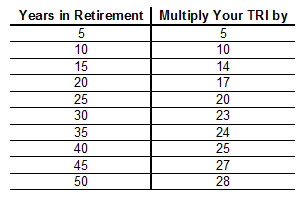
       Now for that multiplication I warned you about before. First, you need to know your target retirement income (TRI) from Part 1. Then, using the table below, figure out what number you should multiply by to determine your target retirement savings (TRS). For example, if you’ve determined you need $40,000/year (your TRI) and you’ll be in retirement for 25 years, just multiply by 20 to determine your target retirement savings. In this case, $40,000 x 20 would mean you need to have $800,000 (in today’s dollars) saved by the time you want to retire.

TRI Factor

       As I mentioned before, using this chart will tell you how much you need to have saved by retirement in today’s dollars. This isn’t the actual number of dollars you’ll need to have in your account because of inflation, but that doesn’t matter. If you continue to use this process once a year, you can be sure you’re saving enough. Make sure you write down your TRS number. You’ll need it for Part 3 so you can figure out how much you should save each year until retirement.

How Much Have You Already Saved?

       You’ll also need to know how much you’ve already saved up before you can determine how much you should be saving every year for retirement. This is also the part where we’ll account for your taxes. Because we don’t know exactly what changes will happen to the tax structure, we’ll have to estimate this as well. Here’s how to add up each of your accounts (taking taxes into consideration):

  • Tax-free Accounts – If you have a Roth IRA or Roth 401(k), you don’t need to worry about taxes. You can include the full value of these accounts in calculating your current retirement savings.
  •  

  • Tax-deferred Accounts – Withdrawals from a Traditional IRA, 401(k), 403(b), 457, or similar accounts will be taxed in retirement. For our purposes, you’ll need to account for the taxes you’ll pay on these accounts. Given our current tax structure, you can plan on paying about 20-25% in federal and state income taxes on these accounts. To figure out how much you should include when adding up your savings, use 75-80% of the account value. If you have $100,000 in your Traditional IRA, you should only use $75,000-80,000 when you’re adding up your savings.
  •  

  • Taxable Accounts – This category includes all your taxable accounts you’re using to save for retirement. It’s a little more difficult to account for taxes in these accounts. You’ll be taxed only on the gain in these accounts. How much of your withdrawals will be taxed depends on your cost basis in these accounts. We’ll estimate that taxes will be about 15-20% on these accounts. So you’ll want to use 80-85% of the account value when adding up your savings.

       Here’s a quick example. Let’s say you have $25,000 saved in a Roth IRA, $20,000 in your 401(k) at work, and no taxable accounts. You’ll include the full $25,000 in the Roth IRA and 75% of your 401(k), or $15,000. This gives you a total savings of $40,000.

       After you’ve figured out how much you’ve saved, you need to determine how much that is as a percentage of your TRS. In the example above, we determined you’d need $800,000 to retire. If you’ve saved $40,000 already, you’ve saved up 5% of your target retirement savings (TRS). (That is, $40,000/$800,000 is 0.05 or 5%.)

       To figure out how much you’ll need to save every year, you need to know your target retirement savings (TRS) and how much you’ve saved already as a percentage of your TRS. In Part 3, we’ll continue to use the example above with a TRS of $800,000 and having 5% of that number already saved up.

       Here’s a quick recap of what you’ve done already:

  • 1. Figure out how much income you’ll need in retirement (your TRI).
  • 2. Figure out how many years you’ll spend in retirement.
  • 3. Multiply your TRI by the appropriate number from the chart above to determine how much you’ll need to have saved for retirement (your target retirement savings or TRS).
  • 4. Add up your current savings after accounting for taxes. Then figure out how much that number is as a percentage of your TRS (divide current savings by your TRS).

       In our working example, we decided we need $40,000/year in retirement. We also figure we’ll spend 25 years in retirement. Then, we multiplied our TRI ($40,000) by the number in the chart for 25 years in retirement, which was 20. That gave us a target retirement savings (TRS) of $800,000. Finally, we figured out we have saved up $40,000, or 5% of our TRS, after accounting for taxes.

       To make sure you know what to do next, sign up for free updates to Provident Planning!