Archives For Saving

How to Build Up Your Emergency Fund

Corey —  September 25, 2009

       If you’ve decided you need an emergency fund, you know where you’ll keep it, and you know how much you’ll need, all you need to do now is start building it up! There are two main ways you can do this: jump start it or one brick at a time.

Jump Start Your Emergency Fund

       The best way to build up your emergency fund quickly is to jump start it. Use a windfall (like an inheritance or tax refund check) to bulk up your emergency fund by $1,000 or $2,000 all at once. You can also try selling your Stuff to make some quick cash to throw in your emergency fund. You could try getting a part-time or temp job and use all the income to build up your savings. (You can do the same thing to help you pay off debt!) These are all serious steps to quickly building up your emergency fund. However, it’s much more likely that you’ll build it up slowly over time.

One Brick at a Time

       Your other choice is to build up your emergency fund just a little at a time. If you opened an Orange Savings account at ING Direct, you can easily do this by creating an automatic savings plan where you automatically deposit the same amount in your emergency fund every month (or as frequently as you choose). Here’s what to do:

       Make room in your budget. Before you set up an automatic savings plan, you need to know how much you can save each month without breaking your budget. So yes, you’ll need to make a budget. Then, if you don’t have anything left over to save each month (or if it’s not enough), you’ll need to find ways to cut back. Look at your unnecessary expenses (wants) and the areas you care the least about first. These are the things that you can do without and still survive. Either cut back on these items or eliminate them completely. Then use the money you’ve freed up to save for your emergency fund.

       Set up your automatic savings plan at ING Direct. This is very easy to do. Once you log in to ING Direct, just click the Automatic Savings Plan (ASP) icon:

ASP Icon

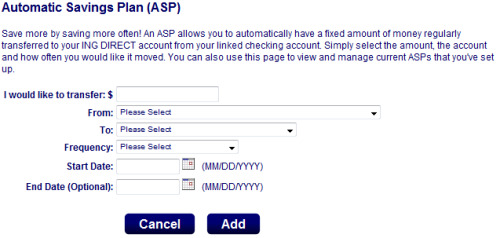
       Then, you’ll see a screen like this:

ASP Form

       All you need to do is enter the amount, pick the account to transfer from and the account to transfer to, pick the frequency (either weekly, bi-weekly, the fifteenth and end of each month, or monthly), and enter a start date. ING will then automatically make the transfer using the information you’ve provided. You don’t have to do anything else.

       When you’ve reached your goal, just go back to that page to turn off the automatic savings plan. It’s as simple as that.

       You can use this plan with just about any high-yield savings account. I just recommend ING Direct for the reasons I outlined in my article about where you should keep your emergency fund.

Take Action!

       Nearly all the personal finance ideas you need to follow are very simple. Understanding personal finance is not the problem – that’s easy. With a clear, concise explanation I’m sure anyone can understand the basics of personal finance. The hard part is taking the action needed to put the information into use. The actions themselves aren’t hard, but maintaining the motivation and discipline required for success can be daunting. Don’t let fear or complacency keep you from action. Choose success, use the information you have, and take the steps to gain control over your finances today.

Emergency Fund – How Much Is Enough?

Corey —  September 18, 2009

       Over the last two weeks, we’ve looked at why you need an emergency fund and where you should keep your emergency fund. Today, we’re going to talk about how much you should save in your emergency fund.

       There’s a wide range of advice out there regarding emergency funds. My approach is designed to be simple, straightforward, and safe enough to cover most emergencies. If you feel like you should save more or less than I recommend, then do what works for you.

Base It on Living Expenses

       When figuring out how much you’ll need in your emergency fund, you’ll need to know your monthly living expenses. This should include everything you’ll have to keep paying if you lose your job. The budget items you’re most likely to drop are income taxes and savings. If you want to keep up your monthly savings, then include that in your living expenses. It would be best to include monthly savings, but it’s always something you can shoot for later.

       To figure this out, you’ll need to have created a budget. If you haven’t done that yet, you’ll need to work on making your budget. Don’t worry – it’s not complicated. Don’t think you can get around it either – a budget is a powerful tool that you’ll need to do this, to see where you can save the most, and to figure out how much you should save for retirement.

Essential: One Month of Living Expenses

       You absolutely must have at least one month’s worth of living expenses saved in an emergency fund before you do anything else – even paying off high interest debt. Why? It’s not going to do you any good to pay off your credit cards if you’re going to have to use them again to cover your emergencies. The very first step you need to take in getting your financial house in order is to save up at least one month of living expenses. Throw everything you can at this goal – earn more, spend less, and sell your extra stuff if you need to. After you’ve taken care of your high interest debts, you can push toward a larger emergency fund and other goals.

Milestone 1: Three Months of Living Expenses

       Once you’ve got your debt under control, your next emergency fund milestone should be three months worth of living expenses. This gives you a large enough cushion to withstand a job loss if you can find another job fairly quickly. It will also help you cover car repairs, some medical bills, and other small to medium sized emergencies. If you’re married and you both have stable jobs, you might feel comfortable stopping here. If you’re single, married with one income, self-employed, or have an unstable job, you’ll want to keep going.

Milestone 2: Six Months of Living Expenses

       An emergency fund with six months worth of living expenses should be large enough for most people. You’ll have plenty of time to find a new job in most scenarios. However, you might want a larger emergency fund if the economy looks bleak or if you are single or married with one income and you have an unstable job or you are self-employed. In those cases, I’d recommend going for a larger emergency fund.

Milestone 3: Twelve Months of Living Expenses

       If you’re self-employed or have an unstable job and you rely on only one income, you’re going to want to play it safe and save up twelve months of living expenses in your emergency fund. This will help you make it through rough patches in your career when profits are down or you lose your job. This would also be a great idea if you or your children have medical needs that require large payments at unpredictable intervals.

Adjust for Your Situation

       If you feel that your situation doesn’t fall into one of these specific categories, then use these as guidelines and save what you feel you’ll need. This guide should help most people get close to the right sized emergency fund for them. Don’t get discouraged if you feel like it’s a lot. Attack this goal in small steps and you’ll quickly make progress. If you have questions, just leave them in the comments and I’ll try to help!

Where to Keep Your Emergency Fund

Corey —  September 11, 2009

       If you realize you need an emergency fund and you’re ready to get started, the first thing you need to do is figure out where you’re going to keep it. Will you stuff it in your mattress, put it in a savings account at your local bank or credit union, or open a high-yield online savings account?

The Problem with Your Mattress or Local Bank

       Inflation will eat away at the value of your emergency fund unless you’re earning enough interest to beat it. The problem with keeping your emergency fund under your mattress or in your local bank is that they don’t provide enough interest to beat inflation. You’ll get no interest from your mattress, and banks are notorious for savings account interest rates of 0.05% (maybe 0.50% if you’re lucky). If you want to earn a decent amount of interest, you’ll have to look elsewhere.

Consider a Credit Union or High-Yield Online Savings Account

       Credit unions and online banks offer far higher interest rates than banks. And online banks often offer a higher interest rate than credit unions. If you are able to join a credit union, find out what kind of interest rate they offer. Then, compare it to an online savings account to find the best deal.

I Recommend ING Direct’s Orange Savings Account

       My wife and I have our emergency fund and all of our short-term savings with ING Direct in their Orange Savings Account. I highly recommend ING Direct to my family and friends, and I strongly encourage you to consider using them for your emergency fund. ING Direct has all the features you’d normally expect including automatic transfers, free electronic transfers, and free bill pay. I have five specific reasons I recommend them over everyone else:

  1. Customer Service – ING Direct is known for its excellent customer service. You can quickly reach a knowledgeable Associate by calling their customer service number (1-888-464-0727). They’re available 7 days a week from 8 AM to 8 PM (EST). I’ve always received friendly, prompt, and helpful service from them. I’ve always talked to a real person in less than a minute when I called.
  2.  

  3. Easy to Use – ING Direct has a simple user interface with plenty of help available if needed. It’s straightforward and easy to learn. And if you ever get stuck or have a question, you can get help quickly by calling their customer service number. (And you won’t be stuck waiting for 20 minutes to talk to someone.)
  4.  

  5. Consistently High Interest Rates – ING Direct is consistently among the highest interest rates in online savings accounts. They don’t always have the top rate, but they don’t bait you in with a promotional rate and then rip you off later. I like knowing that I’m getting a competitive rate all the time.
  6.  

  7. Security – When you sign up for a savings account with ING Direct, you’ll see why they’ve received top marks for their security features. They are one of the most secure banks you can use. They take security seriously and it shows. The New York Times had a piece showing that ING Direct has the lowest rate of identity theft among the top 25 banks in the U.S.
  8.  

  9. Multiple Accounts – It’s very easy to open multiple savings accounts at ING Direct. A couple clicks and you can have an account specifically for your insurance bill. You can then set up automatic transfers to that account so you’ll be ready when that bill comes. I have an account specifically for our heating oil bill because we only pay it in the winter and it comes in large chunks ($400-600 a bill). This is a very useful feature for budgeting and segregating your savings so you can see your progress toward specific goals.

Opening an Account at ING Direct

       Opening an Orange Savings account at ING Direct is very easy. Go to their website at www.ingdirect.com and click “Open an account”. Then click “Orange Savings Account”.

Orange Savings Account

       After clicking the “Open Now” button and reading the instructions, you’ll be taken to their short application. It should take you less than 5 minutes to fill out all the forms. You’ll just need to have your checkbook handy so you can link your ING Direct account to your checking account.

Orange Savings Account Application

       In one or two business days, you’ll receive two small deposits in your checking account. Log in to ING Direct to confirm those deposits, and then you’ll be able to withdraw from ING to your checking account. They’ll let you deposit to ING from your checking account even if you haven’t confirmed those deposits.

Free Updates!

       I’ll talk more about how much you should save in your emergency fund, ways to build it up, and when you should use it. If you don’t want to miss that information, sign up for free updates to Provident Planning!

       In the earlier parts of this series, I explained how you should calculate how much income you’ll need in retirement, how much you’ll need to retire, and how much you already have saved for retirement. I’ll be honest. After looking at the second article and realizing what I would have to include in this one, the whole thing was too complicated.

       I want you to actually do this. I want people to have an accurate way to calculate their retirement needs and how much they should save. So I’ve put a lot of work into creating the calculator I’ve included with this post. It doesn’t assume you’ll get the same return every year in the stock market. I’ve used Monte Carlo simulations to account for the fact that stock market returns are variable. Also, it assumes you’ll invest in a diversified portfolio that becomes more conservative as you get older. I’ll explain exactly how you should invest for retirement in an upcoming series of posts.

       Since this calculator simplifies what you need to do, I’m revamping the steps you need to take to calculate how much you should save for retirement. You’re still going to have to do some work, but if you want a good answer you can’t get around doing a little work. Here are the steps followed by the calculator:

1. Figure Out How Much Income You’ll Need in Retirement.

       The first thing you need to know is exactly how much income you’ll need in retirement. This calculator assumes you’ve calculated your retirement income needs in a specific way. To calculate that number, follow the instructions in the first post of this series.

2. Enter Your Current Age.

       Straightforward if you ask me…

3. Enter Your Retirement Age.

       Again, pretty straightforward. Enter the age you’ll be when you want to retire (or think you’ll want to retire).

4. Estimate Your Life Expectancy.

       I realize you don’t know exactly when you’re going to die, but to plan for retirement you need to estimate something. The best way I’ve found to estimate your life expectancy is to use the free life expectancy calculator at Living to 100. This calculator considers your family health history and your own habits to estimate your life expectancy. You’ll also receive tips on how to increase your life expectancy by changing your habits.

       If you’re married, both you and your spouse should use the life expectancy calculator. Then, use the longer of your two life expectancies. Make sure that the difference between the life expectancy you use and the retirement age you used covers the entire time period you or your spouse will be drawing on your retirement portfolio. (For example, you’re 30 and your spouse is 25. You want to retire when you’re 65 and your spouse is 60. Your life expectancy is 85 and your spouse’s is 90. You’ll only need your retirement assets for 20 years, but your spouse will need them for 30 years. Since your spouse will be drawing on your retirement assets for 30 years, you should use a life expectancy of 95 – your retirement age of 65 plus the 30 years your spouse will be alive.)

5. Calculate Your Current Savings after Accounting for Taxes.

       You’ll also need to know how much you’ve already saved up before you can determine how much you should be saving every year for retirement. This is where we’ll account for your taxes. Because we don’t know exactly what changes will happen to the tax structure, we’ll have to estimate this as well. Here’s how to add up each of your accounts (taking taxes into consideration):

  • Tax-free Accounts – If you have a Roth IRA or Roth 401(k), you don’t need to worry about taxes. You can include the full value of these accounts in calculating your current retirement savings.
  •  

  • Tax-deferred Accounts – Withdrawals from a Traditional IRA, 401(k), 403(b), 457, or similar accounts will be taxed in retirement. For our purposes, you’ll need to account for the taxes you’ll pay on these accounts. Given our current tax structure, you can plan on paying about 20-25% in federal and state income taxes on these accounts. To figure out how much you should include when adding up your savings, use 75-80% of the account value. If you have $100,000 in your Traditional IRA, you should only use $75,000-80,000 when you’re adding up your savings.
  •  

  • Taxable Accounts – This category includes all your taxable accounts you’re using to save for retirement. It’s a little more difficult to account for taxes in these accounts. You’ll be taxed only on the gain in these accounts. How much of your withdrawals will be taxed depends on your cost basis in these accounts. Since we don’t know exactly what your cost basis will be, we’ll estimate that taxes will be about 15-20% on these accounts. If you know you’ll have a high cost basis, you can adjust accordingly. (If you don’t know what I’m talking about, you probably shouldn’t be investing in a taxable account.) So you’ll want to use 80-85% of the account value when adding up your savings.

       Here’s a quick example. Let’s say you have $25,000 saved in a Roth IRA, $20,000 in your 401(k) at work, and no taxable accounts. You’ll include the full $25,000 in the Roth IRA and 75% of your 401(k), or $15,000. This gives you a total savings of $40,000.

6. Use This Calculator.

       If you’ve followed those first five steps, you’ll have everything you need to use this calculator. After you’ve entered how much income you’ll need in retirement, your current age, your retirement age, your life expectancy, and your current savings, you’ll get an amount you should save this year. Then, increase your annual savings by inflation each year.

*Note: Click the ‘Click to Edit’ button to use the calculator with your own numbers.

       To get a usable answer from this calculator, make sure you’ve followed my instructions. The reason this calculator is so simple is because I’ve built in the assumption that you’ve followed my instructions for calculating everything. So if you think something’s wrong with the calculation, make sure you’ve followed the instructions. (especially on calculating how much income you’ll need in retirement)

       Disclaimer: No guarantee is made that you’ll definitely reach your retirement goals by following the recommendations of this calculator or my articles. This calculator bases its return calculations on the historical risk and return of a diversified portfolio of index funds using Monte Carlo simulations to emulate the variability of the stock market. Past performance is no guarantee of future results, but without a crystal ball it’s the best we have to go on. This information is for education purposes only and does not represent investment advice or an offer of any security for sale.

6. Repeat Every 3-5 Years.

       This calculator works best when you come back every 3 to 5 years, go through the process once again, and get a new number for how much you should save. The reason this is important is because it will consider the changes in your account value that the calculator couldn’t possibly know. So if you have really good results in the stock market, you can save a little less. If not, you might need to save a little more. Just be sure to come back to this calculator every few years until you retire.

Feel Free to Share and Stay Tuned!

       If you’ve found this calculator helpful, feel free to share it with your friends. If you want to learn how to invest for retirement and make sure your asset allocation is correct, sign up for free updates to Provident Planning!

You Need an Emergency Fund

Corey —  September 4, 2009

       If you have an unexpected expense of $1,000 today, where will you get the money? If your answer doesn’t involve credit cards, payday lenders, or any other form of borrowing money, you can skip the rest of this post. However, if the only way you could pay such an expense would be to borrow from someone (including family), you need to learn about an emergency fund.

What Is an Emergency Fund?

       An emergency fund is an easily accessible stash of money that you use only for emergencies. It’s not used to pay for your vacation. It’s not used to buy a new car. It’s not used to buy pizza on Friday night. It’s money that you use only when you have a true emergency.

What Counts As an Emergency?

       Before establishing an emergency fund, you need to decide what will qualify as an emergency and what will not. This will help you determine exactly how much you should save up, and it will ensure that you don’t spend your emergency fund unwisely. Anything that does not qualify as an emergency (in your definition) but comes up irregularly should have it’s own savings fund. One example of an irregular, but expected, expenses is your auto insurance. Here are a few examples of emergencies:

  • Unemployment
  • Unexpected medical bills
  • Car repairs
  • An appliance breaks (stove, refrigerator, etc.)
  • Storm damage to your home that’s less than your deductible
  • Mistakes – forgotten bills, taxes that you didn’t account for, etc
  •        You can adjust this list for your situation, but this is a good place to start. Obviously, if you have an old car or old appliances, you’ll want to set aside money in a special savings fund to replace those things if necessary.

    What If You Can’t Afford to Save Up for an Emergency Fund?

           Can you really afford not to have an emergency fund? If things are so tight for you already that you can’t begin saving $10, $20, or $50 a month for emergencies, then what are you going to do when your car needs a repair that costs $400? You’ll only put yourself in a worse position by not having an emergency fund.

           I’m not saying you need to save up $5,000 in the next two months. It will take time to get your emergency fund as big as it needs to be. You’ll want to get the first $1,000 saved up as quickly as you can to protect from any imminent emergencies, but you can save up the rest over time.

    Do I Need an Emergency Fund If I’m Paying Off Debts?

           Yes! You probably need an emergency fund more than anyone. You’ve recognized you need to get out of debt, and you’re working hard to accomplish that goal. But an unexpected emergency could set you back quite a ways because you’ll have to borrow to cover the costs. By having an emergency fund, you can protect all the hard work you’ve put into paying off your debts so far.

           Again, you don’t need a full six months of your expenses as an emergency fund if you’re trying to pay off your debts right now. Save up that first $1,000 or $2,000 as fast as you can, then focus on paying off your debt as fast as you can. If you have an emergency, replenish your emergency fund and then get back to tackling those debts. Once you’ve conquered your debts, continue saving in your emergency fund until you have met your goal.

    Stay Tuned!

           We’ll discuss many more aspects of emergency funds in later posts like how much you should have saved up, where you should keep it, how to build it up, and when you should use it. Stay tuned by signing up for free updates to Provident Planning!

       Once you’ve determined how much income you’ll need in retirement, the next step is to figure out how much you’ll need to have saved up by retirement. Don’t worry. I’m not going to make you do complicated math. If you can multiply, you can figure this out. First, we need to determine how long you’ll be retired.

How Long Are You Going to Live?

       Let’s pull out your crystal ball and figure out how old you’ll be when you die. If you don’t have one, then you’re already aware that we’re only estimating here. There’s no way to know for certain when you’ll take your last breath, but you can plan by taking your health and family history into consideration.

       You can use the free life expectancy calculator over at Living to 100 to estimate how long you’ll live. You’ll even get some tips on changes you can make to live a healthier, longer life. If you’re married, use the longer life expectancy between the two of you.

How Many Years Will You Spend in Retirement?

       Once you’ve estimated your life expectancy, all you need to do is subtract your retirement age from your life expectancy. If you expect to live to age 90 and you want to retire at age 65, you’ll spend 25 years in retirement. Remember that number. You’ll need it in the next step.

How Much Will You Need to Have Saved by Retirement?

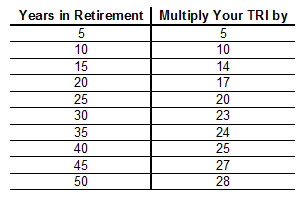
       Now for that multiplication I warned you about before. First, you need to know your target retirement income (TRI) from Part 1. Then, using the table below, figure out what number you should multiply by to determine your target retirement savings (TRS). For example, if you’ve determined you need $40,000/year (your TRI) and you’ll be in retirement for 25 years, just multiply by 20 to determine your target retirement savings. In this case, $40,000 x 20 would mean you need to have $800,000 (in today’s dollars) saved by the time you want to retire.

TRI Factor

       As I mentioned before, using this chart will tell you how much you need to have saved by retirement in today’s dollars. This isn’t the actual number of dollars you’ll need to have in your account because of inflation, but that doesn’t matter. If you continue to use this process once a year, you can be sure you’re saving enough. Make sure you write down your TRS number. You’ll need it for Part 3 so you can figure out how much you should save each year until retirement.

How Much Have You Already Saved?

       You’ll also need to know how much you’ve already saved up before you can determine how much you should be saving every year for retirement. This is also the part where we’ll account for your taxes. Because we don’t know exactly what changes will happen to the tax structure, we’ll have to estimate this as well. Here’s how to add up each of your accounts (taking taxes into consideration):

  • Tax-free Accounts – If you have a Roth IRA or Roth 401(k), you don’t need to worry about taxes. You can include the full value of these accounts in calculating your current retirement savings.
  •  

  • Tax-deferred Accounts – Withdrawals from a Traditional IRA, 401(k), 403(b), 457, or similar accounts will be taxed in retirement. For our purposes, you’ll need to account for the taxes you’ll pay on these accounts. Given our current tax structure, you can plan on paying about 20-25% in federal and state income taxes on these accounts. To figure out how much you should include when adding up your savings, use 75-80% of the account value. If you have $100,000 in your Traditional IRA, you should only use $75,000-80,000 when you’re adding up your savings.
  •  

  • Taxable Accounts – This category includes all your taxable accounts you’re using to save for retirement. It’s a little more difficult to account for taxes in these accounts. You’ll be taxed only on the gain in these accounts. How much of your withdrawals will be taxed depends on your cost basis in these accounts. We’ll estimate that taxes will be about 15-20% on these accounts. So you’ll want to use 80-85% of the account value when adding up your savings.

       Here’s a quick example. Let’s say you have $25,000 saved in a Roth IRA, $20,000 in your 401(k) at work, and no taxable accounts. You’ll include the full $25,000 in the Roth IRA and 75% of your 401(k), or $15,000. This gives you a total savings of $40,000.

       After you’ve figured out how much you’ve saved, you need to determine how much that is as a percentage of your TRS. In the example above, we determined you’d need $800,000 to retire. If you’ve saved $40,000 already, you’ve saved up 5% of your target retirement savings (TRS). (That is, $40,000/$800,000 is 0.05 or 5%.)

       To figure out how much you’ll need to save every year, you need to know your target retirement savings (TRS) and how much you’ve saved already as a percentage of your TRS. In Part 3, we’ll continue to use the example above with a TRS of $800,000 and having 5% of that number already saved up.

       Here’s a quick recap of what you’ve done already:

  • 1. Figure out how much income you’ll need in retirement (your TRI).
  • 2. Figure out how many years you’ll spend in retirement.
  • 3. Multiply your TRI by the appropriate number from the chart above to determine how much you’ll need to have saved for retirement (your target retirement savings or TRS).
  • 4. Add up your current savings after accounting for taxes. Then figure out how much that number is as a percentage of your TRS (divide current savings by your TRS).

       In our working example, we decided we need $40,000/year in retirement. We also figure we’ll spend 25 years in retirement. Then, we multiplied our TRI ($40,000) by the number in the chart for 25 years in retirement, which was 20. That gave us a target retirement savings (TRS) of $800,000. Finally, we figured out we have saved up $40,000, or 5% of our TRS, after accounting for taxes.

       To make sure you know what to do next, sign up for free updates to Provident Planning!

The first step in figuring out how much you need to save for retirement is to determine how much income you’ll need in retirement. This number will affect how much you need to have saved up on the day you retire. While you won’t know exactly how much you’ll be spending when you’re retired, you need to come up with the best estimate possible.

Step One: Forget the 70%, 80%, 90%, 95%, or any other % Rule

Any rule that says you’ll need a certain percent of your pre-retirement income is complete nonsense. Everyone’s situation is different. Some people will need only 40% of their pre-retirement income, while others may want 120%. Your retirement income needs strongly depend upon your personal situation. By using one of the many percent rules, you’ll be shooting for a much higher income than you actually need – or worse, you won’t save enough. So forget all these rules, and let’s look at your personal situation.

Step Two: Look at Your Current Spending

If you haven’t already been tracking your expenses, now is the time to start. Trying to predict your future expenses is going to be extremely difficult if you don’t even know what you’re spending right now. There are plenty of ways to track your expenses, some easy and others more time-consuming. I’ll let you choose the method you like best. It doesn’t really matter as long as you can get a fairly accurate picture of where your money is going.

It’s also important to have a clear understanding of your health insurance. There a number of different plans available, but a good amount of research is absolutely crucial before going through with any of them. Depending on your plan, you may have access to prescription drugs. This becomes increasingly important as you become older. Thankfully, you can still order your medications via online pharmacy. Not only is this less expensive than buying medication at a drug store, but it is also much more convenient, as everything goes straight to your home.

Step Three: Figure Out Which Categories Are Likely to Change

The next thing you’ll want to do is determine which parts of your budget are likely to change when you’re retired. Figure all of this stuff in today’s dollars (what it would cost today). Inflation will be accounted for later. Here are a few possibilities:

    • Housing – If you have a mortgage now but you won’t in retirement, make sure you take that out of your retirement income needs. You’ll still have property taxes, utilities, maintenance costs, and homeowner’s insurance. If you’re going to sell your home and rent in retirement, don’t forget to account for that. If you rent now, will you own a home by the time you retire? If so, estimate those costs by talking with people who live in homes similar to one you’d like to buy. If not, figure on still paying rent and renter’s insurance during retirement.


    • Kids – If your children will be on their own by the time you retire, you can cut out any related costs when figuring your retirement income needs. You may even be able to plan on downsizing your home after your kids have moved out – saving you more on housing.


    • Job – If you won’t be working, forget the commute, business clothes, and any meals you bought with co-workers or clients. If you’ll be working part-time, estimate what your related costs will be.


    • Savings – If you’re retired, you most likely won’t be saving for retirement. You’ll still want to set aside some money for emergencies and other goals, but you can cut this spending category way down if you’re currently saving a lot.


    • Insurance – Life and disability insurance are designed to cover the risk of premature death while you’re working. If you don’t need to work during retirement, you can cut out these costs as well (unless you need the life insurance for estate taxes). Health insurance may go up or down depending on your current situation. Medicare Part B costs about $1,200 a year right now with a $135/year deductible and 20% coinsurance after that. If you’ll have 40 quarters of covered employment, you won’t pay Part A premiums. Medicare Part D (prescription coverage) currently costs about $360/year in its basic form and about $760/year if you want some gap coverage. Any Medigap policy premiums will depend on the coverage you buy.


    • Health Care – If you have or develop a chronic illness, your health care costs may go up quite a bit in retirement. Medicare will cover most of the basic stuff, but if you have specific conditions you’ll either need to pay for related costs out of your own pocket or cover them with a Medigap policy. If you’re healthy now, you may not need to account for increased health care costs in retirement. This should be additional motivation to start living healthy now before it’s too late! You’ll save a lot of money and enjoy life more.


    • Senior Discounts – Some of your current costs may go down in retirement because of senior discounts. Golf may be cheaper, dining out may cost a little less, and public transportation may provide discounts as well. You might also be able to get lower rates on insurance policies. Don’t get too caught up trying to figure these things out. It largely depends on what you’ll be doing in retirement and whether or not a discount will be available.


    • Travel – Will you travel more or less in retirement? Many people travel a lot in the first few years of retirement, but return to their regular habits after that. Don’t forget the senior discounts that may apply and the fact that you can travel at off-peak times to save even more money. You’re not in a hurry either, so maybe you’ll drive instead of flying.


    • New Hobbies/Activities – Will you be taking up any new past-times in retirement? How much do you think they’ll cost? Will you stop doing some of the things you do now, and how much will that save you? Maybe you’re planning on volunteering a lot, which means you’ll have some transportation costs to account for. If you’ll be planning missionary trips, include those here or in the travel category.


  • Income Taxes – Don’t include your income taxes (federal, state, or local) in your required retirement income. We’ll account for some of those in step four and the rest in Part 2 of this series.

This list is not all-inclusive. Some of these categories won’t apply to you, and I’ve missed some that probably do. You’ll need to consider your own situation and adjust accordingly. Once you’ve figured out what will likely change for you in retirement, come up with an annual retirement income need.

Step Four: Deduct Any Income Sources

Next, you’ll want to add up all your income sources in retirement. If you’re close to retirement, you might be able to include Social Security – younger people would do best not to count on Social Security yet because of the uncertainty. Pensions, business income that will continue, and any part-time employment are all possible sources of income in retirement. Take your annual retirement income need and subtract your after-tax retirement income. This will give you your target retirement income (TRI), which we’ll use in Parts 2 and 3 of this series to determine how much you should be saving for retirement.

Stay tuned for Parts 2 and 3 of this series to figure out how much you should be saving for retirement. The best way to make sure you don’t miss a thing is to sign up for free updates to Provident Planning.