Archives For Retirement

       In the earlier parts of this series, I explained how you should calculate how much income you’ll need in retirement, how much you’ll need to retire, and how much you already have saved for retirement. I’ll be honest. After looking at the second article and realizing what I would have to include in this one, the whole thing was too complicated.

       I want you to actually do this. I want people to have an accurate way to calculate their retirement needs and how much they should save. So I’ve put a lot of work into creating the calculator I’ve included with this post. It doesn’t assume you’ll get the same return every year in the stock market. I’ve used Monte Carlo simulations to account for the fact that stock market returns are variable. Also, it assumes you’ll invest in a diversified portfolio that becomes more conservative as you get older. I’ll explain exactly how you should invest for retirement in an upcoming series of posts.

       Since this calculator simplifies what you need to do, I’m revamping the steps you need to take to calculate how much you should save for retirement. You’re still going to have to do some work, but if you want a good answer you can’t get around doing a little work. Here are the steps followed by the calculator:

1. Figure Out How Much Income You’ll Need in Retirement.

       The first thing you need to know is exactly how much income you’ll need in retirement. This calculator assumes you’ve calculated your retirement income needs in a specific way. To calculate that number, follow the instructions in the first post of this series.

2. Enter Your Current Age.

       Straightforward if you ask me…

3. Enter Your Retirement Age.

       Again, pretty straightforward. Enter the age you’ll be when you want to retire (or think you’ll want to retire).

4. Estimate Your Life Expectancy.

       I realize you don’t know exactly when you’re going to die, but to plan for retirement you need to estimate something. The best way I’ve found to estimate your life expectancy is to use the free life expectancy calculator at Living to 100. This calculator considers your family health history and your own habits to estimate your life expectancy. You’ll also receive tips on how to increase your life expectancy by changing your habits.

       If you’re married, both you and your spouse should use the life expectancy calculator. Then, use the longer of your two life expectancies. Make sure that the difference between the life expectancy you use and the retirement age you used covers the entire time period you or your spouse will be drawing on your retirement portfolio. (For example, you’re 30 and your spouse is 25. You want to retire when you’re 65 and your spouse is 60. Your life expectancy is 85 and your spouse’s is 90. You’ll only need your retirement assets for 20 years, but your spouse will need them for 30 years. Since your spouse will be drawing on your retirement assets for 30 years, you should use a life expectancy of 95 – your retirement age of 65 plus the 30 years your spouse will be alive.)

5. Calculate Your Current Savings after Accounting for Taxes.

       You’ll also need to know how much you’ve already saved up before you can determine how much you should be saving every year for retirement. This is where we’ll account for your taxes. Because we don’t know exactly what changes will happen to the tax structure, we’ll have to estimate this as well. Here’s how to add up each of your accounts (taking taxes into consideration):

  • Tax-free Accounts – If you have a Roth IRA or Roth 401(k), you don’t need to worry about taxes. You can include the full value of these accounts in calculating your current retirement savings.
  •  

  • Tax-deferred Accounts – Withdrawals from a Traditional IRA, 401(k), 403(b), 457, or similar accounts will be taxed in retirement. For our purposes, you’ll need to account for the taxes you’ll pay on these accounts. Given our current tax structure, you can plan on paying about 20-25% in federal and state income taxes on these accounts. To figure out how much you should include when adding up your savings, use 75-80% of the account value. If you have $100,000 in your Traditional IRA, you should only use $75,000-80,000 when you’re adding up your savings.
  •  

  • Taxable Accounts – This category includes all your taxable accounts you’re using to save for retirement. It’s a little more difficult to account for taxes in these accounts. You’ll be taxed only on the gain in these accounts. How much of your withdrawals will be taxed depends on your cost basis in these accounts. Since we don’t know exactly what your cost basis will be, we’ll estimate that taxes will be about 15-20% on these accounts. If you know you’ll have a high cost basis, you can adjust accordingly. (If you don’t know what I’m talking about, you probably shouldn’t be investing in a taxable account.) So you’ll want to use 80-85% of the account value when adding up your savings.

       Here’s a quick example. Let’s say you have $25,000 saved in a Roth IRA, $20,000 in your 401(k) at work, and no taxable accounts. You’ll include the full $25,000 in the Roth IRA and 75% of your 401(k), or $15,000. This gives you a total savings of $40,000.

6. Use This Calculator.

       If you’ve followed those first five steps, you’ll have everything you need to use this calculator. After you’ve entered how much income you’ll need in retirement, your current age, your retirement age, your life expectancy, and your current savings, you’ll get an amount you should save this year. Then, increase your annual savings by inflation each year.

*Note: Click the ‘Click to Edit’ button to use the calculator with your own numbers.

       To get a usable answer from this calculator, make sure you’ve followed my instructions. The reason this calculator is so simple is because I’ve built in the assumption that you’ve followed my instructions for calculating everything. So if you think something’s wrong with the calculation, make sure you’ve followed the instructions. (especially on calculating how much income you’ll need in retirement)

       Disclaimer: No guarantee is made that you’ll definitely reach your retirement goals by following the recommendations of this calculator or my articles. This calculator bases its return calculations on the historical risk and return of a diversified portfolio of index funds using Monte Carlo simulations to emulate the variability of the stock market. Past performance is no guarantee of future results, but without a crystal ball it’s the best we have to go on. This information is for education purposes only and does not represent investment advice or an offer of any security for sale.

6. Repeat Every 3-5 Years.

       This calculator works best when you come back every 3 to 5 years, go through the process once again, and get a new number for how much you should save. The reason this is important is because it will consider the changes in your account value that the calculator couldn’t possibly know. So if you have really good results in the stock market, you can save a little less. If not, you might need to save a little more. Just be sure to come back to this calculator every few years until you retire.

Feel Free to Share and Stay Tuned!

       If you’ve found this calculator helpful, feel free to share it with your friends. If you want to learn how to invest for retirement and make sure your asset allocation is correct, sign up for free updates to Provident Planning!

       Once you’ve determined how much income you’ll need in retirement, the next step is to figure out how much you’ll need to have saved up by retirement. Don’t worry. I’m not going to make you do complicated math. If you can multiply, you can figure this out. First, we need to determine how long you’ll be retired.

How Long Are You Going to Live?

       Let’s pull out your crystal ball and figure out how old you’ll be when you die. If you don’t have one, then you’re already aware that we’re only estimating here. There’s no way to know for certain when you’ll take your last breath, but you can plan by taking your health and family history into consideration.

       You can use the free life expectancy calculator over at Living to 100 to estimate how long you’ll live. You’ll even get some tips on changes you can make to live a healthier, longer life. If you’re married, use the longer life expectancy between the two of you.

How Many Years Will You Spend in Retirement?

       Once you’ve estimated your life expectancy, all you need to do is subtract your retirement age from your life expectancy. If you expect to live to age 90 and you want to retire at age 65, you’ll spend 25 years in retirement. Remember that number. You’ll need it in the next step.

How Much Will You Need to Have Saved by Retirement?

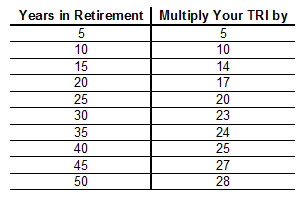
       Now for that multiplication I warned you about before. First, you need to know your target retirement income (TRI) from Part 1. Then, using the table below, figure out what number you should multiply by to determine your target retirement savings (TRS). For example, if you’ve determined you need $40,000/year (your TRI) and you’ll be in retirement for 25 years, just multiply by 20 to determine your target retirement savings. In this case, $40,000 x 20 would mean you need to have $800,000 (in today’s dollars) saved by the time you want to retire.

TRI Factor

       As I mentioned before, using this chart will tell you how much you need to have saved by retirement in today’s dollars. This isn’t the actual number of dollars you’ll need to have in your account because of inflation, but that doesn’t matter. If you continue to use this process once a year, you can be sure you’re saving enough. Make sure you write down your TRS number. You’ll need it for Part 3 so you can figure out how much you should save each year until retirement.

How Much Have You Already Saved?

       You’ll also need to know how much you’ve already saved up before you can determine how much you should be saving every year for retirement. This is also the part where we’ll account for your taxes. Because we don’t know exactly what changes will happen to the tax structure, we’ll have to estimate this as well. Here’s how to add up each of your accounts (taking taxes into consideration):

  • Tax-free Accounts – If you have a Roth IRA or Roth 401(k), you don’t need to worry about taxes. You can include the full value of these accounts in calculating your current retirement savings.
  •  

  • Tax-deferred Accounts – Withdrawals from a Traditional IRA, 401(k), 403(b), 457, or similar accounts will be taxed in retirement. For our purposes, you’ll need to account for the taxes you’ll pay on these accounts. Given our current tax structure, you can plan on paying about 20-25% in federal and state income taxes on these accounts. To figure out how much you should include when adding up your savings, use 75-80% of the account value. If you have $100,000 in your Traditional IRA, you should only use $75,000-80,000 when you’re adding up your savings.
  •  

  • Taxable Accounts – This category includes all your taxable accounts you’re using to save for retirement. It’s a little more difficult to account for taxes in these accounts. You’ll be taxed only on the gain in these accounts. How much of your withdrawals will be taxed depends on your cost basis in these accounts. We’ll estimate that taxes will be about 15-20% on these accounts. So you’ll want to use 80-85% of the account value when adding up your savings.

       Here’s a quick example. Let’s say you have $25,000 saved in a Roth IRA, $20,000 in your 401(k) at work, and no taxable accounts. You’ll include the full $25,000 in the Roth IRA and 75% of your 401(k), or $15,000. This gives you a total savings of $40,000.

       After you’ve figured out how much you’ve saved, you need to determine how much that is as a percentage of your TRS. In the example above, we determined you’d need $800,000 to retire. If you’ve saved $40,000 already, you’ve saved up 5% of your target retirement savings (TRS). (That is, $40,000/$800,000 is 0.05 or 5%.)

       To figure out how much you’ll need to save every year, you need to know your target retirement savings (TRS) and how much you’ve saved already as a percentage of your TRS. In Part 3, we’ll continue to use the example above with a TRS of $800,000 and having 5% of that number already saved up.

       Here’s a quick recap of what you’ve done already:

  • 1. Figure out how much income you’ll need in retirement (your TRI).
  • 2. Figure out how many years you’ll spend in retirement.
  • 3. Multiply your TRI by the appropriate number from the chart above to determine how much you’ll need to have saved for retirement (your target retirement savings or TRS).
  • 4. Add up your current savings after accounting for taxes. Then figure out how much that number is as a percentage of your TRS (divide current savings by your TRS).

       In our working example, we decided we need $40,000/year in retirement. We also figure we’ll spend 25 years in retirement. Then, we multiplied our TRI ($40,000) by the number in the chart for 25 years in retirement, which was 20. That gave us a target retirement savings (TRS) of $800,000. Finally, we figured out we have saved up $40,000, or 5% of our TRS, after accounting for taxes.

       To make sure you know what to do next, sign up for free updates to Provident Planning!

The first step in figuring out how much you need to save for retirement is to determine how much income you’ll need in retirement. This number will affect how much you need to have saved up on the day you retire. While you won’t know exactly how much you’ll be spending when you’re retired, you need to come up with the best estimate possible.

Step One: Forget the 70%, 80%, 90%, 95%, or any other % Rule

Any rule that says you’ll need a certain percent of your pre-retirement income is complete nonsense. Everyone’s situation is different. Some people will need only 40% of their pre-retirement income, while others may want 120%. Your retirement income needs strongly depend upon your personal situation. By using one of the many percent rules, you’ll be shooting for a much higher income than you actually need – or worse, you won’t save enough. So forget all these rules, and let’s look at your personal situation.

Step Two: Look at Your Current Spending

If you haven’t already been tracking your expenses, now is the time to start. Trying to predict your future expenses is going to be extremely difficult if you don’t even know what you’re spending right now. There are plenty of ways to track your expenses, some easy and others more time-consuming. I’ll let you choose the method you like best. It doesn’t really matter as long as you can get a fairly accurate picture of where your money is going.

It’s also important to have a clear understanding of your health insurance. There a number of different plans available, but a good amount of research is absolutely crucial before going through with any of them. Depending on your plan, you may have access to prescription drugs. This becomes increasingly important as you become older. Thankfully, you can still order your medications via online pharmacy. Not only is this less expensive than buying medication at a drug store, but it is also much more convenient, as everything goes straight to your home.

Step Three: Figure Out Which Categories Are Likely to Change

The next thing you’ll want to do is determine which parts of your budget are likely to change when you’re retired. Figure all of this stuff in today’s dollars (what it would cost today). Inflation will be accounted for later. Here are a few possibilities:

    • Housing – If you have a mortgage now but you won’t in retirement, make sure you take that out of your retirement income needs. You’ll still have property taxes, utilities, maintenance costs, and homeowner’s insurance. If you’re going to sell your home and rent in retirement, don’t forget to account for that. If you rent now, will you own a home by the time you retire? If so, estimate those costs by talking with people who live in homes similar to one you’d like to buy. If not, figure on still paying rent and renter’s insurance during retirement.


    • Kids – If your children will be on their own by the time you retire, you can cut out any related costs when figuring your retirement income needs. You may even be able to plan on downsizing your home after your kids have moved out – saving you more on housing.


    • Job – If you won’t be working, forget the commute, business clothes, and any meals you bought with co-workers or clients. If you’ll be working part-time, estimate what your related costs will be.


    • Savings – If you’re retired, you most likely won’t be saving for retirement. You’ll still want to set aside some money for emergencies and other goals, but you can cut this spending category way down if you’re currently saving a lot.


    • Insurance – Life and disability insurance are designed to cover the risk of premature death while you’re working. If you don’t need to work during retirement, you can cut out these costs as well (unless you need the life insurance for estate taxes). Health insurance may go up or down depending on your current situation. Medicare Part B costs about $1,200 a year right now with a $135/year deductible and 20% coinsurance after that. If you’ll have 40 quarters of covered employment, you won’t pay Part A premiums. Medicare Part D (prescription coverage) currently costs about $360/year in its basic form and about $760/year if you want some gap coverage. Any Medigap policy premiums will depend on the coverage you buy.


    • Health Care – If you have or develop a chronic illness, your health care costs may go up quite a bit in retirement. Medicare will cover most of the basic stuff, but if you have specific conditions you’ll either need to pay for related costs out of your own pocket or cover them with a Medigap policy. If you’re healthy now, you may not need to account for increased health care costs in retirement. This should be additional motivation to start living healthy now before it’s too late! You’ll save a lot of money and enjoy life more.


    • Senior Discounts – Some of your current costs may go down in retirement because of senior discounts. Golf may be cheaper, dining out may cost a little less, and public transportation may provide discounts as well. You might also be able to get lower rates on insurance policies. Don’t get too caught up trying to figure these things out. It largely depends on what you’ll be doing in retirement and whether or not a discount will be available.


    • Travel – Will you travel more or less in retirement? Many people travel a lot in the first few years of retirement, but return to their regular habits after that. Don’t forget the senior discounts that may apply and the fact that you can travel at off-peak times to save even more money. You’re not in a hurry either, so maybe you’ll drive instead of flying.


    • New Hobbies/Activities – Will you be taking up any new past-times in retirement? How much do you think they’ll cost? Will you stop doing some of the things you do now, and how much will that save you? Maybe you’re planning on volunteering a lot, which means you’ll have some transportation costs to account for. If you’ll be planning missionary trips, include those here or in the travel category.


  • Income Taxes – Don’t include your income taxes (federal, state, or local) in your required retirement income. We’ll account for some of those in step four and the rest in Part 2 of this series.

This list is not all-inclusive. Some of these categories won’t apply to you, and I’ve missed some that probably do. You’ll need to consider your own situation and adjust accordingly. Once you’ve figured out what will likely change for you in retirement, come up with an annual retirement income need.

Step Four: Deduct Any Income Sources

Next, you’ll want to add up all your income sources in retirement. If you’re close to retirement, you might be able to include Social Security – younger people would do best not to count on Social Security yet because of the uncertainty. Pensions, business income that will continue, and any part-time employment are all possible sources of income in retirement. Take your annual retirement income need and subtract your after-tax retirement income. This will give you your target retirement income (TRI), which we’ll use in Parts 2 and 3 of this series to determine how much you should be saving for retirement.

Stay tuned for Parts 2 and 3 of this series to figure out how much you should be saving for retirement. The best way to make sure you don’t miss a thing is to sign up for free updates to Provident Planning.

       The other day I was playing around with an Excel spreadsheet I made. I was looking at how much you need to save to reach your retirement goals. At one point, I thought to myself, “What happens if you save more than necessary? How much will it increase your chances of reaching your retirement goal?” The answer I found was very interesting and backs up a verse in Proverbs. But before I can tell you what I discovered, I’ll have to explain what I was doing and how I was doing it.

Monte Carlo Analysis

       In financial planning, we use Monte Carlo analysis to simulate random stock market returns among other things. When you’re planning your retirement, it doesn’t make sense to assume you’re going to get an 8% return every single year. The stock market just doesn’t work that way. Monte Carlo analysis gives a more realistic, though not perfect, representation of how the stock market actually delivers returns.

       Monte Carlo analysis uses the assumptions you give it to randomly pick numbers within a specific range. I used Monte Carlo analysis to pick random stock market returns within a range based on historic performance results. I looked at how a person’s savings would grow as they invest for 45 years to reach their retirement goals.

       Each 45 year investment period is called a “trial”. The success or failure of a trial depends on whether or not you reach your goal at the end of the period. I was testing to see whether you would have accumulated enough money to retire at the end of 45 years based on your retirement goals.

       Running just one trial isn’t enough. To get a meaningful result, you have to run thousands of trials. To figure out your success rate, you divide the number of successful trials by the total number of trials you ran. In my example, I ran 5,000 trials (that means 5,000 sets of 45 year investment periods). An 80% success rate would mean that 4,000 out of my 5,000 trials were successful.

       Monte Carlo analysis is useful because it incorporates the uncertainty of the stock market into your retirement planning. It has some limitations, but it’s the best we can do for trying to predict the future. The stock market doesn’t work exactly the way the model works, and there’s also the question of what a good result should be. Traditionally, a success rate of 80% or higher is “good” because there are so many assumptions built in to the model. Trying to go for a higher success rate means you’re placing much more importance on your assumptions being correct.

       I found that saving 20% of your desired retirement income and increasing it by inflation each year would give you an 82% success rate to reach your retirement goals. That’s pretty good, but then I wondered what would happen if you saved even more. How much would your success rate increase if you saved even more?

The Results: The Diminishing Marginal Utility of Hoarding

       So I proceeded to run a Monte Carlo analysis at different savings rates. I started at 0% and increased it by 5% for each new analysis all the way up to 100%. Here’s a graph of my results:

Success Rate As a Function of Savings

       As you can see, saving 0% gives you a 0% chance of reaching retirement – which makes sense, right? Saving 10% gives you about a 60% success rate, and saving 20% gives you an 82% success rate. But do you notice the interesting part? As you begin to save more than 20%, your chances of successfully reaching your retirement goals go up less and less. After you hit that 20% savings mark you don’t get very much bang for your buck.

       It might be easier to see what I’m talking about using this chart:

The Marginal Utility of Hoarding

       So when you go from saving 0% for retirement to saving 5%, you increase your chances of success by 37%. If you go from 5% to 10%, you increase your success rate by another 23% giving you a success rate of 60%. From 10% to 15% increases your chances of success by 13%, and from 15% to 20% gives you another 9% increase. Once you get to 20% though, saving another 5% only increases your success rate by 3%. Every little bit more that you save gives you a smaller and smaller increase in your chances of success.

       This shows what I call “the diminishing marginal utility of hoarding”. In economics, the law of diminishing marginal utility says that for each additional unit you use you get less satisfaction than you did with the last one. For example, eating one chocolate bar tastes good. A second one right after doesn’t taste quite as good, the third a little less so, and so on. Eating seven chocolate bars in a row just gives you a sick stomach.

       What we’re seeing here is the law of diminishing marginal utility applied to saving. Saving money for retirement is good. But once you get to a certain point (which depends on how long you have until retirement and how much you have already saved), saving more and more doesn’t increase your chances of success quite as much as it did before.

How Can This Be True?

       Because Monte Carlo analysis is looking at thousands of possible scenarios, you’re going to have some scenarios where the stock market loses money for several years in a row. While that’s (hopefully) not as likely in real life, saving more and more isn’t going to help you much if that happens. You’ll just keep losing the money, and the impact is even greater if you already have a lot saved. So this phenomenon is partly due to the method we’re using, but it also illustrates a fundamental truth – being stingy doesn’t help you quite as much as you might think it will.

What God Has to Say about It

       I was so excited to see these results because they help illustrate some of God’s wisdom about giving:

       24 There is one who scatters, and increases yet more. There is one who withholds more than is appropriate, but gains poverty. 25 The liberal soul shall be made fat. He who waters shall be watered also himself.

Proverbs 11:24-25 (WEB)

       Maybe you’re thinking I didn’t really prove that point, and you’d be right if you’re only thinking about dollars and cents. When Jesus talked about giving our money to the poor, He never said that it would make us rich in this life. When we give to honor God, we store up treasures in Heaven. This is precisely how one person can give away a lot of his money and become wealthier while another is stingy but becomes poor.

       Being a stingy miser won’t give you a better chance of reaching your retirement goals. Once you’re saving enough, you have to be content that you’re doing what you should and hand the rest over to God. Hoarding money for yourself doesn’t help you that much in this life, and it will severely impoverish you in the next.

       So how do you know when you’re saving enough? To find out, sign up for free updates to Provident Planning. I’ll be examining that question and many more that will help you prepare for a retirement that honors God and live a life that glorifies His name.