Archives For Corey

       J.D. Roth at Get Rich Slowly has some good articles on how to figure out your real hourly wage. The first one titled “How to Compute Your REAL Hourly Wage” is a good start to calculating this number, but it leaves out taxes. The second article titled “Beyond “Real Hourly Wage”: How Much Time Does Stuff Actually Cost?” gets closer to a more accurate number, but I personally think you should do it a little differently.

We Still Work by furryscaly on Flickr       J.D. talks about deducting your fixed expenses to calculate your real hourly wage to figure out how many hours things cost in terms of your disposable income. I think this is a good number to keep in mind, but you should also consider your hourly wage in terms of net income as well (income minus work related expenses and taxes). This net income hourly wage can help you see how much of your time is spent paying for your necessities and put those costs in perspective. This is mostly just an interesting experiment, but it can help you realize that your time is worth something and spending money means giving up your time.

       However, what I really want to talk about is the discussion that came up following J.D.’s article about Things It’s Cheaper to Do Yourself. Some commenters contend that if a task would cost less per hour to outsource than you can earn in an hour then you’re better off paying someone else to do it for you. However, this logic is often flawed once you consider reality. This is a topic that’s been on my mind for a while, but J.D.’s article and the discussion prompted me to go ahead with my post.

What Are You Doing Instead?

       When I pay someone to change my oil what do I do while I wait? I’m usually stuck sitting in a waiting room or browsing through the store (if I’m at Pep Boys or Walmart). I don’t earn any money while I’m waiting, so I can’t say I’m saving money or time by paying someone else to change my oil for me. If I can drop my car off and go do some income-producing activity, then it might be better for me to outsource the oil change. Even then, I need to make sure that my net after-tax hourly rate is going to be large enough to offset the cost of paying someone else to change my oil. If it’s not, then I’m better off changing the oil myself.

       The same can be said of many other activities we outsource. It’s easy to say, “Yeah, I’ll pay Jim $30 to mow my yard because it would take me 3 hours and I can earn $10/hour.” But this logic only works out if we take the time we would have spent mowing the yard and use it to earn money or provide ourselves with some other sort of value. This could mean enjoying a leisure activity or spending time with family. If mowing the yard would have prevented us from those (non-income producing) activities, then paying someone else to mow our yard might make sense depending on how much we value that time.

Sometimes It’s Better to Hire a Professional

Beautiful Tools by geishaboy500 on Flickr       Another exception would be projects that are better completed by a professional. If you do not have the ability to complete a project, then it’s probably best to pay a professional. You’ll save more money by having someone do it right the first time than having to go back and fix the mistakes you made trying to do it yourself. This can also be true if a project requires very specialized tools that we may never use again. This is the same logic we apply when we realize it’s better to rent a bulldozer to dig a hole than to buy it if we’re probably not going to use it again.

       However, it’s sometimes better to do a job yourself because you’ll know the quality of your work. When you hire someone else, you can get unlucky and end up with a “professional” who does shoddy work. With careful research and good referrals, you can usually avoid such misfortune. But if you know how to do a project and can do it well, you’re likely to get better results by doing it yourself than by hiring a “professional”. It also might be worthwhile to do it yourself because you’ll learn new skills you can use again in the future – thus allowing you to do even more yourself and save more money.

What’s It Worth to You?

DoItYourself.com       My point is that most of the time it makes sense to do it yourself. There are a few exceptions where this is not true, but simply valuing our time based on our gross hourly wage is flawed. We have to look at the value of our time spent in the replacement activity (the thing we’re doing instead of the DIY project). If the value of our replacement activity outweighs the cost of outsourcing, then we can safely say it’s better to outsource. This still neglects the benefits of learning new skills and the satisfaction that many people experience when they do something themselves, but that’s a very subjective benefit.

       Just as every other personal finance decision needs to be considered in light of your personal situation, so does weighing the option of doing something yourself or paying someone else to do it. Depending on the value of your time, the activity you’ll do instead of doing it yourself, your skill set, and your desire to do it yourself, it may or may not make sense to outsource a project. Be sure you consider these factors before you say you’re saving yourself money or time by outsourcing.

How Long is Long Term?

Corey —  October 16, 2009

       Two good questions when we invest money are:

  1. How long until I’m likely to get a positive return?
  2. How long until I’ll get close to the average return?

       Since we can’t predict the future, the easiest way to answer these questions is to look at what happened in the past. Keep in mind we’re looking at the worst case scenarios for each of these questions.

How Are You Invested?

       Your investment returns and risk (volatility) greatly depend on your asset allocation. The more of your portfolio that’s invested in stocks, the higher your risk will be. Higher risk means it will take longer to know for certain you’ll have a positive return over any given time frame. It also means it will take longer to know for certain that you’ll get your required return over any given time frame.

       To answer these questions accurately, we have to look at the mix of stocks and bonds in your portfolio. Assuming you’re invested in a diversified portfolio, the answers to your questions are given below.

How Long Until I’m Likely to Get a Positive Return?

       Put another way, this question is: “What’s the minimum amount of time I need to be invested in a specific portfolio to be fairly certain I won’t get a negative return?”. Here are the answers based on historical investment results since 1927.

  • 0% in Stocks (100% in Bonds): 3 Years
  • 10% in Stocks: 5 Years
  • 20-50% in Stocks: 7 Years
  • 60-80% in Stocks: 10 Years
  • 90-100% in Stocks: 15 Years

       Again, these answers assume you’re using a diversified portfolio as recommended here.

How Long Until I’ll Get Close to the Average Return?

       This question can also be posed as: “How long do I need to be invested so I can be reasonably sure I’ll get a return somewhere close to the historical average?”. The first step to answering this question is to define “close to the historical average”. For the purposes of this article, we’ll define close to the historical average as 75% of the historical average. For example, if the historical average for a given portfolio is 10%, then we’d consider 7.5% as being “close to” that average. We’re looking at the longest historical time period that it took to get close to the average return. So what’s the maximum amount of time we would have to stay invested in order to get close to the average?

  • 0-10% in Stocks: 55 Years
  • 20% in Stocks: 50 Years
  • 30% in Stocks: 45 Years
  • 40% in Stocks: 35 Years
  • 50-100% in Stocks: 30 Years

       Now, it’s important to remember we’re looking at the worst case scenario in both of these analyses. In reality, we’re likely to experience better results than these worst case scenarios. Most of these worst case scenarios occurred during the Great Depression.

       Historically speaking, a 100% Stock portfolio only experienced single digit returns twice over any 30 year period. Both of those single digit periods were during the 30 year periods beginning in 1928 and 1929—the worst times in history to begin investing.

       These time periods are good to keep in mind especially when we’re experiencing difficult times. When it feels like your investments aren’t performing as they should, just remember that it can take many years before you can expect to get a positive or average return in the worst case scenario.

Civil War gravestones at Vicksburg by Matito on Flickr       Estate planning is probably the most neglected aspect of personal finance because we don’t like to deal with the reality of our own death. Making decisions about who will get what when we die and medical treatments we do or don’t want while dying are not exactly at the top of our “fun” list. But taking the time to deal with these critical issues can save your family and friends a lot of heartache, stress, and even money. There are four main estate documents you’re likely to need: a will, a durable power of attorney, an advance medical directive or living will, and a health care power of attorney.

Will

       A will simply states who you want to handle your estate (file the paperwork and make sure things are distributed properly) and how you want your property distributed. Everyone should have a will. Without a will, your estate will be distributed according to the laws of your state and the court will appoint someone to administer your estate. The handling and distribution of your estate could cost much more this way and go against your wishes.

       While there are ways to create your own will (like www.nolo.com or Quicken WillMaker), these tools should only be used in very straightforward situations. If your estate exceeds the estate tax exemption amounts, you have a complicated family situation, or you want to distribute your assets in a complex manner, you should consult with an estate attorney. If you even think you have a complicated situation, you should meet with an estate attorney to talk about it.

Durable Power of Attorney

       A durable power of attorney gives someone else the power to act on your behalf in a legal or business matter. That person is called your “attorney-in-fact”, and they are required by law to act in your best interest at all times. However, you must still be careful whom you choose for this position as any action they take will be treated as if you had done it yourself. The “durable” part simply means that it remains in effect even if you are incapacitated (e.g., in a coma). This document is useful when you are unable to act on legal or business matters for yourself either because you’re incapacitated or you’re just not available (e.g., out of the country).

       It’s a good idea to have a durable power of attorney regardless of your situation. This enables your attorney-in-fact to handle your affairs and sign on your behalf. Having one will make difficult situations a little easier to deal with. These documents can give very broad ranging powers to your attorney-in-fact, so you’ll want to consult an attorney before signing one and carefully consider who you will appoint as your attorney-in-fact.

Advance Medical Directive or Living Will and a Health Care Power of Attorney

       All of these documents deal with the health care decisions that must be made when you are unable to make them for yourself. If you’re in a coma or too sick to respond, these documents can guide your family members and physicians in determining your wishes.

       An advance medical directive or living will (depending on where you live) will provide specific instructions about the health care treatments you want or don’t want when you’re facing a terminal illness or condition. These can be very specific or very general, depending on what you include. However, they don’t usually address all possible situations and may not be clear enough to provide guidance for critical decisions. They do not give anyone the power to make decisions for you. They just make your wishes known.

       A health care power of attorney works just like a durable power of attorney except it is only for health care decisions. You appoint an attorney-in-fact and give them the power to make health card decisions on your behalf. You can include your wishes in this document as well, but unless you’re clear you can run into the same problems as the living will. While this won’t eliminate all possible problems (like family disputes), it does make clear who you want to have the final say about your health care decisions.

       The best strategy is to have both of these documents in place. This way you provide some guidance on your wishes but you also give someone else the power to make decisions in scenarios you may not have considered. Be as clear and straightforward as possible so there is no question about your desires.

       Again, you can use do-it-yourself tools to accomplish this, but you must be careful to ensure that your documents will comply with state laws. The counsel of an estate attorney will help you consider all possible scenarios. Some states provide free example documents you can use. Pennsylvania offers a combined living will and health care power of attorney that you can fill out. Search for similar resources for your own state.

Review and Update!

       The nice thing about getting your estate documents drafted and signed is that you don’t have to do it every year. Once you’ve completed them, you’ll just need to get them reviewed and updated as your situation or state laws change. If you get married, divorced, have children, or experience other major changes, you’ll want to meet with your estate attorney to review and update your documents. Don’t neglect this or you (or your family) could end up regretting it!

       Again, if you’re going to use an estate attorney, shop around. Don’t settle for the first quote you get. Talk to several attorneys, stick with the ones who specialize in estate planning, and ask for referrals from your family and friends. You may also be able to get a good referral from your accountant, financial planner, real estate agent, or banker. The most expensive attorney is not necessarily the best, but do your research before you go with the cheapest option.

       Finally, don’t put off this important but very unexciting task! It doesn’t sound like fun, but it is essential to having an organized and efficient financial plan. It will also help to ease the stress your family will endure during those painful situations. So get to work and get those estate documents ASAP!

       If you’ve determined that you need life insurance, your next step is to figure out how much coverage you should buy. You don’t need a complicated calculator to figure this out. You only need to know how much income you’ll need to replace if you die and how many years until you’ll retire.

Replacement Income

       Life insurance’s primary function is income replacement in case you die prematurely. How much income you replace will be up to you. You can choose to replace your entire income. Or you could assume you personally spend about 20% of your income and just replace 80% of your income. Finally, you could choose just to cover essential expenses for your survivors (like shelter, food, clothing, utilities, etc.).

       If you have children, you’ll most likely want to plan on replacing your entire income. If you don’t have children, you’ll need to decide what purpose you want your life insurance to serve. Is it to fully replace the income you would have earned or just to cover the essentials? Once you’ve figured out how much income you want to replace, you just need to determine how much insurance coverage you’ll need.

How Much Life Insurance?

       Now you need to figure out how many years you’ll need to replace your income. Generally, you’ll use the number of years until you retire. (But you should adapt the calculation to your situation if necessary.) Then use this chart to find out what factor you should multiply your replacement income by:

Life Insurance Factors

       So if you need to replace an income of $40,000/year and you have 40 years until retirement, you’ll multiply $40,000 by 25 to get $1,000,000 of insurance coverage needed.

       Next, subtract any savings you have that could be used instead of insurance. (Don’t count retirement savings because your spouse will need that for retirement.) That will leave you with the total amount of insurance coverage you need to buy. If you’re married, just repeat this process for your spouse.

That’s It!

       That’s all you need to do to figure out how much life insurance you need. Just make sure you’re very careful about deciding how much income you’ll need to replace as that’s the biggest factor in this calculation.

Selfish or Selfless?

Corey —  October 13, 2009

       Jesus did not call His followers to lead selfish lives. He taught about selfless living. He told us to forgive an unlimited number of times. He told us to give generously to the needy from our own abundance. He told us to love our enemies. He told us to repay evil with good. In every case of justified judging, keeping what we deserve and earned, hating, and revenge, Jesus taught us to choose love instead.

       Why does this matter for our personal finances? Jesus spoke often about wealth and the dangers of loving money. In every case, he told us we must not submit ourselves to the service of money or the lusts of riches. If we do, we cannot serve God. He did not leave us a middle ground. Jesus told us to sell what we have and give it to the poor. He didn’t say keep some extra wealth back for yourself to enjoy because you worked so hard for it. He called us to lovingly give to the needy out of our abundance.

       What’s an abundance? It’s having much more than we need. Not the kind of “I need a million dollar home” need. These are the basics we need for a comfortable (not luxurious) life. Jesus calls His followers to live simply so they can meet the needs of the poor and so they will not become slaves to money.

       Jesus didn’t tell us we should not work to meet our needs. But He did call us to avoid seeking wealth as our main pursuit in life. He told us that we should instead seek the Kingdom of God. Those who choose to follow Jesus must give up the selfish life and seek the selfless life.

       But how well are we doing this? American Christians as a whole (including me) have done a terrible job of following Jesus’ teachings about wealth and giving. We choose to satisfy our selfish desires (early retirement, vacation homes, frivolous luxuries, and other unnecessary wants) instead of meeting the basic needs of the millions of starving, homeless, hurting, and sick around the world. And it’s not that we just do these things once or twice in our lives. We have made an entire lifestyle – developed an entire culture – around it.

       As Christians we often try to justify it by saying we tithe or give to this charity or that mission. Or we claim that God has blessed us, so He must want us to enjoy at least some of it. But I’ve never found any justification for our selfish behavior anywhere in Jesus’ teaching at all. If I’m wrong, please show me.

       Jesus called us to live generously and sacrificially. He told us to put our desires and rights aside and put the needs of others first. I cannot see how Jesus could want me to buy a big screen TV when people are starving. I cannot see how it is loving of me to want a fancier house when people will sleep out in the rain tonight. I am blessed by God with everything I need to enjoy each day and do His work. I have not completely mastered these ideas – I still struggle with similar choices all the time. But God is opening my heart to the needs of others and showing me just how greatly blessed I really am.

       We have found too many reasons to push Jesus’ words aside to justify our own selfishness. We claim to follow Him, but we don’t do what He taught. Instead, we work so hard to get all the things we want (and don’t need). We are blind to how Satan has gained control of our hearts through our culture and money. We are not serving God when we spend on our extravagant wants. We are serving money (and Satan).

       There’s no secret to living a selfless life. There’s no formula. And I can’t set guidelines for what you should and shouldn’t do. You must choose to look at Jesus’ life for your example. You must choose to listen to His teaching for guidance. You must love Him, and He will teach you what it means to love others.

       Are we really willing to follow Jesus’ teaching? Are we ready to forsake the world, set aside our desires, and give generously to the needy in the name of Jesus? Are we going to take up His cross? Or are we going to close our eyes and shut our ears to the needs of the poor while we justify our selfish actions?

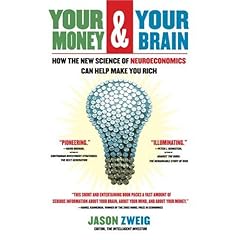
Your Money & Your Brain:  How the New Science of Neuroeconomics Can Help Make You Rich       Jason Zweig, a senior writer for Money magazine, is the author of a very interesting book called Your Money & Your Brain: How the New Science of Neuroeconomics Can Help Make You Rich. The book talks about how your brain can affect your money decisions, often detrimentally, and how you can learn to spot the problems you can create for yourself. It isn’t heavy in technical discussion, but it also doesn’t practically lay out exactly how you should invest your money. You should use it more as a guide to understand why it’s foolish to keep reading the investment news all the time and to help you understand why active investing is so widely used even though it has no academic research to stand on.

       Today, I just want to talk about a few excerpts from this book so we can understand why we tend to make the mistake of seeing patterns where there are none. This is often the case for those who believe in technical analysis or market timing or many other tenets of active investing. I hope this example can help you begin to see how our brain tricks us into thinking we can predict the future based on some pattern we see.

Humans Are Great at Finding Patterns

       Zweig acknowledges that humans are very good at finding and understanding simple patterns. This ability was extremely important to our ancestors and still serves us well today.

       That’s what helped our ancestors survive the hazardous primeval world, enabling them to evade predators, find food and shelter, and eventually to plant crops in the right place at the right time of year. Today, our skill at seeking and completing patterns helps us navigate many of the basic challenges of daily life. (“Here comes the train I have to catch.” “The baby’s hungry.” “My boss is always a butthead on Mondays.”)

Your Money & Your Brain: How the New Science of Neuroeconomics Can Help Make You Rich – Jason Zweig

       It’s really great that we have this ability – but only when we actually need it. When it comes to investing, obsessively looking for patterns in random data can be extremely detrimental to our investment performance. By trying to find patterns and use them to our advantage, we often do much worse than if we had taken the statistically superior route.

Pigeons and Rats – Why They Can Often Be Smarter Than Us

another rat by asplosh on Flickr       Many people spend an amazing amount of time looking through tons of stock market information trying to find some kind of pattern they can use for a great new investment strategy. Even though the information is essentially random, we look for patterns that aren’t there so we can find a way to make even more money. In the process of doing all this, we often lose much more money than if we had just invested in a diversified portfolio of index funds.

       For decades, psychologists have demonstrated that if rats or pigeons knew what a stock market is, they might be better investors than most humans are. That’s because rodents and birds seem to stick within the limits of their abilities to identify patterns, giving them what amounts to a kind of natural humility in the face of random events. People, however, are a different story.

Your Money & Your Brain: How the New Science of Neuroeconomics Can Help Make You Rich – Jason Zweig

       Experimenters can test this by flashing one of two lights, green or red, onto a screen. The sequence is completely random, but 80% of the time they will flash a green light. They’ll flash the red light the other 20% of the time. (For example, a set of 20 flashes could be: GGRGGGGRGGGGRGRRGGGG. Another run might look like this: RRGGGGGRGGGRGGGGGRGG.) If you’re going to try to guess the next color to appear, your best strategy is to always pick green because it’s going to show up 80% of the time. Rats and pigeons generally use this optimal strategy when researchers reward them with some food for guessing the right color.

       Humans, however, tend to flunk this kind of experiment. Instead of just picking green all of the time and locking in an 80 percent chance of being right, people will typically pick green four out of five times, quickly getting caught up in the game of trying to call when the next red flash will come up. On average, this misguided confidence leads people to pick the next flash accurately on only 68 percent of their tries. Stranger still, humans will persist in this behavior even when the researchers tell them explicitly—as you cannot do with a rat or pigeon—that the flashing of the lights is random. And, while rodents and birds usually learn quite quickly how to maximize their score, people often perform worse the longer they try to figure it out.

Your Money & Your Brain: How the New Science of Neuroeconomics Can Help Make You Rich – Jason Zweig

To Get Better Results, Stop Trying So Hard

Lonely Hammock by *Micky on Flickr       Once you realize you have a tendency to seek patterns where they don’t exist, you can stop yourself from making stupid mistakes about your investments. Trying to pick stocks based on anyone’s predictions (yours or someone else’s) can easily lead to bad results. Companies can go down for a myriad of reasons you’ll never be able to predict no matter how much research you do. As Jason Zweig says, “No one can predict the unpredictable.” So relax, learn more about index fund investing, and spend more time doing the things you enjoy instead of worrying about your portfolio.

       If you find that you can’t tear yourself away from Jim Cramer or endless hours of researching companies, try this suggestion. Keep 90-95% of your invested money in a diversified portfolio of index funds. Use the other 5-10% to try out Jim Cramer’s predictions or your own hunches, but don’t use all of your money for these “strategies”. Having a play money account can help keep you from making serious mistakes with your entire nest egg—as long as you don’t start believing you’ve just found the best investment strategy in the world. Give it a few years and you’re likely to always see the index portfolio outperforming your play money.

       There’s a ton more discussion and examples of how our brain can mess up good financial decisions in Jason’s book. So if you’re interested, check it out at your local library or purchase a copy from Amazon or another book retailer.

       There are many ways to create a budget and track your spending. The only “right” way is the way that works for you. This is a short list of some ways you can track your spending and create a budget.

Paper & Pencil or a Spreadsheet (Microsoft Excel, OpenOffice Calc, or Google Docs Spreadsheet)

Pencils and Moleskines 04 by Paul Worthington on Flickr       Creating your own method of tracking and categorizing your spending and then creating a budget can give you a much better understanding of your situation. It takes a bit of time and is not the easiest way by far, but it is free and keeps all of your information private. You simply create categories for all of your expenses, track them manually, and then create or update your budget as your situation changes. If you don’t have the discipline to track all of your expenses and continue to update the spreadsheet, then I don’t recommend you try this method.

Quicken

       Quicken has been the standard personal money management software for quite some time, but many competitors are emerging and offering better products. Quicken can import data from your financial institutions, track your spending and help you create a budget, and offers various reports so you can get a better picture of your financial situation. Quicken Online is currently free (but that could change), so if you’re comfortable storing all of your login information online in one spot you might want to check it out. If you want an alternative that keeps all your information on your computer, you can try Quicken Deluxe for $59.99. (You might be able to find a better deal elsewhere online, so shop around!) My own personal experience with Quicken Deluxe wasn’t especially great. It takes a while to set it up and you’ll have to get familiar with how the program works. However, if you need a way to automatically track your spending it may be worth the initial effort.

Mint

Mint       Mint is a free, online money management program that can pull together all of your bank, credit union, and credit card data to help you track your spending and budget for your expenses. To get all that information in one place, you’ll have to give them your user names and passwords. While Mint uses the same kind of data encryption as your bank, there is still risk in putting all of your financial information in one place online. If that data were ever compromised, you’d have to change the information on all your accounts to protect yourself. I’m OK with using Mint because I researched their security measures and feel comfortable with it, but you might not. I recommend you look into it for yourself and make your own decision. Also, Mint’s computer algorithms look at your spending patterns to offer you specific deals through their sponsors so you may or may not be comfortable with that as well.

Mvelopes

Mvelopes       Mvelopes is another online money management program that has received good reviews around the web. You get a free 30 day trial, but after that it will cost you anywhere from $7.90/month to $13.20/month depending on the membership period you select. Like Mint, Mvelopes gathers data from your bank, credit union, and credit card accounts to help you track your spending and create a budget. Again, I personally wouldn’t feel comfortable with having all of my account logins stored in one place regardless of the encryption and security used. But if you’re comfortable with it, Mvelopes might be another easy way to start tracking your spending and keeping a budget.

My Method

Google Docs       Personally, I just use a Google Docs Spreadsheet to create a budget so I can have an idea of what my spending should look like. Every so often, I check over different categories to make sure I’m not overspending. However, I don’t really track my spending closely because I have my spending well under control, my savings is automatic, my bills are on auto-pay, and I have a sizable emergency fund. Unless all of those apply to you, I recommend you track your spending. The Spreadsheet method also isn’t for those who don’t have the discipline to dig in and do most of the dirty work themselves (as opposed to a computer program doing the grunt work for you). Here’s a template of the Google Spreadsheet I use. You can save a copy for yourself if you have a Google account and use their “Save” feature under the “File” menu. You should be able to save a copy to your computer, too. You’ll have to edit it for your own situation, as I can’t list every possible expense category a person might have.

There’s More Than One Way to Skin a Budget

       There are many other ways you can track your spending and create a budget. I didn’t even mention You Need a Budget or PearBudget. You can also do variations on any of these methods. For example, for the paper & pencil method you could use envelopes to split up your money and make sure you don’t overspend. What are some other methods you use to track your spending or maintain a budget? Leave your tips in the comments!