Archives For September 2010

Ruffling a Few Primerica Feathers

Corey —  September 8, 2010

Sparrow with Its Feathers Ruffled by bterrycompton on Flickr       Last week I wrote about why I hate MLMs (multi-level marketing companies). It seems I’ve ruffled a few Primerica feathers with my comment on the company. I received two emails from Primerica agents last week – one who I know has been reading for a while and another I’ve never heard from before.

       Both emails essentially said that I don’t understand what Primerica stands for or the value of “network marketing”. (By the way, that’s just another name for multi-level marketing. You get your family, friends, and neighbors to buy from you and recruit them to work under you. Then they do the same and so on. You can make a little money selling products directly, but the big bucks come after you’ve developed a huge down-line or “organization” as Primerica calls it.)

       Now I don’t want to end up in a saga like Lazy Man and Money’s with MonaVie where people start threatening to kill me or blackmail me because of my opinions. But I do want you all to be aware of the truth about Primerica before working with them. My concerns about Primerica can also be applied to many other brokerage companies and insurance companies, but Primerica seems a little more dangerous to me because of the focus on recruiting you for their business opportunity and not just selling you their financial products.

       So I thought it might be worthwhile to do a bit more digging to see what I can learn about Primerica – their products, their “business opportunity”, their training, and so on. Since I’ve been trained in financial planning and have experience in the industry, I can cut through the jargon for you and plainly explain what’s going on.

       Unless you all have objections, I’ll begin writing some posts where I look at the different aspects of Primerica and help you understand what you need to know about the company. Here’s how you can help.

       If you’ve had an experience/encounter with Primerica, please share your story in the comments or contact me directly. This includes learning about the “business opportunity”, meeting with a friend of yours who started working for Primerica, or any other experience you’ve had with the company. I only have one limited experience with Primerica, and finding accurate and comprehensive information online about the company can be difficult.

       Also, if you’ve got some questions about Primerica that you need answered now, please feel free to leave a comment or contact me. I may use your question as the subject of a post, or I might just write you back with an answer/analysis.

       My goal is to give you the most honest, objective, and accurate information I can about Primerica, its products, and its business opportunity. My hope is that this information will help you make a good, informed decision so you won’t waste your money or your time. Until I have more information on here, I can only advise you to question everything. Thanks for helping me as I try to help you!

Bible with Cross Shadow by knowhimonline on Flickr       Today’s Personal Finance Bible Scripture comes from Proverbs 13:7.

   7One man pretends to be rich, yet has nothing;
     another pretends to be poor, yet has great wealth.

Proverbs 13:7 (NIV)

       While I think it’s fun to look at this verse as a warning against “keeping up with the Joneses”, I think the Amplified Bible gives us a more accurate and applicable translation:

   7One man considers himself rich, yet has nothing [to keep permanently]; another man considers himself poor, yet has great [and indestructible] riches.

Proverbs 13:7 (AMP)

       As Christians, we have a great reward in Christ Jesus. Even the poorest of Christians in this life is far richer than the wealthiest non-Christian. This is why I emphasize so strongly that God’s blessing in a Christian’s life may not come in the form of material things. We are already greatly blessed because Christ died for us—material things beyond food and clothing are merely extras.

       Contentment is so important in a Christian’s life because it helps us realize that we don’t need much in this life to be happy beyond a close relationship with our God. Once we fully grasp this reality, we can begin to serve God with all our heart, all our soul, and all our mind.

       In the last part of this series, we continued talking about practical applications when we take on God’s View of the World, Money, and our lives. How should we act and what should we do when we take on God’s View and live out His will? We’re still continuing that discussion today.

       How does God want us to deal with our circumstances? Paul provides us with some insight in 1 Thessalonians 5:16-18:

       16 Rejoice always. 17 Pray without ceasing. 18 In everything give thanks, for this is the will of God in Christ Jesus toward you.

1 Thessalonians 5:16-18 (WEB)

       I’ve talked about 1 Thessalonians 5:16-18 before, so I won’t go into as much depth here. This passage clearly sets out God’s expectations for how we should live, regardless of our circumstances. We are to always rejoice, pray without ceasing, and give thanks in everything. God wants our lives focused on the Gift He has given us, becoming closer to Him, and enjoying the good things He has blessed us with. There’s no room for greed or materialism when our hearts are focused on those things. That’s God’s will for us—that we’re focused on Him instead of this world.

       So we know by now we shouldn’t be focused on material things or amassing great wealth, but we still have needs while we’re living on Earth. What should we ask God for, and how much of it should we request? Agur gives us some good guidelines in Proverbs 30:8-9.

     8 Remove far from me falsehood and lies.
     Give me neither poverty nor riches.
     Feed me with the food that is needful for me (my daily bread);

     9 lest I be full, deny you, and say, ‘Who is Yahweh?’
     or lest I be poor, and steal,
     and so dishonor the name of my God.

Proverbs 30:8-9 (WEB)

Our Daily Bread by ms. Tea on Flickr       Agur asks God for his daily bread—just enough. If we have too much, we become inclined to believe we did it all ourselves and begin to deny even the existence of God. It is very easy to start relying on our wealth more than we rely on God. We get too focused on our material well-being and no longer see the need for God in our lives, so we disown Him and pretend He doesn’t exist. On the other hand, if we have too little we may become inclined to steal. This would dishonor God because it is sin—against God for not trusting in Him and against our neighbors for not loving them.

       This idea of our daily bread should be quite familiar to most Christians. It’s part of the Lord’s Prayer—Jesus’ example of how we ought to pray and where our hearts should be focused when we pray. Jesus wanted us to realize that this request for our daily bread is important. Asking God for just enough, being modest and content, and not letting materialism rule our lives—these are the things that allow us to honor God sincerely in our lives. It is such an important concept that Jesus included it in His example for prayer (not to mention all the time He spent telling parables and teaching about contentment and a focus on heavenly treasures).

       We see two main practical applications here. First, we should be content with our circumstances because it is God’s will for our lives. If we’re focused on the gift of eternal salvation, we don’t have to be as worried about the things of this world. We’re free to be joyful always, pray continually, and give thanks in all circumstances. Second, we should be asking God for just enough to get by each day—not for millions of dollars, or a huge house, or a BMW—just our daily bread. We bring nothing into this world, and we won’t take anything out when we leave it. This is why Paul says we should be content if we have food and clothing (1 Timothy 6:8). That’s all we really need to get by (though a warm shelter is nice as well, it’s not completely necessary). When we start worrying about getting more than that, we take our focus off of God and put it back onto the World. And that’s a sure way to keep ourselves from fully serving God.

Note: I do not mean that we should completely neglect our material needs, but it’s all about where our hearts are focused. Wherever your treasure is, that’s where your heart will be also. So if you’re consumed with thinking about material things and wealth, your heart can’t really belong to God. That’s the only true sin, because once God gets your heart He’ll get everything else with it. It’s all He really needs from us—and that’s why it’s so vitally important that we don’t give our hearts to materialism.

Want to read the entire Bible study series on Contentment? Download your free copy of Contentment Is Wealth: A Bible Study on Contentment now!

       I pulled this out of our mail the other day:
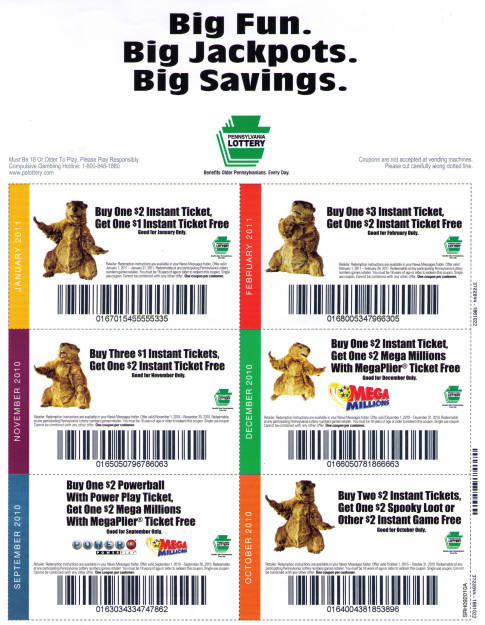
PA Lottery Coupons

       Seriously? Someone at the Pennsylvania Lottery must be playing a joke. Big Savings? Let me get this straight. You’re going to use a coupon to buy a lottery ticket, and that’s going to bring you big savings? Let’s think about this just a bit.

What Are Your Chances of Winning?

       Let’s use the September coupon for our example. This coupon gives you one $2 Mega Millions with MegaPlier ticket for free if you buy one $2 Powerball with Power Play ticket. Basically, this is just one set of numbers because a regular ticket costs $1 for one play and the Power Play (or MegaPlier) doubles the cost of the ticket.

       The Pennsylvania Lottery’s website says your overall chances of winning a prize with a Powerball ticket are 1 in 35.11.

       We can figure out your chances for winning any of the specific prizes with some simple math. If your chances of winning a prize are 1 in 35.11, that means you have a 2.8482% chance ((1/35.11)*100) of winning every time you play Powerball. (Not very good, huh?) Basically, you can only expect to win something once out of every 35 tickets you buy. But that doesn’t tell us how much the ticket is really worth because your prize can range from $3 to $14,000,000 (or $6 to $14,000,000 if you buy the Power Play option) given the current jackpot. To figure out the value of your ticket, we’ll need to do a little more math.

What’s Your Ticket Really Worth?

       By using the odds given for each specific prize level, we can figure out the average prize for a winning ticket. Overall, you have a 2.8482% chance to win on any given ticket. You can use the same process to figure out your chances of winning a given prize. For example, the Pennsylvania Lottery website says you have a 1 in 61.73 chance of winning the lowest prize of $3. That’s a 1.61996% chance ((1/61.73)*100) of winning $3 on any given ticket. Since you have a 2.8482% chance of winning any prize, you’d expect a little more than half of your winning tickets to have a $3 prize. (The math is simple: 1.61996/2.8482 = 0.568766 * 100 = 56.8766%.)

       Continuing this process for each prize level, we can figure out your chances of winning a specific prize any time you have a winning ticket. This table shows those chances for a regular Powerball winning ticket.

Match Prize Chance of Winning This Prize on a Winning Ticket
5 Numbers + Powerball Jackpot (currently $14,000,000) 0.000018%
5 Numbers $200,000 0.0006833%
4 Numbers + Powerball $10,000 0.0048552%
4 Numbers $100 0.1845%
3 Numbers + Powerball $100 0.2573%
3 Numbers $7 9.7787%
2 Numbers + Powerball $7 4.4604%
1 Number + Powerball $4 28.4363%
Powerball Only $3 56.8772%

       Now we can figure out the value of a winning ticket simply by multiplying the prize by your chance of getting that prize on any given winner. Doing that tells us that the average winning ticket for regular Powerball is worth $7.65 ($8.65 – $1.00 for playing). Adding the Power Play to the mix changes the prize values, so the average winning ticket for Powerball plus Power Play is worth $24.04 ($26.04 – $2 for playing). (And technically, it would be worth a little less than that because there’s always the chance you might have to split the jackpot with someone else. But I don’t feel like finding the stats on that or doing the math.)

       That leads us to the next question. If the average winning ticket is worth $7.65 (or $24.04 for Power Play), then what is the average ticket worth? You only have a 2.8482% chance of winning that $7.65 (or $24.04). We need to take into account the cost of your losing tickets, which you’ll have 97.1518% of the time. Remember, you have to buy 35.11 tickets before you can expect to have a winning ticket (based on the odds). That leaves you with 34.11 losing tickets. If you’re playing regular Powerball, you’ll need to spend (that is, lose) $34.11 to win $7.65. If you’re playing Powerball with Power Play, you’re looking at a cost of $68.22 to win $24.04.

       Our last bit of math will tell us the average value of any given ticket. Let’s check regular Powerball first. On average, you’ll spend $34.11 to win $7.65 leaving you with an overall loss of $26.46. Divide that by the total number of tickets you had to buy (35.11) and you’ll find that the average regular Powerball ticket is worth -$0.75. To put it another way, instead of buying a $1 Powerball ticket you might as well throw three quarters in the trash. (Oh wait, I forgot…the Pennsylvania lottery benefits older residents – every day. So maybe you should just donate the three quarters instead.)

       What about Powerball plus Power Play? It certainly looks like a more attractive value proposition at first glance since the average winning ticket is worth so much more. On average, you’ll spend $68.22 to win $24.04 leaving you with an overall loss of $44.18. So that means the average Powerball plus Power Play ticket is worth -$1.26. This time, instead of donating three quarters rather than buy a Powerball plus Power Play ticket you should donate five quarters! In terms of absolute dollars, you lose more with Power Play but the % loss is better than regular Powerball. (In regular Powerball, you lose 75% of your money forever. With Power Play, it’s “only” 63%. Granted, it starts looking a little better when the jackpot is very large, but your chances of splitting the prize increase as more people buy tickets. This means the lottery is always going to be a losing bet.)

       Let’s put this all into a little perspective. Buying a Powerball lottery ticket would be the equivalent of getting a $10,000 gift, going out into your back yard, and then proceeding to burn $7,500 of it for “fun”. Big Fun – according to the Pennsylvania Lottery.

You Want Big Savings? I’ll Show You Big Savings.

       I’m not going to take the time to prove that the lottery (in any form) is a waste of your money. You can simply look at the July 2009 – June 2010 annual income and expense report from the Pennsylvania Lottery to see that they only end up paying out about 61% of their total sales to winners. Talk about a great business! I’d take a 30% net profit margin any day. (The other 9% goes to other expenses.)

       Looking at those numbers from the other end, we see that lottery players as a whole are buying something with a guaranteed return of -39%! You want big savings? Here’s a thought. Stop paying the poor people’s tax.

Don’t play the lottery!