Archives For Personal Finance Bible Study

       In the last part of this series, we started talking about the results of following God’s teaching on contentment. How will contentment benefit you, and what kind of effects will it have on your life? We’ll finish that discussion and this entire series on contentment today.

       Paul speaks about contentment in two specific ways that clearly show the results of being content. First, he talks of facing every situation with contentment. Second, he discusses how contentment brings great gain and saves us from many sorrows.

The Secret to Happiness

       In Philippians 4:10-14, Paul thanks the church at Philipi for the gifts they gave him. He explains that he’s not trying to get them to give more, since he has never been in need because he’s learned to be content in any situation through God’s strength. But he thanks them just the same.

       10 But I rejoice in the Lord greatly, that now at length you have revived your thought for me; in which you did indeed take thought, but you lacked opportunity. 11 Not that I speak in respect to lack, for I have learned in whatever state I am, to be content in it. 12 I know how to be humbled, and I know also how to abound. In everything and in all things I have learned the secret both to be filled and to be hungry, both to abound and to be in need. 13 I can do all things through Christ, who strengthens me. 14 However, you did well that you shared in my affliction.

Philippians 4:10-14 (WEB)

       These verses highlight the striking difference between God’s kind of contentment and the world’s kind of contentment. We generally view contentment and happiness as something we get after some certain requirements are met.

When I get that new car, I’ll be happy.
 
When I get promoted and start making more money, I’ll be set.
 
When I can move to a nicer neighborhood, then I’ll be content.
 
When I retire, life will really start to get better.

       From the world’s perspective, contentment is almost always something that comes in the future. But the contentment God wants to give us is for the past, present, and future. It’s not for just the good times but the bad also. God’s contentment brings us happiness and peace in any situation. The world’s contentment only happens when everything’s turning up roses.

       How is it possible that we can learn to be content in any and every situation that comes our way? How can we possibly be content if we have to drive a beat up, old car to a dead-end job just so we can pay the rent on our drafty apartment? And that’s where we make our first mistake. We don’t have to do anything. God has already handled it all for us.

       All we really have to do is realize two simple things. First, there is nothing worthwhile that the world can offer us when compared to the blessings God has already given us. We have eternal life in Christ. What does it matter if we’re not wearing Armani suits and driving BMWs while we’re here on Earth? Second, Christ will give us the strength we need to make it through any situation we encounter—we are not alone in our struggles. We can be happy in every circumstance because God is with us and our standing in this life does not matter in our eternal life.

Contentment Is Wealth

       The next passage I want to look at is 1 Timothy 6:3-16. Paul is speaking to Timothy here, giving him instructions on how to lead a godly life and teach others the way as well.

       3 If anyone teaches a different doctrine, and doesn’t consent to sound words, the words of our Lord Jesus Christ, and to the doctrine which is according to godliness, 4 he is conceited, knowing nothing, but obsessed with arguments, disputes, and word battles, from which come envy, strife, insulting, evil suspicions, 5 constant friction of people of corrupt minds and destitute of the truth, who suppose that godliness is a means of gain. Withdraw yourself from such.

       6 But godliness with contentment is great gain. 7 For we brought nothing into the world, and we certainly can’t carry anything out. 8 But having food and clothing, we will be content with that.

       9 But those who are determined to be rich fall into a temptation and a snare and many foolish and harmful lusts, such as drown men in ruin and destruction. 10 For the love of money is a root of all kinds of evil. Some have been led astray from the faith in their greed, and have pierced themselves through with many sorrows.

       11 But you, man of God, flee these things, and follow after righteousness, godliness, faith, love, patience, and gentleness. 12 Fight the good fight of faith. Lay hold of the eternal life to which you were called, and you confessed the good confession in the sight of many witnesses. 13 I command you before God, who gives life to all things, and before Christ Jesus, who before Pontius Pilate testified the good confession, 14 that you keep the commandment without spot, blameless, until the appearing of our Lord Jesus Christ; 15 which in its own times he will show, who is the blessed and only Ruler, the King of kings, and Lord of lords; 16 who alone has immortality, dwelling in unapproachable light; whom no man has seen, nor can see: to whom be honor and eternal power. Amen.

1 Timothy 6:3-16 (WEB)

       This is a clear message against the “Prosperity Gospel” that’s so prevalent today and was apparently widespread in the time of the early Church as well. So many people see God as a means to get rich in this life by preying on others, and they preach that God will bless us with material wealth if we’ll just call in right now and give them some money for “God’s work”. Others preach that God will bless us abundantly if we give more money to our church, or that we can’t really receive God’s full blessing unless we’re giving a full tithe (ten percent) to our church.

       But you see, God is not so much concerned about whether we’re blessed in our earthly life. He wants to see us blessed in our eternal life. God has already blessed us abundantly by giving us His Son so that we can live with Him in Heaven. How much money we have or how comfortable we are here on Earth matters very little when we bring eternity into the picture.

       And God has abolished these rules of “you do this, and I’ll give you that”. For those who are living in Jesus Christ, there is no law saying we must give 10% of our income to the church. We try to impose rules and laws for God and end up missing the entire point. When Christ came and taught the Jews, he spoke with authority about the laws of Moses. What did He teach? That God doesn’t just want us to meet some minimums and go home from church thinking we’re good to go for the next week. No, when Jesus taught about the laws he told us to do much more than the laws tell us to do. We’re supposed to go above and beyond the expectations we think we’re supposed to meet. So while I’m in no way against giving generously to your church or the needy, I am 100% against teaching Christians that the tithe is a requirement they must all meet. But we’ll look at this more when we discuss giving.

       We also see here the famously misquoted scripture about money being the root of all kinds of evil. People often leave out the “love of” part, thus changing the meaning dramatically. Money in and of itself is not evil—it is just a thing, a tool to be used. But the love of money takes our focus off God and leads us into all kinds of evil things. Again, it comes back to whether or not our hearts belong to God. If our hearts belong to God, we will serve and glorify Him in all things. If they belong to money, we will never be able to please God and will always be led astray. Paul tells Timothy, and all Christians, to run from all these evil things and not let the love of money take over our lives.

       I’ve gotten sidetracked a bit, but those were important points. What this passage means for the results of contentment lies in verses six through ten. Godliness is not a means to financial gain, but true godliness with God’s contentment provides us with great wealth. First, we receive spiritual wealth because contentment allows us to remain focused on God and ignore worldly materialism.

       Second, we receive great material wealth through contentment because we’ll “need” less. When we are content and need less “stuff”, we don’t need to be as rich or make as much money to be happy. That is to say, we don’t have to be as focused on making money or building wealth if we can be happy living on $25,000/year versus $50,000 or $75,000/year. Once we learn to be content in any situation through God’s strength, what used to seem like so little becomes great wealth because we just don’t need as much. Despite what numerous websites and scammers may claim, the best way to get rich quick is to be content.

       The point is this: contentment and godliness together give us great gain because we will be blessed spiritually by being more focused on God and materially because we’ll just “need” less of the world’s “stuff”. Though it’s strange to hear and difficult to believe (from a worldly perspective), learning to be content with whatever situation you’re in by relying on God can make you richer than Bill Gates and Warren Buffet combined.

Want to read the entire Bible study series on Contentment? Download your free copy of Contentment Is Wealth: A Bible Study on Contentment now!

       In the last part of this series, we finished talking about practical applications when we take on God’s View of the World, Money, and our lives. We looked at how we should act and what we should do when we take on God’s View and live out His will. Today, we’ll start talking about the results of following God’s teaching on contentment. How will contentment benefit you, and what kind of effects will it have on your life?

Delighting God

       When our focus is no longer on wealth and material things but fully centered on God, we can begin to please Him. It’s amazing to think that despite our weaknesses and shortcomings we can still manage to please the Creator of the entire universe by simply learning to be content and centering our lives around Him.

   23 Thus says Yahweh,
       “Don’t let the wise man glory in his wisdom,
       neither let the mighty man glory in his might,
       don’t let the rich man glory in his riches;

       24 but let him who glories glory in this,
       that he has understanding, and knows me,
       that I am Yahweh who exercises loving kindness,
       justice, and righteousness, in the earth:
       for in these things I delight,” says Yahweh.

Jeremiah 9:23-24 (WEB)

       It’s nearly unthinkable that we can delight God, but we really can delight Him when we talk more about His goodness and our relationship with Him than our wealth or accomplishments.

Enjoying Life

       In Ecclesiastes, Solomon experiences all the things the world tells us will make us happy—power, wealth, and pleasure. He reflects on his experience and realizes all the things the world recommends are quite meaningless. He also reflects on what he sees in the world, and most of his learning about the best things in life is summed up by Ecclesiastes 8:15.

       15 Then I commended mirth, because a man has no better thing under the sun, than to eat, and to drink, and to be joyful: for that will accompany him in his labor all the days of his life which God has given him under the sun.

Ecclesiastes 8:15 (WEB)

       Now, Solomon is not recommending that we all “eat, drink, and be merry” as the world understands it. He’s commending the enjoyment of life, which is really what contentment boils down to. When we’re content in any situation and learn to value God and His ways above all else, we can find true joy in life that will stay with us always.

       The joy of contentment in God can keep us happy and optimistic no matter what happens to us because it’s founded on Him. The eternal power and truth of God can overcome any situation, allowing us to fully enjoy life and realize our blessings even in the worst circumstances. And learning to be content in every situation can give us joy that lasts throughout our entire lives—unlike wealth, which is so uncertain and may not last through tomorrow.

A Strong Tower

       Throughout the Bible, we see a continual reference to God as a strong tower and mighty fortress. He protects those who trust in Him, and His strength overcomes all obstacles. When we are content with God’s provision, blessing, and His gift of eternal life through Jesus Christ, we have the ultimate protection from any worldly disaster. Poverty, sickness, economic depressions, death, stock market crashes, natural disasters, job loss—none of them can hurt us because we will always have eternal life in Jesus. Despite what the world says, it just doesn’t matter what happens to us in this life. Nothing can ever separate us from the love of Jesus.

       Do I mean that God will protect us from all these things? Not at all. Terrible things happen to Christians all the time and they really test our faith. But if we weigh the worst tragedy against the fact that we have been saved by Christ, we’ll always see that we are truly blessed. God keeps us safe through all things because He has given us eternal security through Jesus. Wealth can never do that.

   10 The name of Yahweh is a strong tower:
   the righteous run to him, and are safe.

   11 The rich man’s wealth is his strong city,
   like an unscalable wall in his own imagination.

Proverbs 18:10-11 (WEB)

       We like to imagine wealth will protect us from all the bad things in life and give us access to all the good things in life. What we don’t realize is that we are just imagining that it can do all those things. Wealth can only protect you so much, and it can only give you the things that the world says are good. But there’s no guarantee that your wealth will be there when you really need it.

       There is only one guarantee, and there’s only one way we can find true safety in life. Trusting in God and finding contentment in what He’s blessed us with—whether little or much—will provide us with a strong tower capable of withstanding anything that might come our way. Contentment in God gives us joy that lasts as long as we live rather than a little pleasure for a fleeting moment.

       The truth is that money and things can never give us the happiness and security we’re seeking. God has already given us all the happiness and joy we could ever need—we just need to look at our lives through His eyes. Once we start doing that, we’ll see how truly rich we already are.

Want to read the entire Bible study series on Contentment? Download your free copy of Contentment Is Wealth: A Bible Study on Contentment now!

       In the last part of this series, we continued talking about practical applications when we take on God’s View of the World, Money, and our lives. How should we act and what should we do when we take on God’s View and live out His will? We’ll finish that discussion today, and in the next part of the series we’ll start talking about the results of following God’s teaching on contentment.

       Proverbs has tons of great personal finance advice, but Proverbs 23:4-5 has a very practical application for our lives—especially today.

   4 Don’t weary yourself to be rich.
   In your wisdom, show restraint.

   5 Why do you set your eyes on that which is not?
   For it certainly sprouts wings like an eagle and flies in the sky.

Proverbs 23:4-5 (WEB)

       When we look at the world around us, we can see people everywhere wearing themselves out trying to get rich. And how many families have been torn apart because of an obsession with work? How many people have committed suicide because they lost their wealth? We have to be wise enough to know when to quit—when enough is enough.

Bald Eagle by Velo Steve on Flickr       Worldly wealth can be quite fickle. It’s temporary (even if it lasts your entire life), faulty, and can disappear very quickly. I’m sure we all know of cases where money has come and gone quite easily. That’s the problem with worldly wealth. While we think we’ll get security if we have enough of it, the truth is that it’s built on a weak foundation and can’t provide the things we really need. Even if it gets us through our old age, we can’t do much with it once we’re dead.

       This is why Jesus tells us to focus on heavenly treasure and God’s kingdom. Unlike worldly wealth, these things are permanent. They’re built on a foundation stronger than any we’ve ever known. The lasting treasure we pile up in heaven will always provide for us during this life. And when we’ve passed on, we’ll still have all of it. No matter what happens to us, we can never lose the treasure of God’s love living in us. We might not be rich and famous, but we’ll always have the invaluable gift of eternal life.

       Paul mirrors the wisdom of this proverb in his instructions to Timothy for the rich:

       17 Charge those who are rich in this present world that they not be haughty, nor have their hope set on the uncertainty of riches, but on the living God, who richly provides us with everything to enjoy; 18 that they do good, that they be rich in good works, that they be ready to distribute, willing to communicate; 19 laying up in store for themselves a good foundation against the time to come, that they may lay hold of eternal life.

1 Timothy 6:17-19 (WEB)

       Wealth makes it easy for us to become arrogant and stop trusting in God. We gain a false sense of security, because the truth is that worldly wealth is very uncertain. But when we place our trust wholly in God, He provides everything we need. God can give us joy that we can’t get from anything else on Earth. His joy lets us see the true value of things in our life, and His love working through us makes our lives much more valuable than any amount of money ever will.

       Paul’s very practical advice is that we should use money to do good—not to store it up and trust in it. We should focus on doing good things for other people in the service of God. We should be generous and always ready to share. This is the essence of God’s view on contentment—that we should not be obsessed with things or wealth or status, but that we should always be ready to do good, to love others, to share what we have, and to always trust that He will provide everything we need.

       Contentment means that we stop being obsessed with buying that new iPod, but instead we give that money to the hungry.

Give us this day... by Mr. Kris on Flickr

(Click the picture to read about the tragedy of hunger in our world.)

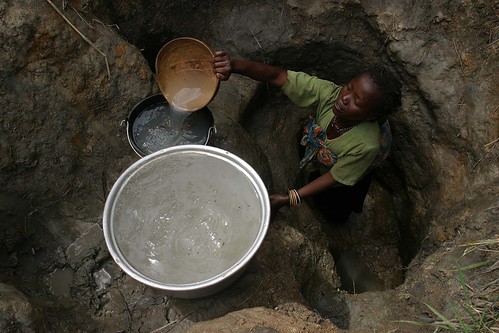
       It means that we drive our old car a little longer, so that we may be able to give clean water to the thirsty.

Woman with child collecting water by hdptcar on Flickr

       It means we live in a smaller home, so that we can provide shelter for those that have no place to stay warm or out of the rain.

Homeless by Henrique Vicente on Flickr

       It means that we stop spending so much time working and pursuing wealth, so that we can spend time building relationships with our family, our friends, our neighbors, complete strangers, and even our enemies.

Relationship by Smile My Day on Flickr

       Fully pursuing contentment means that we totally trust in God for His providence, and we stop worrying about what’s going to happen in the economy.

       And what do we get for all of this? A good foundation of heavenly treasure that lasts for eternity, and the ability to experience true life rather than that illusion of the “good life” that’s fed to us every day. Contentment allows us to live out a true life in Jesus and to fully experience His love, mercy, grace, and forgiveness.

Want to read the entire Bible study series on Contentment? Download your free copy of Contentment Is Wealth: A Bible Study on Contentment now!
       In the last part of this series, we continued talking about practical applications when we take on God’s View of the World, Money, and our lives. How should we act and what should we do when we take on God’s View and live out His will? We’re still continuing that discussion today.

       How does God want us to deal with our circumstances? Paul provides us with some insight in 1 Thessalonians 5:16-18:

       16 Rejoice always. 17 Pray without ceasing. 18 In everything give thanks, for this is the will of God in Christ Jesus toward you.

1 Thessalonians 5:16-18 (WEB)

       I’ve talked about 1 Thessalonians 5:16-18 before, so I won’t go into as much depth here. This passage clearly sets out God’s expectations for how we should live, regardless of our circumstances. We are to always rejoice, pray without ceasing, and give thanks in everything. God wants our lives focused on the Gift He has given us, becoming closer to Him, and enjoying the good things He has blessed us with. There’s no room for greed or materialism when our hearts are focused on those things. That’s God’s will for us—that we’re focused on Him instead of this world.

       So we know by now we shouldn’t be focused on material things or amassing great wealth, but we still have needs while we’re living on Earth. What should we ask God for, and how much of it should we request? Agur gives us some good guidelines in Proverbs 30:8-9.

     8 Remove far from me falsehood and lies.
     Give me neither poverty nor riches.
     Feed me with the food that is needful for me (my daily bread);

     9 lest I be full, deny you, and say, ‘Who is Yahweh?’
     or lest I be poor, and steal,
     and so dishonor the name of my God.

Proverbs 30:8-9 (WEB)

Our Daily Bread by ms. Tea on Flickr       Agur asks God for his daily bread—just enough. If we have too much, we become inclined to believe we did it all ourselves and begin to deny even the existence of God. It is very easy to start relying on our wealth more than we rely on God. We get too focused on our material well-being and no longer see the need for God in our lives, so we disown Him and pretend He doesn’t exist. On the other hand, if we have too little we may become inclined to steal. This would dishonor God because it is sin—against God for not trusting in Him and against our neighbors for not loving them.

       This idea of our daily bread should be quite familiar to most Christians. It’s part of the Lord’s Prayer—Jesus’ example of how we ought to pray and where our hearts should be focused when we pray. Jesus wanted us to realize that this request for our daily bread is important. Asking God for just enough, being modest and content, and not letting materialism rule our lives—these are the things that allow us to honor God sincerely in our lives. It is such an important concept that Jesus included it in His example for prayer (not to mention all the time He spent telling parables and teaching about contentment and a focus on heavenly treasures).

       We see two main practical applications here. First, we should be content with our circumstances because it is God’s will for our lives. If we’re focused on the gift of eternal salvation, we don’t have to be as worried about the things of this world. We’re free to be joyful always, pray continually, and give thanks in all circumstances. Second, we should be asking God for just enough to get by each day—not for millions of dollars, or a huge house, or a BMW—just our daily bread. We bring nothing into this world, and we won’t take anything out when we leave it. This is why Paul says we should be content if we have food and clothing (1 Timothy 6:8). That’s all we really need to get by (though a warm shelter is nice as well, it’s not completely necessary). When we start worrying about getting more than that, we take our focus off of God and put it back onto the World. And that’s a sure way to keep ourselves from fully serving God.

Note: I do not mean that we should completely neglect our material needs, but it’s all about where our hearts are focused. Wherever your treasure is, that’s where your heart will be also. So if you’re consumed with thinking about material things and wealth, your heart can’t really belong to God. That’s the only true sin, because once God gets your heart He’ll get everything else with it. It’s all He really needs from us—and that’s why it’s so vitally important that we don’t give our hearts to materialism.

Want to read the entire Bible study series on Contentment? Download your free copy of Contentment Is Wealth: A Bible Study on Contentment now!

       In the last part of this series, we started talking about practical applications when we take on God’s View of the World, Money, and our lives. How should we act and what should we do when we take on God’s View and live out His will? We’re continuing that discussion today.

       Without God’s View, we tend to worry—a lot. Even after we begin to fully follow Him, we still worry. Why do we worry? Because we haven’t begun to rely on God and trust in His goodness. But in Luke 12:22-31, Jesus tells us not to worry about worldly cares:

Do Not Worry

       22 He said to his disciples, “Therefore I tell you, don’t be anxious for your life, what you will eat, nor yet for your body, what you will wear. 23 Life is more than food, and the body is more than clothing. 24 Consider the ravens: they don’t sow, they don’t reap, they have no warehouse or barn, and God feeds them. How much more valuable are you than birds! 25 Which of you by being anxious can add a cubit to his height (or an hour to your life)? 26 If then you aren’t able to do even the least things, why are you anxious about the rest?

       27 Consider the lilies, how they grow. They don’t toil, neither do they spin; yet I tell you, even Solomon in all his glory was not arrayed like one of these. 28 But if this is how God clothes the grass in the field, which today exists, and tomorrow is cast into the oven, how much more will he clothe you, O you of little faith? 29 Don’t seek what you will eat or what you will drink; neither be anxious. 30 For the nations of the world seek after all of these things, but your Father knows that you need these things. 31 But seek God’s Kingdom, and all these things will be added to you.”

Luke 12:22-31 (WEB)

This passage is also found in Matthew 6:25-34.

Lily by Per Ola Wiberg (Powi) on Flickr       We can spend a lot of time worrying about the what-ifs in our life. What if I lose my job? What if I get a terminal illness? What if I can’t retire? What if I die? But do we help anything by fretting over these things that may never happen? Even if they do happen, is there anything we can do to stop them from happening? In truth, there’s little good that can come from worrying, so why do it?

       Instead of worrying about all possible future disasters, we should be focused on only one thing: seeking God’s kingdom. God knows what our needs are, and He will take care of us. Once we begin to rely on God and trust in His goodness, we can allow Him to provide the things we need. But until we let God change our hearts so we can fully trust Him, we will be so preoccupied with worry that we won’t be able to seek His kingdom and see His blessings in our lives.

       Does this mean we shouldn’t plan ahead for anything, or that we shouldn’t save for emergencies? Not at all. But it does mean that we shouldn’t be so worried about the cares of this life that we’re prevented from fully pursuing God’s kingdom. We should be so intensely focused on serving God and serving others that our worldly needs rarely cross our minds.

       Once we fully trust in God’s providence, we can begin to see that we have nothing to fear in this life. There are no worries to concern ourselves with when we’re fully resting in the Father’s arms.

       5 Be free from the love of money, content with such things as you have, for he has said, “I will in no way leave you, neither will I in any way forsake you.” 6 So that with good courage we say, “The Lord is my helper. I will not fear. What can man do to me?”

Hebrews 13:5-6 (WEB)

       God has promised that He will never leave or forsake us. He is always there to help us, and He always will be. We may not always understand how He’s working in our lives, and we may not see Him when He’s by our side. But He has promised that He will always take care of us. With a promise like that from the Creator of the entire universe, what do we really have to fear? What can we possibly worry about? God is in charge, and He’s taking care of everything for us.

       So how do we use this practically? Realize that once you fully submit yourself to God and His will for your life, He will take care of all your needs. Plan for what you know (like retirement and random emergencies). Take control of the things you can actually control (like your spending and attitude, not the economy or the government). And leave the rest to God. If you belong to God, what can happen to you in this life that can ruin you forever? Even death has no power, because once you die you’ll be with God for eternity. The presence of God is the only thing we need ever concern ourselves with in this life.

Want to read the entire Bible study series on Contentment? Download your free copy of Contentment Is Wealth: A Bible Study on Contentment now!

       In the last part of this series, we finished looking at God’s View of the World, Money, and our lives so we can start to focus on serving Him instead of serving Money. Today we’re going to start talking about practical applications. How should we act and what should we do when we take on God’s View and live out His will?

       The scripture today comes from Luke 6:20-38, and we’ll be looking at it in three parts. The first part we’ll look at is Luke 6:20-26:

The Beatitudes

   20 He lifted up his eyes to his disciples, and said,
   “Blessed are you who are poor,
   for yours is the Kingdom of God.

   21 Blessed are you who hunger now,
   for you will be filled.
   Blessed are you who weep now,
   for you will laugh.

   22 Blessed are you when men shall hate you, and when they shall exclude and mock you, and throw out your name as evil, for the Son of Man’s sake. 23 Rejoice in that day, and leap for joy, for behold, your reward is great in heaven, for their fathers did the same thing to the prophets.

   24 But woe to you who are rich!
   For you have received your consolation.

   25 Woe to you, you who are full now,
   for you will be hungry.
   Woe to you who laugh now,
   for you will mourn and weep.

   26 Woe, when men speak well of you,
   for their fathers did the same thing to the false prophets.”

Luke 6:20-26 (WEB)

       God doesn’t want us worried about our situation in this life. Even if we’re poor, hungry, and hated by men, we have an eternal reward in Heaven. Once we start keeping that in the front of our minds, we can see that we really are blessed, apart from our outward condition, and we are to be envied among men. Wealth and happiness in this life are only temporary rewards. If we focus on having those things in this life instead of being true to God, then we’ll have already received our reward.

       So what’s the practical application here? Stop worrying about your wealth, pantry, and reputation as men view those things, and instead focus on being rich in good works, full of God’s Word, and true to God’s will.

       The next part we’ll look at is from Luke 6:27-36:

Love for Enemies

       27 “But I tell you who hear: love your enemies, do good to those who hate you, 28 bless those who curse you, and pray for those who mistreat you. 29 To him who strikes you on the cheek, offer also the other; and from him who takes away your cloak, don’t withhold your coat also. 30 Give to everyone who asks you, and don’t ask him who takes away your goods to give them back again.

31 As you would like people to do to you, do exactly so to them. 32 If you love those who love you, what credit is that to you? For even sinners love those who love them. 33 If you do good to those who do good to you, what credit is that to you? For even sinners do the same. 34 If you lend to those from whom you hope to receive, what credit is that to you? Even sinners lend to sinners, to receive back as much. 35 But love your enemies, and do good, and lend, expecting nothing back; and your reward will be great, and you will be children of the Most High; for he is kind toward the unthankful and evil. 36 Therefore be merciful, even as your Father is also merciful.”

Luke 6:27-36 (WEB)

       While this section has very little to do with personal finance (apart from giving), it does show us just how different our lives will be if we take on God’s View of the World, Money, and our lives. Jesus is telling us here that instead of being focused on wealth and plenty in this life we should live out these few instructions. I think Jesus is showing us that contentment acted out in life ends up focused more on doing good and showing love than earning money and gaining wealth. I’ll let you contemplate how this applies to your own life, but it’s a good example of what actions and thoughts should replace our desire and efforts for wealth.

       Finally, we’ll look at Luke 6:37-38:

Judging Others

       37 “Don’t judge, and you won’t be judged. Don’t condemn, and you won’t be condemned. Set free, and you will be set free. 38 Give, and it will be given to you: good measure, pressed down, shaken together, and running over, will be given to you. For with the same measure you measure it will be measured back to you.”

Luke 6:37-38 (WEB)

       Jesus tells us we’ll be greatly rewarded if we follow His teaching. Many take this to mean material rewards (a.k.a. the Prosperity Gospel), but I’m fairly certain Jesus is speaking in terms of spiritual and eternal rewards. If we are truly content and focused on God’s ways, are we going to care about being greatly rewarded in this life? Not at all—we’ll realize we already have a great reward in Heaven with Jesus. But think of the great reward we could have in this life if everyone took Jesus’ teaching to heart and lived it out. Can you imagine the peace, calm, and happiness we would all have if this happened? Now that would be a great blessing indeed!

Want to read the entire Bible study series on Contentment? Download your free copy of Contentment Is Wealth: A Bible Study on Contentment now!

       In the last part of this series, we continued looking at God’s View of the World, Money, and our lives so we can start to focus on serving Him instead of serving Money. We’re finishing that discussion today, and we’ll start talking about practical applications in the next part of this series.

       In David’s prayer to God after the Israelites’ freewill offering for the building of the temple, we see an excellent example of God’s View of the World, Money, and our lives:

       10 Therefore David blessed Yahweh before all the assembly; and David said, “You are blessed, Yahweh, the God of Israel our father, forever and ever. 11 Yours, Yahweh, is the greatness, the power, the glory, the victory, and the majesty! For all that is in the heavens and in the earth is yours. Yours is the kingdom, Yahweh, and you are exalted as head above all. 12 Both riches and honor come from you, and you rule over all; and in your hand is power and might; and it is in your hand to make great, and to give strength to all. 13 Now therefore, our God, we thank you, and praise your glorious name.

       14 But who am I, and what is my people, that we should be able to offer so willingly as this? For all things come from you, and of your own have we given you. 15 For we are strangers before you, and foreigners, as all our fathers were. Our days on the earth are as a shadow, and there is no remaining. 16 Yahweh our God, all this store that we have prepared to build you a house for your holy name comes from your hand, and is all your own.

       17 I know also, my God, that you try the heart, and have pleasure in uprightness. As for me, in the uprightness of my heart I have willingly offered all these things. Now have I seen with joy your people, that are present here, offer willingly to you. 18 Yahweh, the God of Abraham, of Isaac, and of Israel, our fathers, keep this forever in the hearts of your people, and prepare their heart for you.

1 Chronicles 29:10-18 (WEB)

       David recognizes the awesome power of God. God is the ruler of all things, creator of all things, owner of all things, and giver of all things. We are truly nothing in comparison to all of God’s glory. Our very few days on Earth (when compared to God’s eternity) are but a shadow. We must remember that we have not created all we have—it all comes from God.

       The second part of David’s prayer has some especially good points to keep in mind in our giving. First, everything we have comes from God, so when we give we’re really only giving what is already God’s. Second, we must give willingly and honestly to truly bring joy to God. He doesn’t want our Money for the sake of having our money. A willing offering is a sign of complete loyalty to God—it shows that our heart belongs to God and not Money.

       If a willing and honest desire to give back to God in thanks for His goodness, mercy, and glory is not in your heart, pray that God will help change your heart and focus your mind on His ways. If you already have a willing and honest desire to give, pray that God will keep that desire in your heart forever and that He will keep your heart loyal to Him.

       To view everything as belonging to God, to view contentment as the ultimate path to wealth, and to give God all praise and glory are ideas that go against our human nature and the ways of society. It may be difficult to take on God’s View and live it out because it will seem like foolishness to many people. But consider what Jesus said in Matthew 16:26:

       26 “For what will it profit a man, if he gains the whole world, and forfeits his life? Or what will a man give in exchange for his life?”

Matthew 16:26 (WEB)

This passage is also found in Luke 9:25.

       What good will millions of dollars do for you if you lose your soul in the process? How much will you care about having a nice car and a nice home if it means you have severed your relationship with Christ? Is there anything in this world that’s really worth eternal separation from God?

       It’s so easy to let Things creep into our lives and put up a barrier between us and Jesus. Sometimes it happens without our realizing it. But we have to remember that nothing is worth more than our life in Christ. When the Things of this World seem to start taking priority over your faith, step back for a moment and consider: Is it worth it?

Want to read the entire Bible study series on Contentment? Download your free copy of Contentment Is Wealth: A Bible Study on Contentment now!