Archives For Investing

How Compound Interest Works

Corey —  January 12, 2010

       To get a small fortune, you have two options:

  1. Start with a large fortune.
  2.  
    OR
     

  3. Use the power of compound interest (or returns).

       I don’t have any good tips on how to start life with a large fortune, but I can tell you about compounding and how it works.

Simple Interest

       First, you need to understand simple interest. Simple interest is just a flat interest rate paid only on your initial deposit year after year. Let’s say you’ve got a bond that pays you 8% simple interest. If you buy $100 worth of that bond, you’ll get $8 in interest for the first year. Then, because this is simple interest, you’re going to get $8 in interest every year after that until the bond is repaid (and you get your original $100 back). Here’s what it looks like on a chart:
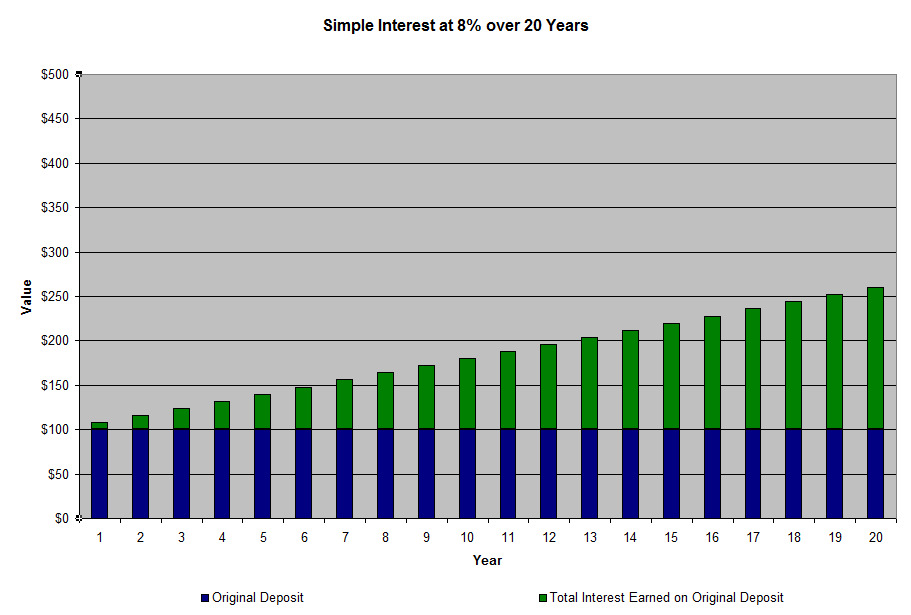


       With simple interest, you’re only earning interest on your principal (or your deposit). You’ll get $8 every single year. You never earn interest on interest. At the end of 20 years, you’ll have your initial $100 plus $160 you earned from interest.

Compound Interest

       Compound interest lets you earn interest on your principal (what you start out with), but you also earn interest on interest you’ve already been paid. We’ll keep the same assumptions as before – you earn 8% interest and you start out with $100 – but this time we’ll be using compound interest.

       At the end of the first year, you’ll still only earn $8 in interest ($100 * 0.08). But at the end of the second year, you’ll earn a total of $8.64 in interest ($100 * 0.08 + $8 * 0.08). In the third year, you’ll earn $9.33 in interest ($100 * 0.08 + $8 * 0.08 + $8.64 * 0.08). This process keeps continuing and you keep earning more and more interest every year. Here’s what it looks like on a chart:
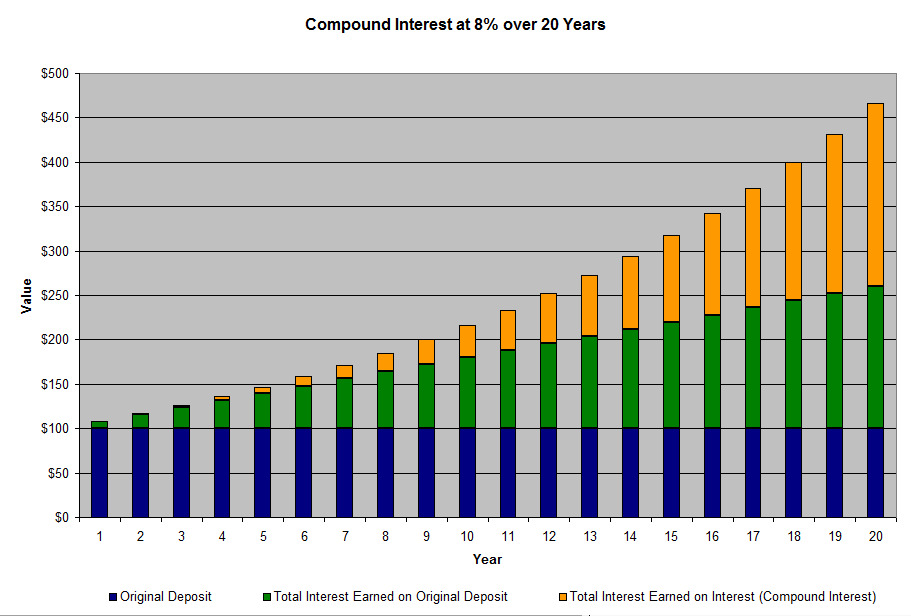


       Compound interest is all about earning interest on interest (and principal). You’re generating earnings from previous earnings. In the example above, you’d have your initial $100 plus $366.10 in interest at the end of 20 years. That’s $206.10 more than what you’d get from simple interest. The only difference between the two is the ability to earn interest on interest.

       Compounding is why it pays to start saving as early as possible. In the first year, you may only get an extra $0.64. But in the twentieth year, compound interest gives you an extra $26.43. The amount of interest you earn on previous interest just keeps growing and growing the longer you go.

       Let’s look at a quick example. Let’s say we have three people who are all going to invest for retirement. They’re all 25 years old, and they’re all looking to retire at age 65. They’re all going to invest $25,000 at one time, but they start at different times. Sue invests her $25,000 today, Bob invests his $25,000 ten years later, and Frank invests his $25,000 ten years after Bob. To keep it simple, we’ll assume they earn 8% every year. Here’s what happens:


       Sue only started ten years before Bob, but she ended up with over $290,000 more than he did. Likewise, Bob started only ten years before Frank, but he ended up with over $135,000 more. The only difference between these three people was how many years they let their money compound. Sue had 40 years, Bob had 30 years, and Frank only had 20 years. Compounding has the most power when you have the most time. That’s why it’s important to start saving early (not just for retirement, but for any goal).

Your Thoughts

       Did these examples help you better understand compound interest? If not, what questions do you still have? Let me know in the comments and I’ll do my best to help you and give a clearer answer.


Not for Itching Ears

Corey —  December 31, 2009

       If you want to hear how the Bible can make you a millionaire, you’re in the wrong place. If you want to hear that you can give 10% and you’ve done your duty to God, you’re in the wrong place. If you want to hear how easy life is going to be as a Christian, you should go do another Google search because you’re not going to find that here.

       Provident Planning is not a place for people with itching ears.

       But if you want to hear the Gospel of Jesus Christ, you’ve come to the right place. If you want to know what the Bible – not man – teaches about money, you’ve come to the right place. If you desire to be a lover of God rather than a lover of money, then I invite you to join me as I seek God’s Truth for personal finances.

       3 For the time will come when they will not listen to the sound doctrine, but, having itching ears, will heap up for themselves teachers after their own lusts; 4 and will turn away their ears from the truth, and turn aside to fables.

2 Timothy 4:3-4 (WEB)

       A lot of the most popular teaching about personal finance for Christians emphasizes how Biblical financial principles can make you rich. This naturally appeals to many people because the love of money is so prevalent in our society. Those who teach how the Bible can make you rich while putting little emphasis on God’s true purpose for those riches are doing nothing but scratching the itching ears.

       God’s Word is not a guide on how to get rich and enjoy all the fine things of the World. God doesn’t want rich Christians to splurge on luxuries while their brothers and sisters die from hunger and thirst. The Gospel is not about how you can prosper in this life. Jesus didn’t die on the cross so you can retire early.

       Jesus warned us of the dangers of greed. He taught us to give generously to anyone in need. He taught us to seek God’s Kingdom first – to make it our top priority in life. All of God’s Word testifies to the fact that our best life will be an eternal life in Heaven – not here on Earth. He has warned us that this life will be full of trials, tribulations, hard times, and difficulties. But He has promised us the most wonderful blessing – eternal life with Him for anyone who believes in His Son, Jesus Christ.

       3 If anyone teaches a different doctrine, and doesn’t consent to sound words, the words of our Lord Jesus Christ, and to the doctrine which is according to godliness, 4 he is conceited, knowing nothing, but obsessed with arguments, disputes, and word battles, from which come envy, strife, insulting, evil suspicions, 5 constant friction of people of corrupt minds and destitute of the truth, who suppose that godliness is a means of gain. Withdraw yourself from such.

1 Timothy 6:3-5 (WEB)

       Many false teachers talk about how God will bless you if you’re a Christian. Or they tell you to send them a love gift or plant a seed and God will pour out miraculous financial blessings for you. These people do not teach the whole Word of God! We are to have nothing to do with those who twist the Scriptures for their own financial gain or teach a gospel different from the one Jesus taught.

       As Christians, we are rich – but you can’t measure our wealth in dollars. We have eternal life with God as our promised reward for faith in Jesus. That reward outweighs anything you can imagine for yourself in this life – and that reward is why contentment and giving should be our primary concerns when it comes to money. Reflect on these words from the Bible:

       6 But godliness with contentment is great gain. 7 For we brought nothing into the world, and we certainly can’t carry anything out. 8 But having food and clothing, we will be content with that.

       9 But those who are determined to be rich fall into a temptation and a snare and many foolish and harmful lusts, such as drown men in ruin and destruction. 10 For the love of money is a root of all kinds of evil. Some have been led astray from the faith in their greed, and have pierced themselves through with many sorrows.

       11 But you, man of God, flee these things, and follow after righteousness, godliness, faith, love, patience, and gentleness. 12 Fight the good fight of faith. Lay hold of the eternal life to which you were called, and you confessed the good confession in the sight of many witnesses. 13 I command you before God, who gives life to all things, and before Christ Jesus, who before Pontius Pilate testified the good confession, 14 that you keep the commandment without spot, blameless, until the appearing of our Lord Jesus Christ; 15 which in its own times he will show, who is the blessed and only Ruler, the King of kings, and Lord of lords; 16 who alone has immortality, dwelling in unapproachable light; whom no man has seen, nor can see: to whom be honor and eternal power. Amen.

       17 Charge those who are rich in this present world that they not be haughty, nor have their hope set on the uncertainty of riches, but on the living God, who richly provides us with everything to enjoy; 18 that they do good, that they be rich in good works, that they be ready to distribute, willing to communicate; 19 laying up in store for themselves a good foundation against the time to come, that they may lay hold of eternal life.

1 Timothy 6:6-19 (WEB)

       So if you want to learn what God says about money and what the Bible teaches about personal finance, then please sign up for free updates to Provident Planning. And if you ever find me teaching anything contrary to the Scripture or the Gospel of Jesus Christ, please contact me and let me know.

       But if you just want someone to tell you the things you want to hear, you’ll have to go somewhere else to get your ears scratched.

       Although I generally love everything about Vanguard, I wish they had an easy way to rebalance your portfolio. Since they don’t, I’ve created this free portfolio rebalancing calculator to make it a bit easier.

       All you have to do is enter your total portfolio value, the current amount of each investment, and your target allocation for each investment. Entering investment names and symbols is optional. I’ve pre-entered the investment names and symbols for the Vanguard funds you’ll find in my free portfolio allocation calculator, but you can use this calculator for any portfolio with up to 20 investments. If you need to figure out how many shares to buy or sell, simply divide the result by the current price per share. (This isn’t necessary when using Vanguard’s website. They let you buy in dollar amounts.)

       The calculator will tell you how much to buy or sell of each investment to reach your target asset allocation. If you’re adding cash to the portfolio, simply add the amount you’re going to deposit to your “Total Portfolio Value”. If you’re planning to withdraw cash from the portfolio, simply subtract that amount from your “Total Portfolio Value”. Then enter everything else like normal.

       Any odd cents will be added to or subtracted from the last investment listed on the spreadsheet. You’re responsible for double-checking the calculator’s results. I can’t fix user error, and I can’t guarantee that this calculator is error-free (though I’m fairly sure it works fine). If you have any questions or suggestions, leave them in the comments below and I’ll try to help you. You’ll want to expand it to full screen view or save it as an Excel file to see everything at once.

*Note: Click the ‘Click to Edit’ button to use the calculator with your own numbers.

       If you’re the least bit interested in investing, I’m sure you’ve heard of ETFs (exchange traded funds) by now. They’re often touted as the lowest-cost option for investors who don’t want to pick individual stocks. Even my beloved Vanguard has begun pushing their ETFs much more than their index mutual funds – citing the lower expense ratios of the ETFs.

       But in all the fanfare about how cheap ETFs are, we seem to lose sight of the fact that you have to pay commissions when you buy or sell ETFs on the stock market. On the other hand, there is no cost to buy or sell mutual funds directly from Vanguard. There’s also the problem of bid/ask spreads on ETFs and premiums/discounts over the NAV (net asset value) of ETFs. I don’t have the data to analyze those costs, and it’s not possible to fully know the impact of those costs (because it depends on future prices as well).

       However, we can ask ourselves if the lower expense ratios on ETFs will offset the trading costs we have to pay to buy and sell them. This is a relatively easy question that just requires some math.

How Often Are You Trading?

       The more frequently you buy or sell ETFs, the more you’ll pay in trading commissions. So if you’re investing a certain dollar amount every month (also called dollar cost averaging), you’re going to pay one commission fee for each ETF in your portfolio every single month. (The same applies if you’re selling every month to generate income from your portfolio, though you probably won’t sell from every single ETF every month.)

       Those trading costs can add up very quickly and easily overcome your savings on the expense ratios.

A Cost Comparison

       Let’s use a simple example to see why you need to carefully consider all the costs involved with ETFs. We’ll assume you’re investing in a 100% stock portfolio that duplicates the world markets. That means you’d have 40% in U.S. stocks and 60% in International stocks. You could do this using Vanguard’s Total Stock Market Index and Total International Stock Index mutual funds. Or you could use Vanguard’s Total Stock Market ETF and FTSE All-World ex-US ETF. Your portfolio expense ratio for a 40% U.S./60% International mix would be:

  • Vanguard Mutual Funds – 0.28%
  •        

  • Vanguard ETFs – 0.19%

       That’s a difference of 0.09% – meaning that you’d save 0.09% of your portfolio value every year if you used Vanguard’s ETFs instead of their Mutual Funds. So what does that mean in dollars? It depends on how much you have to invest.

  • $10,000 to invest = $9 saved per year
  • $25,000 to invest = $22.50 saved per year
  • $50,000 to invest = $45 saved per year
  • $100,000 to invest = $90 saved per year

       This holds true until you have $250,000 invested, because at that point you can get a lower expense ratio on the Total Stock Market Index mutual fund – bringing the total expense ratio for the mutual fund portfolio down to 0.24% and lowering your savings to 0.05%.

  • $250,000 to invest = $125 saved per year
  • $500,000 to invest = $250 saved per year
  • $1,000,000 to invest = $500 saved per year

       So you can see the cost savings isn’t quite as great as the media makes it out to be. Yes, $500 saved is $500 saved – but you need $1,000,000 to invest before you’ll realize that kind of savings every year!

       Then we need to consider your trading costs for using the ETFs. The lowest commissions I’ve found are at TradeKing where they charge $4.95/trade or Zecco where they charge $4.50/trade. Here’s what your costs would look like for a 2 ETF portfolio if you’re using TradeKing (you’d save a little more by using Zecco):

  • Trading once per year – $9.90
  •        

  • Trading twice per year – $19.80
  •        

  • Trading six times per year – $59.40
  •        

  • Trading twelve times per year – $118.80

       So if you’re trading six or more times a year (buying or selling both ETFs in your portfolio) and you have less than $25,000 invested, you’re better off just getting the mutual funds directly from Vanguard (because you won’t have to pay trading costs). You could lower your trading costs by only buying one ETF at a time and only buying or selling once or twice a year, but that is not how most people invest.

       After you have $25,000 to invest you could use Zecco and get 10 free trades every month. But that $25,000 minimum balance for free trades applies to only one account, so if you have multiple accounts (more than one IRA, or an IRA and a taxable account) you can only get the free trades on one of them. If you’ve only got one account and you’ve got more than $25,000 to invest, then using Zecco to buy Vanguard ETFs could be a good choice. But there is a $30 annual fee for IRAs at Zecco, which will still eat into your cost savings (plus another $30 IRA closing fee if you ever decide to move to another brokerage firm). If you want to open an account at Zecco, you can go to their website.

It Only Gets Worse

       We only looked at a very basic portfolio in that cost comparison. But what if you want to invest in a more diversified portfolio or you want to add bonds? The trading costs only get higher and higher, unless, of course, you can use Zecco’s or another brokerage firm’s free trades program.

       However, as I pointed out, those free trades programs are generally quite limited and may carry other costs like annual service fees. You also have to deal with the uncertainty of whether those programs will continue. Once the terms of the free trades program changes (as they have in the past), you may end up paying a lot more in commissions than just $4.95/trade.

       You won’t run into those problems if you’re buying and selling mutual funds directly from Vanguard. And in many cases, you’re better off going that route anyway. Especially considering that the cost savings on ETFs don’t really amount to much even if you have a large portfolio. Add in those unknown costs of the bid-ask spread (probably negligible) and NAV premium/discount (could be a problem depending on when you buy/sell) and you have another variable in the equation.

Make Sure ETFs Make Sense for You

       The point of all this is not to say that you should never use ETFs. The point is that you should carefully weigh the costs of using ETFs against the savings. That’s the only way you’ll know for sure if ETFs are actually a good choice for you.

       Or you can just ignore the math, listen to all the financial “experts” on the TV, and do what they say. It’s up to you.

Why I Use Vanguard

Corey —  December 10, 2009

       Last week, I outlined my reasons for using and recommending index funds. Today, I’m going to give you my reasons for using and recommending Vanguard‘s index mutual funds in particular. I don’t have any affiliation with Vanguard. I have just found them to have a great product and great service, so I feel comfortable recommending them to you. There are no affiliate links in this post, and nobody paid me to write this.

Low Costs

       On average, Vanguard has the lowest cost index funds available in the market. Yes, there are a few competitors like Schwab and Fidelity who beat Vanguard’s expense ratio on the S&P 500 index fund. But that’s generally the only index fund category where anyone comes close to Vanguard’s low expenses. By and large, Vanguard beats the pants off everyone else who offers index funds.

       In addition to their low-cost index funds, Vanguard charges no commissions when you purchase their mutual funds directly through them. They also won’t eat you alive with account fees. They only fee they charge is $20 for each fund where your balance is less than $10,000, but they’ll waive this fee if you sign up for electronic delivery of your statements!

       Three of their mutual funds have purchase fees, but these are only international funds and the fees are below 0.75%. These fees are used to offset the costs of purchasing international companies. (However, I don’t recommend using any of the funds with a purchase fee.) Several of their mutual funds have redemption fees, but I only recommend three of these. Within the three I recommend, two of them don’t have a redemption fee after 2 months and the other one doesn’t have a redemption fee after one year. The redemption fees Vanguard charges are all meant to discourage active investors from short-term trading in Vanguard’s funds. This is good for the long-term investor because short-term investors create extra costs for everyone else when they actively trade in mutual funds. (Those extra costs would include trading costs and tax costs.)

       It’s hard to beat Vanguard when it comes to low costs, and that’s because of my second reason for using them.

Client Owned

       Vanguard is different from the other mutual fund companies because it’s not publicly traded or privately owned. Vanguard is owned by the mutual funds it manages, and those mutual funds are owned by the clients. So Vanguard works like a credit union for mutual funds.

       What does this mean for you? It means Vanguard has no conflicting interests. Their main goal is to keep your costs as low as possible – not to give big profits to private owners or dividends to stockholders. Vanguard keeps the interests of it’s mutual fund shareholders in mind and always seeks ways to provide great service while keeping costs low. Those low costs mean you get to keep more of your investment dollars.

Excellent Customer Service

       Vanguard has a long history of excellent customer service. When you call, you’ll speak to a human in less than a few minutes. I’ve only had great experiences with their customer service representatives, and they always seek to help you with any problems you might encounter. Even if they didn’t have such low costs, you’d probably consider using them just for their customer service.

Extensive Selection of Index Mutual Funds

       Vanguard has the largest selection of index mutual funds available, which means I can easily construct a diversified portfolio with low-cost funds. This factor also plays into the low cost point I explained above. You see, when you go to Schwab or Fidelity for index funds you’ll find one of two things:

  1. They charge much higher fees than Vanguard on their other index funds.
  2.        

  3. They don’t have many other index funds to choose from.

       For other mutual fund companies, their low-cost index funds are a loss-leader. They use the promise of a 0.07% expense ratio on their S&P 500 index fund to suck you into buying their 1% expense ratio funds for other asset classes. Think of it like a sale at the grocery store. The hot dogs are half price, but they’ve marked up the buns, ketchup, mustard, and relish.

       Vanguard has more index funds than anyone else and they’re consistently low cost. There are no loss leaders here.

No Noise

       Finally, Vanguard doesn’t bombard you with useless financial noise. They don’t come on TV (another reason they have such low costs) telling you that you should meet with an advisor now to buy more because the market’s going up or to sell more because the future is so bleak. If you check out Vanguard’s website, you’ll see that they teach you to focus on the long-term and watch your costs. They’ll tell you to avoid:

  • Trying to time the market
  •        

  • Worrying about day-to-day price changes
  •        

  • Trading for the short term
  •        

  • Listening the the market “noise”

       That’s the same thing you’ll hear from me, The Oblivious Investor, and others who don’t have a vested interest in selling you something that’s overpriced or making you think they can “beat the market”.

       So those are my reasons for using Vanguard. If you want to figure out how to invest in a diversified, low-cost portfolio of index funds at Vanguard, I recommend checking out my free Vanguard portfolio allocator. It provides portfolio advice based on your age and the amount of money you have available to invest. If you’ve used Vanguard in the past, let me know about your experience in the comments!

Why I Use Index Funds

Corey —  December 3, 2009

       If you’ve used my free portfolio recommendation calculator, you’ll know that I recommend a diversified portfolio of low-cost index mutual funds. Some people recommend actively managed mutual funds or picking your own stock investments, but here are my reasons for using and recommending index mutual funds.

Maximum Diversification

       Index funds offer unsurpassed access to a diverse number of stocks and bonds within any single asset class. A single index fund can give you a piece of over 4,000 companies. Try replicating that with individual stocks and you’ll find yourself sinking under all those commission charges. Most actively managed funds are concentrated on no more than 30 stocks. If they’re investing in more than that, then what are you paying those “smart” fund managers for anyway?

Low Costs

       Index mutual funds handily beat actively managed mutual funds when it comes to costs and fees. This is especially true when you compare low-cost index funds (like those at Vanguard) to actively managed funds. On average, other mutual funds cost six times more than Vanguard’s. Mutual funds at Vanguard have total expenses of about 0.2%, while the expense ratio on actively managed funds is commonly 1.2% or even higher. The less you pay in costs, the more you keep for yourself. Additionally, index funds have lower portfolio turnover (buying and selling stocks) than actively managed funds – resulting in lower trading costs and lower taxes.

Tax Efficiency

       Because index funds trade much less often than actively managed funds or stock-picking brokers, you’ll pay lower taxes. Now this only matters in taxable accounts (not 401(k) plans, 403(b) plans, 457 plans, IRAs, or other similar accounts). But in taxable accounts it can make a BIG difference in your net returns.

Market Performance Less Fees

       An index fund will always perform exactly as well as the index it tracks less the fees (expense ratio). So if you invest in an S&P 500 index fund, you can be guaranteed to get returns equal to the S&P 500 minus the expense ratio you pay for the index fund. This is essentially guaranteed because that’s the purpose of the index fund – to match the index.

       This is not true with stock picking or actively managed funds. You have no idea what your performance will be. Actually, there’s a good chance you’ll underperform an index fund invested in similar assets. A study by the Center for Research in Security Prices (CRSP) found that over a 31 year period (1970-2000) only 19 of 345 mutual funds (only 5.5%) beat their benchmarks by 1% or more. Another 42 funds (or 12.2%) matched their benchmarks within 1% (plus or minus). Meanwhile, 80 of the funds underperformed their benchmarks by at least 1% and another 204 funds were discontinued due to their dismal performance.

       So if you took your chances with funds that try to beat the market, you only had a 17.7% chance of at least matching the market. That’s worse than a 1 in 5 chance. You would have had over an 80% chance of doing worse than the market! If you had used index funds, you would have had a 100% chance of matching the market’s performance within 1%. Take your pick.

Less Time Required to Monitor

       Using index funds requires far less time than stock picking or using actively managed funds. If you’re picking stocks, you’ll have to continually keep up on your “favorite picks” to make sure you don’t miss any “opportunities” or pitfalls. If you’re using actively managed mutual funds, you have to keep up on your fund manager and you might have to search for replacement funds if yours is discontinued because of poor performance.

       Using index funds allows you to focus on more important things in life – things you enjoy more than poring over financial statements, mutual fund prospectuses, and investment research. Even though those sound like worthwhile activities to increase your investment returns, research has shown that there is little to no evidence that such strategies are profitable in the long run.

The Evidence Favors Indexing

       Mountains of evidence exists in the form of academic research supporting the case of index funds. There’s far more than I can cover in this short post, and most of you won’t be interested in reading it. But if you are, I highly recommend checking out the 12 Steps at Index Funds Advisors. There you can find all the evidence you need to see that index fund investing is far better than stock picking or using actively managed funds.

       The investment and financial services industries have a vested interest in convincing you that it’s possible to beat the market – either by doing it yourself, buying their systems, or letting them do it for you. But Nobel laureates and academic researchers have found that no evidence exists to support the idea that such strategies will work in the long run. The successes you see among investment professionals and individual investors are exactly what you’d expect to see based purely on statistical luck. Don’t let a lucky few tempt you into frittering away your investment dollars.

Stay Tuned!

       There you have it – my reasons for using and recommending index funds. I’ll be writing more about investing over time, but that’s a good basic introduction as to why index funds are the best choice. If you’re interested in learning more about personal finance, make sure you sign up for free updates to Provident Planning!

Antique German W48 Phone by Qole Pejorian on Flickr       If you’ve decided to hire a financial planner, you should consider your choices very carefully. You’ll be sharing your financial information with this person, so you want to make sure you can trust him to provide quality advice and look out for your interests first. Unless you meet the financial planner at a seminar or some social event, your first contact is likely to be over the phone. Read on to see what you should expect from this first conversation.

The Greeting

       Your call should be answered promptly and by a friendly, professional person. If you’re calling a small, solo financial planning firm, the person who answers may actually be the financial planner. For larger firms, you’re likely to speak with a secretary or assistant first. Let them know you’re interested in learning more about their financial planning services. Depending on the firm’s procedures, you may be transferred directly to a financial planner, a business development/marketing person, or you may be asked for some basic information first. Understand that the firm operates in this way for a specific reason and be willing to work with their requests unless they’re unreasonable.

The Screening

       Early in this initial phone call, the planner or other representative of the firm should ask you if you have a few minutes so they can describe their services. This description should include a summary of the services they offer, their typical client, and the associated fees.

       If they do not tell you what the fees are up front, don’t be afraid to ask them now. This process helps you get an understanding of what the planner can do for you and whether or not you will need the services they offer.

       Some planners may mention a minimum account size or net worth so that you can screen yourself out of their services. If you are far from reaching their minimums, politely say so and move on to the next planner. Trying to work with a financial planner focused on wealthier clients is likely to cost you much more money and may not provide you with the essential services you need.

       If they do not take the time to discuss their services and fees with you but instead rush to set up your first meeting, be very wary. Anyone who is not willing to take the time initially to teach you about what they can offer you is likely a pure salesman. You should be on your guard when hiring a financial planner as there are many out there who will not put your interests first. But be especially careful when the planner moves quickly to set up your appointment without first taking the time to let you know what they do.

The Question

       After describing the services they offer, the financial planner should ask you if you have any specific needs or services they did not mention. They may also ask you, “Do you feel like these services will be helpful to you?” Be up front and clear. If you are looking for a planner who will manage your investments and do your tax returns, say so. This will avoid any misunderstandings or disappointments and keep you from wasting your time in a meeting to find out the planner will not suit your needs. On the other hand, set your expectations carefully. Though it can be nice to get everything done at a “one-stop shop”, you may be forsaking quality or integrity for convenience.

Setting the First Meeting

       If both you and the planner are in agreement that their services may meet your needs, the next step is to set a date, time, and place for the first meeting. The planner should explain what will happen at this first meeting and let you know if you’ll need to bring any specific documents along. They may also send you a packet of information further describing their services and requesting information from you before the initial meeting. Carefully complete any requested information if you’re comfortable with it and return it promptly so the planner has time to review it prior to your meeting.

       You should go into the first meeting not looking for specific recommendations for your situation but with the understanding that you haven’t yet hired this financial planner. You should prepare a list of questions to ask the planner about what their services entail, how they charge for their services, their qualifications, if they are required to put your interests first (fiduciary duty), and if they meet state and federal regulatory requirements.