Archives For Contentment

Bible with Cross Shadow by knowhimonline on Flickr       Today’s Personal Finance Bible Scripture comes from 1 Timothy 6:17-19.

       17 Teach those who are rich in this world not to be proud and not to trust in their money, which is so unreliable. Their trust should be in God, who richly gives us all we need for our enjoyment. 18 Tell them to use their money to do good. They should be rich in good works and generous to those in need, always being ready to share with others. 19 By doing this they will be storing up their treasure as a good foundation for the future so that they may experience true life.

1 Timothy 6:17-19 (NLT)

       I’ve lived my entire life in America, and I’ve only visited one other country (Haiti). But I know how amazingly blessed I am to have been born in a country where prosperity abounds. Even the poor in America are richer than most people in the rest of the world, yet we generally take our wealth for granted and tend to trust in it too much.

       Are you a Christian living in America (or a wealthy or prosperous Christian in any country)? I encourage you to meditate on this verse for the next week. How is God speaking to you through His Word? Do you trust in money more than God? Do you truly believe God provides everything you need? Where are you storing your treasures?

       Let’s try to make sure we don’t get so caught up in the riches of this world that we miss out on true life.

       Poverty has been on my mind for some time now. What is poverty? How do we measure it? How do you overcome it? How do you live in it? Each of these questions (and more) warrants a post or several posts of its own. But that last one is what I want to talk about today.

       I’ve been wondering what it would look like if my wife, Michelle, and I had to live in poverty. What would we have to give up? What would we spend our money on? What would life look like living in poverty?
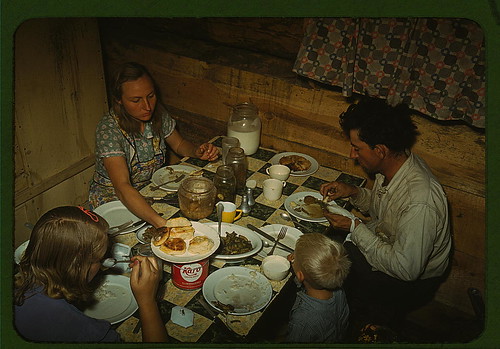
Poor Family from the 1940s
 

Defining Poverty

       In this case, I’m going to define poverty according to the 2009 U.S. federal poverty level guidelines. For two people, the poverty level is $14,570/year. This level applies regardless of where you live in the U.S., which doesn’t make much sense to me since the cost of living varies so much by location. But perhaps the areas with a higher-than-average cost of living adjusts the poverty level guidelines for their assistance programs. That’s something I’ll have to look at in another post!

       I could use a different measure for poverty – a global measure, for instance. But the disparity between the global poverty level guidelines and the U.S. poverty level guidelines is extreme. Based on a $2/day/person poverty guideline (World Bank threshold), we’d be looking at $1,460 or 1/10 of the income for the U.S. poverty level. I can tell you right now that would mean giving up everything except food. No shelter, no transportation, no clothing purchases – absolutely nothing but food…and not much of that.

       So for this article, I’m going to use the federal guideline of $14,570/year which is pre-tax. I’m not going to include food stamps, federal/state health coverage, or tax refunds (namely, the Earned Income Credit). Some studies have shown that the poverty level income would be 30-40% higher if such benefits were included, but I’m going to stick to the $14,570 number for the sake of simplicity.

What Would Our Spending Look Like?

       If our annual income were $14,570, our monthly income would be just over $1,214. Here’s what I think our monthly budget would look like. Some of these numbers are based on actual expenses now and some are based on what I estimated after making changes to our lifestyle. I’m assuming we keep our current jobs.

Category Amount
Income $1,214.17
   
Giving $130.00
Saving $106.70
State & Local Taxes $39.46
Health Insurance $76.93
Rent $400.00
Renter’s Insurance $11.08
Groceries $150.00
Utilities $120.00
Auto (Gas, Maint., & Ins.) $130.00
Other (Household & Personal) $50.00
   
Total Expenses $1,214.17

What We’d Have to Give Up

       So the next question is how would this differ from our current lifestyle? Well, first we’d have to move. We’d have to find a place for 2/3 of the rent we’re paying now, and it would need to be closer to Michelle’s job to cut down on gasoline costs. A different place would also likely cut down on our utilities. This would be a major change since we’d have to move away from our family, friends, and church but not very far – just far enough to make it inconvenient but doable. We’d also likely be living in someone’s basement or sharing a place with another family for rent that cheap.

       We’d have to give up the excellent health insurance we have through Michelle’s work and buy a no-frills $10,000 deductible plan that doesn’t cover office visits or prescriptions. It would only cover serious catastrophes like cancer. In contrast, our current insurance has a very low deductible ($150/$300, I think?) and covers office visits and prescriptions for a low co-pay. We’d also be giving up our dental insurance, though I’m not sure that’s much of a deal anyway.

       Speaking of insurance, we’d have to decrease the coverage on our auto insurance to the state minimum levels and increase the deductible on Michelle’s car to $2,500. We’d also have to think about selling my car but that wouldn’t be completely necessary. Decreasing the coverage limits could expose us to some serious risks if we were to have an accident – likely resulting in bankruptcy if it’s a major accident.

       I don’t mind that we’d be paying less in taxes. But our giving would have to go down and that wouldn’t be so great. We’d have to make some tough choices there. All of our saving would most likely be short-term savings to cover the deductibles for our insurance policies.

       We’d have to spend less on groceries but not much less than we currently spend. I don’t imagine there would be any problems there. We’d just have to limit our meat intake and replace it with beans instead and shop a little more carefully. Eating out would be out of the question. We’d also need to cut our household and personal spending in half.

       Beyond that, we’d have no cell phones, no Internet connection, and no TV (that last one’s not any different from now, but I’m just saying). We wouldn’t be able to pay my student loans unless we gave up saving or giving (or some of both), but forbearance or an income dependent plan would be an option at that point. We’d have no money for entertainment or travel of any kind, and every dollar would need to be meticulously tracked and spent with care. As it is now, I don’t track what we spend our ATM withdrawals on completely so that would have to change.

       So while it wouldn’t be easy or “fun” to live on this budget, it would be possible. But we’d have no chance of saving anything for retirement, buying a house if we wanted to do that, or doing anything that required money outside of this budget. (That means no more sewing or jewelry making for Michelle. My hobbies don’t really require any money right now I think.)

Living Off Uncle Sam (or You, Rather)

       I didn’t include government benefits in that budget, but if I had things would have worked out quite a bit better. Between Section 8 housing, tax refunds, food stamps, health coverage from Pennsylvania, and utility assistance programs I think we could live at pretty much the same standard we currently enjoy. (Except for the housing part…that would likely be a major decline.)

       These benefits would probably comprise at least 25-40% of our budget in this scenario. At that rate, we could probably afford cell phones, an Internet connection, auto insurance at our current coverage, our normal household and personal spending, my student loans, and even some entertainment. Or we could choose to save that money, invest in ourselves (to increase our income), or give to people in more need than ourselves.

Possible But Not Enjoyable

       I’m not making light of this scenario. I’m certain it would still be stressful and emotionally draining, but it wouldn’t be impossible to live this way. (Though I’m having difficulty convincing Michelle of this. :))

       I think the reason I can say this is because Michelle and I are pretty content. We don’t have to have the latest gadgets or fashions. We are naturally frugal people who don’t enjoy spending tons of money. We have low-key hobbies, can entertain ourselves, and know how to cook. We’re also disciplined enough to say no to ourselves on the non-essentials. All these factors combine to make it easier for us to live on less than most people in America. (I don’t say this to boast but to simply point out facts. Many people get sucked into the culture and go with the flow without question. Neither Michelle nor I have ever been ones to follow the crowd.)

       I’m thankful we’re in a situation where we don’t have to make these choices. God has blessed us with all that we need and then some. But I struggled with creating a sample budget for this scenario, and I now have a slight understanding some of the choices people are forced to make when they’re living on so little. I say slight understanding because I don’t think you can truly comprehend what it’s like to live on that kind of income until you’ve done it.

Your Thoughts

       Do you think you could live at the federal poverty level? What would have to change for you? What would you have to give up? Share your thoughts in the comments below!

       In the last part of this series, we finished talking about practical applications when we take on God’s View of the World, Money, and our lives. We looked at how we should act and what we should do when we take on God’s View and live out His will. Today, we’ll start talking about the results of following God’s teaching on contentment. How will contentment benefit you, and what kind of effects will it have on your life?

Delighting God

       When our focus is no longer on wealth and material things but fully centered on God, we can begin to please Him. It’s amazing to think that despite our weaknesses and shortcomings we can still manage to please the Creator of the entire universe by simply learning to be content and centering our lives around Him.

   23 Thus says Yahweh,
       “Don’t let the wise man glory in his wisdom,
       neither let the mighty man glory in his might,
       don’t let the rich man glory in his riches;

       24 but let him who glories glory in this,
       that he has understanding, and knows me,
       that I am Yahweh who exercises loving kindness,
       justice, and righteousness, in the earth:
       for in these things I delight,” says Yahweh.

Jeremiah 9:23-24 (WEB)

       It’s nearly unthinkable that we can delight God, but we really can delight Him when we talk more about His goodness and our relationship with Him than our wealth or accomplishments.

Enjoying Life

       In Ecclesiastes, Solomon experiences all the things the world tells us will make us happy—power, wealth, and pleasure. He reflects on his experience and realizes all the things the world recommends are quite meaningless. He also reflects on what he sees in the world, and most of his learning about the best things in life is summed up by Ecclesiastes 8:15.

       15 Then I commended mirth, because a man has no better thing under the sun, than to eat, and to drink, and to be joyful: for that will accompany him in his labor all the days of his life which God has given him under the sun.

Ecclesiastes 8:15 (WEB)

       Now, Solomon is not recommending that we all “eat, drink, and be merry” as the world understands it. He’s commending the enjoyment of life, which is really what contentment boils down to. When we’re content in any situation and learn to value God and His ways above all else, we can find true joy in life that will stay with us always.

       The joy of contentment in God can keep us happy and optimistic no matter what happens to us because it’s founded on Him. The eternal power and truth of God can overcome any situation, allowing us to fully enjoy life and realize our blessings even in the worst circumstances. And learning to be content in every situation can give us joy that lasts throughout our entire lives—unlike wealth, which is so uncertain and may not last through tomorrow.

A Strong Tower

       Throughout the Bible, we see a continual reference to God as a strong tower and mighty fortress. He protects those who trust in Him, and His strength overcomes all obstacles. When we are content with God’s provision, blessing, and His gift of eternal life through Jesus Christ, we have the ultimate protection from any worldly disaster. Poverty, sickness, economic depressions, death, stock market crashes, natural disasters, job loss—none of them can hurt us because we will always have eternal life in Jesus. Despite what the world says, it just doesn’t matter what happens to us in this life. Nothing can ever separate us from the love of Jesus.

       Do I mean that God will protect us from all these things? Not at all. Terrible things happen to Christians all the time and they really test our faith. But if we weigh the worst tragedy against the fact that we have been saved by Christ, we’ll always see that we are truly blessed. God keeps us safe through all things because He has given us eternal security through Jesus. Wealth can never do that.

   10 The name of Yahweh is a strong tower:
   the righteous run to him, and are safe.

   11 The rich man’s wealth is his strong city,
   like an unscalable wall in his own imagination.

Proverbs 18:10-11 (WEB)

       We like to imagine wealth will protect us from all the bad things in life and give us access to all the good things in life. What we don’t realize is that we are just imagining that it can do all those things. Wealth can only protect you so much, and it can only give you the things that the world says are good. But there’s no guarantee that your wealth will be there when you really need it.

       There is only one guarantee, and there’s only one way we can find true safety in life. Trusting in God and finding contentment in what He’s blessed us with—whether little or much—will provide us with a strong tower capable of withstanding anything that might come our way. Contentment in God gives us joy that lasts as long as we live rather than a little pleasure for a fleeting moment.

       The truth is that money and things can never give us the happiness and security we’re seeking. God has already given us all the happiness and joy we could ever need—we just need to look at our lives through His eyes. Once we start doing that, we’ll see how truly rich we already are.

Want to read the entire Bible study series on Contentment? Download your free copy of Contentment Is Wealth: A Bible Study on Contentment now!

       In the last part of this series, we continued talking about practical applications when we take on God’s View of the World, Money, and our lives. How should we act and what should we do when we take on God’s View and live out His will? We’ll finish that discussion today, and in the next part of the series we’ll start talking about the results of following God’s teaching on contentment.

       Proverbs has tons of great personal finance advice, but Proverbs 23:4-5 has a very practical application for our lives—especially today.

   4 Don’t weary yourself to be rich.
   In your wisdom, show restraint.

   5 Why do you set your eyes on that which is not?
   For it certainly sprouts wings like an eagle and flies in the sky.

Proverbs 23:4-5 (WEB)

       When we look at the world around us, we can see people everywhere wearing themselves out trying to get rich. And how many families have been torn apart because of an obsession with work? How many people have committed suicide because they lost their wealth? We have to be wise enough to know when to quit—when enough is enough.

Bald Eagle by Velo Steve on Flickr       Worldly wealth can be quite fickle. It’s temporary (even if it lasts your entire life), faulty, and can disappear very quickly. I’m sure we all know of cases where money has come and gone quite easily. That’s the problem with worldly wealth. While we think we’ll get security if we have enough of it, the truth is that it’s built on a weak foundation and can’t provide the things we really need. Even if it gets us through our old age, we can’t do much with it once we’re dead.

       This is why Jesus tells us to focus on heavenly treasure and God’s kingdom. Unlike worldly wealth, these things are permanent. They’re built on a foundation stronger than any we’ve ever known. The lasting treasure we pile up in heaven will always provide for us during this life. And when we’ve passed on, we’ll still have all of it. No matter what happens to us, we can never lose the treasure of God’s love living in us. We might not be rich and famous, but we’ll always have the invaluable gift of eternal life.

       Paul mirrors the wisdom of this proverb in his instructions to Timothy for the rich:

       17 Charge those who are rich in this present world that they not be haughty, nor have their hope set on the uncertainty of riches, but on the living God, who richly provides us with everything to enjoy; 18 that they do good, that they be rich in good works, that they be ready to distribute, willing to communicate; 19 laying up in store for themselves a good foundation against the time to come, that they may lay hold of eternal life.

1 Timothy 6:17-19 (WEB)

       Wealth makes it easy for us to become arrogant and stop trusting in God. We gain a false sense of security, because the truth is that worldly wealth is very uncertain. But when we place our trust wholly in God, He provides everything we need. God can give us joy that we can’t get from anything else on Earth. His joy lets us see the true value of things in our life, and His love working through us makes our lives much more valuable than any amount of money ever will.

       Paul’s very practical advice is that we should use money to do good—not to store it up and trust in it. We should focus on doing good things for other people in the service of God. We should be generous and always ready to share. This is the essence of God’s view on contentment—that we should not be obsessed with things or wealth or status, but that we should always be ready to do good, to love others, to share what we have, and to always trust that He will provide everything we need.

       Contentment means that we stop being obsessed with buying that new iPod, but instead we give that money to the hungry.

Give us this day... by Mr. Kris on Flickr

(Click the picture to read about the tragedy of hunger in our world.)

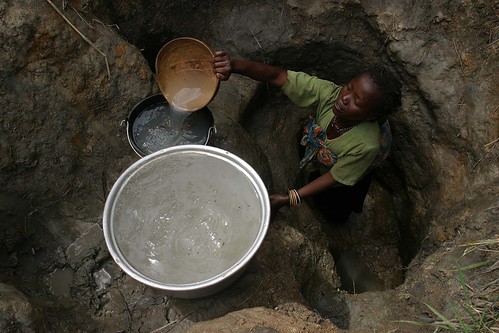
       It means that we drive our old car a little longer, so that we may be able to give clean water to the thirsty.

Woman with child collecting water by hdptcar on Flickr

       It means we live in a smaller home, so that we can provide shelter for those that have no place to stay warm or out of the rain.

Homeless by Henrique Vicente on Flickr

       It means that we stop spending so much time working and pursuing wealth, so that we can spend time building relationships with our family, our friends, our neighbors, complete strangers, and even our enemies.

Relationship by Smile My Day on Flickr

       Fully pursuing contentment means that we totally trust in God for His providence, and we stop worrying about what’s going to happen in the economy.

       And what do we get for all of this? A good foundation of heavenly treasure that lasts for eternity, and the ability to experience true life rather than that illusion of the “good life” that’s fed to us every day. Contentment allows us to live out a true life in Jesus and to fully experience His love, mercy, grace, and forgiveness.

Want to read the entire Bible study series on Contentment? Download your free copy of Contentment Is Wealth: A Bible Study on Contentment now!

Bible with Cross Shadow by knowhimonline on Flickr       Today’s Personal Finance Bible Scripture comes from Proverbs 13:7.

   7One man pretends to be rich, yet has nothing;
     another pretends to be poor, yet has great wealth.

Proverbs 13:7 (NIV)

       While I think it’s fun to look at this verse as a warning against “keeping up with the Joneses”, I think the Amplified Bible gives us a more accurate and applicable translation:

   7One man considers himself rich, yet has nothing [to keep permanently]; another man considers himself poor, yet has great [and indestructible] riches.

Proverbs 13:7 (AMP)

       As Christians, we have a great reward in Christ Jesus. Even the poorest of Christians in this life is far richer than the wealthiest non-Christian. This is why I emphasize so strongly that God’s blessing in a Christian’s life may not come in the form of material things. We are already greatly blessed because Christ died for us—material things beyond food and clothing are merely extras.

       Contentment is so important in a Christian’s life because it helps us realize that we don’t need much in this life to be happy beyond a close relationship with our God. Once we fully grasp this reality, we can begin to serve God with all our heart, all our soul, and all our mind.

       In the last part of this series, we continued talking about practical applications when we take on God’s View of the World, Money, and our lives. How should we act and what should we do when we take on God’s View and live out His will? We’re still continuing that discussion today.

       How does God want us to deal with our circumstances? Paul provides us with some insight in 1 Thessalonians 5:16-18:

       16 Rejoice always. 17 Pray without ceasing. 18 In everything give thanks, for this is the will of God in Christ Jesus toward you.

1 Thessalonians 5:16-18 (WEB)

       I’ve talked about 1 Thessalonians 5:16-18 before, so I won’t go into as much depth here. This passage clearly sets out God’s expectations for how we should live, regardless of our circumstances. We are to always rejoice, pray without ceasing, and give thanks in everything. God wants our lives focused on the Gift He has given us, becoming closer to Him, and enjoying the good things He has blessed us with. There’s no room for greed or materialism when our hearts are focused on those things. That’s God’s will for us—that we’re focused on Him instead of this world.

       So we know by now we shouldn’t be focused on material things or amassing great wealth, but we still have needs while we’re living on Earth. What should we ask God for, and how much of it should we request? Agur gives us some good guidelines in Proverbs 30:8-9.

     8 Remove far from me falsehood and lies.
     Give me neither poverty nor riches.
     Feed me with the food that is needful for me (my daily bread);

     9 lest I be full, deny you, and say, ‘Who is Yahweh?’
     or lest I be poor, and steal,
     and so dishonor the name of my God.

Proverbs 30:8-9 (WEB)

Our Daily Bread by ms. Tea on Flickr       Agur asks God for his daily bread—just enough. If we have too much, we become inclined to believe we did it all ourselves and begin to deny even the existence of God. It is very easy to start relying on our wealth more than we rely on God. We get too focused on our material well-being and no longer see the need for God in our lives, so we disown Him and pretend He doesn’t exist. On the other hand, if we have too little we may become inclined to steal. This would dishonor God because it is sin—against God for not trusting in Him and against our neighbors for not loving them.

       This idea of our daily bread should be quite familiar to most Christians. It’s part of the Lord’s Prayer—Jesus’ example of how we ought to pray and where our hearts should be focused when we pray. Jesus wanted us to realize that this request for our daily bread is important. Asking God for just enough, being modest and content, and not letting materialism rule our lives—these are the things that allow us to honor God sincerely in our lives. It is such an important concept that Jesus included it in His example for prayer (not to mention all the time He spent telling parables and teaching about contentment and a focus on heavenly treasures).

       We see two main practical applications here. First, we should be content with our circumstances because it is God’s will for our lives. If we’re focused on the gift of eternal salvation, we don’t have to be as worried about the things of this world. We’re free to be joyful always, pray continually, and give thanks in all circumstances. Second, we should be asking God for just enough to get by each day—not for millions of dollars, or a huge house, or a BMW—just our daily bread. We bring nothing into this world, and we won’t take anything out when we leave it. This is why Paul says we should be content if we have food and clothing (1 Timothy 6:8). That’s all we really need to get by (though a warm shelter is nice as well, it’s not completely necessary). When we start worrying about getting more than that, we take our focus off of God and put it back onto the World. And that’s a sure way to keep ourselves from fully serving God.

Note: I do not mean that we should completely neglect our material needs, but it’s all about where our hearts are focused. Wherever your treasure is, that’s where your heart will be also. So if you’re consumed with thinking about material things and wealth, your heart can’t really belong to God. That’s the only true sin, because once God gets your heart He’ll get everything else with it. It’s all He really needs from us—and that’s why it’s so vitally important that we don’t give our hearts to materialism.

Want to read the entire Bible study series on Contentment? Download your free copy of Contentment Is Wealth: A Bible Study on Contentment now!

       I pulled this out of our mail the other day:

PA Lottery Coupons

       Seriously? Someone at the Pennsylvania Lottery must be playing a joke. Big Savings? Let me get this straight. You’re going to use a coupon to buy a lottery ticket, and that’s going to bring you big savings? Let’s think about this just a bit.

What Are Your Chances of Winning?

       Let’s use the September coupon for our example. This coupon gives you one $2 Mega Millions with MegaPlier ticket for free if you buy one $2 Powerball with Power Play ticket. Basically, this is just one set of numbers because a regular ticket costs $1 for one play and the Power Play (or MegaPlier) doubles the cost of the ticket.

       The Pennsylvania Lottery’s website says your overall chances of winning a prize with a Powerball ticket are 1 in 35.11.

       We can figure out your chances for winning any of the specific prizes with some simple math. If your chances of winning a prize are 1 in 35.11, that means you have a 2.8482% chance ((1/35.11)*100) of winning every time you play Powerball. (Not very good, huh?) Basically, you can only expect to win something once out of every 35 tickets you buy. But that doesn’t tell us how much the ticket is really worth because your prize can range from $3 to $14,000,000 (or $6 to $14,000,000 if you buy the Power Play option) given the current jackpot. To figure out the value of your ticket, we’ll need to do a little more math.

What’s Your Ticket Really Worth?

       By using the odds given for each specific prize level, we can figure out the average prize for a winning ticket. Overall, you have a 2.8482% chance to win on any given ticket. You can use the same process to figure out your chances of winning a given prize. For example, the Pennsylvania Lottery website says you have a 1 in 61.73 chance of winning the lowest prize of $3. That’s a 1.61996% chance ((1/61.73)*100) of winning $3 on any given ticket. Since you have a 2.8482% chance of winning any prize, you’d expect a little more than half of your winning tickets to have a $3 prize. (The math is simple: 1.61996/2.8482 = 0.568766 * 100 = 56.8766%.)

       Continuing this process for each prize level, we can figure out your chances of winning a specific prize any time you have a winning ticket. This table shows those chances for a regular Powerball winning ticket.

Match Prize Chance of Winning This Prize on a Winning Ticket
5 Numbers + Powerball Jackpot (currently $14,000,000) 0.000018%
5 Numbers $200,000 0.0006833%
4 Numbers + Powerball $10,000 0.0048552%
4 Numbers $100 0.1845%
3 Numbers + Powerball $100 0.2573%
3 Numbers $7 9.7787%
2 Numbers + Powerball $7 4.4604%
1 Number + Powerball $4 28.4363%
Powerball Only $3 56.8772%

       Now we can figure out the value of a winning ticket simply by multiplying the prize by your chance of getting that prize on any given winner. Doing that tells us that the average winning ticket for regular Powerball is worth $7.65 ($8.65 – $1.00 for playing). Adding the Power Play to the mix changes the prize values, so the average winning ticket for Powerball plus Power Play is worth $24.04 ($26.04 – $2 for playing). (And technically, it would be worth a little less than that because there’s always the chance you might have to split the jackpot with someone else. But I don’t feel like finding the stats on that or doing the math.)

       That leads us to the next question. If the average winning ticket is worth $7.65 (or $24.04 for Power Play), then what is the average ticket worth? You only have a 2.8482% chance of winning that $7.65 (or $24.04). We need to take into account the cost of your losing tickets, which you’ll have 97.1518% of the time. Remember, you have to buy 35.11 tickets before you can expect to have a winning ticket (based on the odds). That leaves you with 34.11 losing tickets. If you’re playing regular Powerball, you’ll need to spend (that is, lose) $34.11 to win $7.65. If you’re playing Powerball with Power Play, you’re looking at a cost of $68.22 to win $24.04.

       Our last bit of math will tell us the average value of any given ticket. Let’s check regular Powerball first. On average, you’ll spend $34.11 to win $7.65 leaving you with an overall loss of $26.46. Divide that by the total number of tickets you had to buy (35.11) and you’ll find that the average regular Powerball ticket is worth -$0.75. To put it another way, instead of buying a $1 Powerball ticket you might as well throw three quarters in the trash. (Oh wait, I forgot…the Pennsylvania lottery benefits older residents – every day. So maybe you should just donate the three quarters instead.)

       What about Powerball plus Power Play? It certainly looks like a more attractive value proposition at first glance since the average winning ticket is worth so much more. On average, you’ll spend $68.22 to win $24.04 leaving you with an overall loss of $44.18. So that means the average Powerball plus Power Play ticket is worth -$1.26. This time, instead of donating three quarters rather than buy a Powerball plus Power Play ticket you should donate five quarters! In terms of absolute dollars, you lose more with Power Play but the % loss is better than regular Powerball. (In regular Powerball, you lose 75% of your money forever. With Power Play, it’s “only” 63%. Granted, it starts looking a little better when the jackpot is very large, but your chances of splitting the prize increase as more people buy tickets. This means the lottery is always going to be a losing bet.)

       Let’s put this all into a little perspective. Buying a Powerball lottery ticket would be the equivalent of getting a $10,000 gift, going out into your back yard, and then proceeding to burn $7,500 of it for “fun”. Big Fun – according to the Pennsylvania Lottery.

You Want Big Savings? I’ll Show You Big Savings.

       I’m not going to take the time to prove that the lottery (in any form) is a waste of your money. You can simply look at the July 2009 – June 2010 annual income and expense report from the Pennsylvania Lottery to see that they only end up paying out about 61% of their total sales to winners. Talk about a great business! I’d take a 30% net profit margin any day. (The other 9% goes to other expenses.)

       Looking at those numbers from the other end, we see that lottery players as a whole are buying something with a guaranteed return of -39%! You want big savings? Here’s a thought. Stop paying the poor people’s tax.

Don’t play the lottery!