Archives For Corey

       You won’t see any updates on Provident Planning for the next week and a half because my wife and I will be leaving early Sunday morning for a short-term mission trip in Saint Marc, Haiti. We’re going with a small group from another church to build a duplex in Saint Marc’s 5th Section – the poorest part of that area. The people who live there mostly live in mud houses, which don’t last very long when the hurricanes come through. We’ll be building a concrete block home that will last through the rain.

       This trip was planned well before the earthquake hit Port-au-Prince, but we’ll still be able to make it work with a small change in plans. Instead of flying into Port-au-Prince, we’ll be flying into Santo Domingo (in the Dominican Republic) and driving to Saint Marc. While the people in Port-au-Prince desperately need help right now, the outlying areas may be neglected as the focus goes on to the capital city. Our small team is not experienced enough to deal with the work that needs to be done in Port-au-Prince. But we are ready and able to help with the project planned in Saint Marc, so that’s what we’re doing.

       We’ll be working through the Youth with a Mission base in Saint-Marc and staying there as well. You can check out a tour of the base in this Youtube video:

       Please pray that we’ll be a blessing to the people in Haiti, that they will be a blessing to us, that God will open our hearts to their needs and enable us to share His love, and for the protection of our team. Continue to pray for the people in and around Port-au-Prince as well – the recovery process will be long and difficult.

What Do You Think of Short-term Missions?

       As I was considering this trip, I began to wonder about the effectiveness and efficiency of short-term missions. I found a helpful article at GotQuestions.org that laid out some pros and cons of short-term mission trips. But what do you think? Are such trips a good use of the money God has given us? Are they beneficial for those who go and for those in the areas served? Let me know your thoughts in the comments!


Make a Will for Free

Corey —  January 14, 2010

       I’ve talked about essential estate documents before, and I made the point that everyone needs a will (assuming you’re over 18). A will simply ensures that your assets are given to the people you want in the way you want. But I’ve found that we neglect getting a will for two reasons:

  1. We don’t want to deal with thoughts of our own death. Writing a will makes some people feel like they’re planning to die. But this shouldn’t keep you from doing something that’s good for you and your loved ones. You’re going to die someday. Get over it and get a will.
  2.  

  3. We think we can’t afford it. Everyone knows attorneys don’t come cheap. It’s not uncommon to find attorneys who charge $250/hour or more for their work. A complete estate plan can run anywhere from $500 to $5000 or more depending on who you use. But there are alternatives – and that’s what this article is about.

Do Your Own Will

       The cheapest way to get a will is to do it yourself. But the problem is you can easily make mistakes that will invalidate your will – making it completely useless. Or worse, you could end up writing a will that goes against your wishes without realizing it. And if you’re in Louisiana, you shouldn’t even consider doing estate planning without an attorney (they have some strange laws there).

       But if you’re willing to do some research, carefully consider your decisions, and follow instructions exactly, then making your own will can be a viable alternative to using an attorney. Obviously, the preferred method is to use an experienced estate planning attorney, but if the cost is keeping you from making a will at all then going the do-it-yourself route can cover you until you can afford to pay an attorney.

       Luckily, there are some good resources out there to help you make your own will. One website I found, DoYourOwnWill, has a helpful questionnaire with guidance and detailed instructions on how to properly execute (sign and put into effect) your will. If you’re married, you should do this with your spouse and discuss all the questions together.

       Please note I’m not endorsing this as the best solution and I’m not giving you legal advice. I’m not an attorney and using DoYourOwnWill is not a substitute for an attorney. But if you don’t have a will and you’re not going to get a will because of the cost, this is better than nothing.

       You’ll also find several other free estate planning documents like living wills and powers of attorney. Again, they’re still not a substitute for an attorney and you can make some major mistakes by doing it yourself – but if cost is a problem these are free solutions. Additionally, there are inexpensive estate documents you can purchase online through legalzoom.com or nolo.com. You could also look into software like Quicken WillMaker.

Hire an Experienced Attorney As Soon As Possible

       If you decide to make your own will or use other free estate planning documents, please hire an attorney as soon as you can afford it. An experienced estate planning attorney can help you avoid costly mistakes and carefully consider all the decisions you must make. Make sure you shop around. Don’t settle for the first quote you get. Talk to several attorneys, stick with the ones who specialize in estate planning, and ask for referrals from your family and friends. You may also be able to get a good referral from your accountant, financial planner, real estate agent, or banker. The most expensive attorney is not necessarily the best, but do your research before you go with the cheapest option.

       Do you already have your estate documents? If so, how did you get them? If not, what are you going to do? Let me know in the comments!

       If you want to get out of debt, you need a plan. This post is the first in a series that will show you the quickest way to get out of debt and get on with your life. You’re already off to a good start by taking the initiative to find this article.

Step 1 – Declare War on Your Debt

       If you really want to get out of debt, you have to be committed all the way. It won’t be easy. It won’t be quick. And it probably won’t be much fun (until you pay it all off). To reach your goal of becoming debt free, you must promise yourself that you’re not going to give up until you’re finished.

       Give your debt an ultimatum. Declare war! Proclaim doom and destruction on your debt. Write it down if you need to. This might sound silly, but my point is that you can’t accomplish your goal if you go at it halfheartedly. You need to be enthusiastic about your choice to get out of debt if you want to last until the end.

       So that’s your first step. That’s all you need to do right now. Commit to getting out of debt. Declare war on your debt!

Stay Tuned!

       If you want to keep getting tips on how you can get out of debt and manage your personal finances well, make sure you sign up for free updates to Provident Planning! I’ll be continuing this series throughout the year while I also explore other aspects of dealing with your money.

       Let me know if you’re committed to getting out of debt by leaving a comment below!

How Compound Interest Works

Corey —  January 12, 2010

       To get a small fortune, you have two options:

  1. Start with a large fortune.
  2.  
    OR
     

  3. Use the power of compound interest (or returns).

       I don’t have any good tips on how to start life with a large fortune, but I can tell you about compounding and how it works.

Simple Interest

       First, you need to understand simple interest. Simple interest is just a flat interest rate paid only on your initial deposit year after year. Let’s say you’ve got a bond that pays you 8% simple interest. If you buy $100 worth of that bond, you’ll get $8 in interest for the first year. Then, because this is simple interest, you’re going to get $8 in interest every year after that until the bond is repaid (and you get your original $100 back). Here’s what it looks like on a chart:


       With simple interest, you’re only earning interest on your principal (or your deposit). You’ll get $8 every single year. You never earn interest on interest. At the end of 20 years, you’ll have your initial $100 plus $160 you earned from interest.

Compound Interest

       Compound interest lets you earn interest on your principal (what you start out with), but you also earn interest on interest you’ve already been paid. We’ll keep the same assumptions as before – you earn 8% interest and you start out with $100 – but this time we’ll be using compound interest.

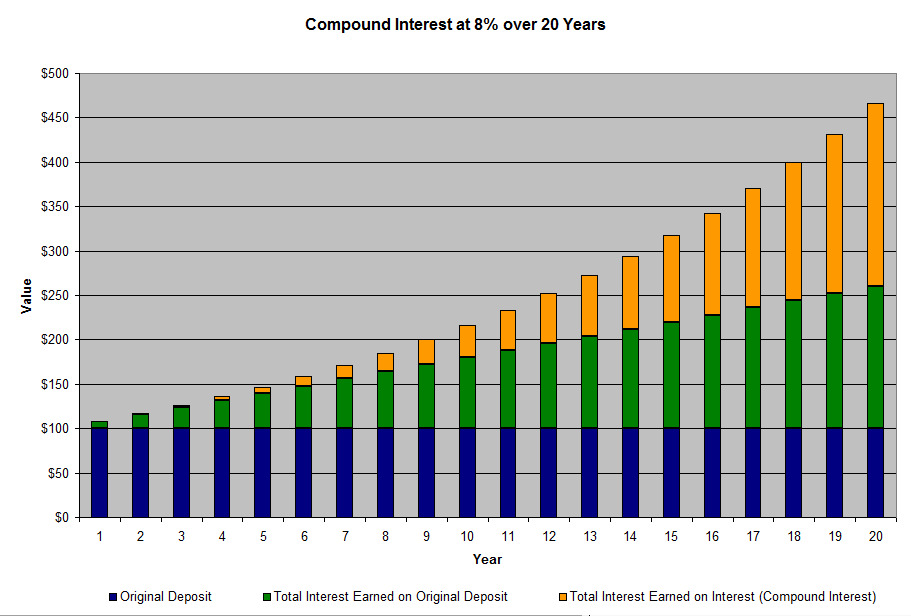
       At the end of the first year, you’ll still only earn $8 in interest ($100 * 0.08). But at the end of the second year, you’ll earn a total of $8.64 in interest ($100 * 0.08 + $8 * 0.08). In the third year, you’ll earn $9.33 in interest ($100 * 0.08 + $8 * 0.08 + $8.64 * 0.08). This process keeps continuing and you keep earning more and more interest every year. Here’s what it looks like on a chart:


       Compound interest is all about earning interest on interest (and principal). You’re generating earnings from previous earnings. In the example above, you’d have your initial $100 plus $366.10 in interest at the end of 20 years. That’s $206.10 more than what you’d get from simple interest. The only difference between the two is the ability to earn interest on interest.

       Compounding is why it pays to start saving as early as possible. In the first year, you may only get an extra $0.64. But in the twentieth year, compound interest gives you an extra $26.43. The amount of interest you earn on previous interest just keeps growing and growing the longer you go.

       Let’s look at a quick example. Let’s say we have three people who are all going to invest for retirement. They’re all 25 years old, and they’re all looking to retire at age 65. They’re all going to invest $25,000 at one time, but they start at different times. Sue invests her $25,000 today, Bob invests his $25,000 ten years later, and Frank invests his $25,000 ten years after Bob. To keep it simple, we’ll assume they earn 8% every year. Here’s what happens:


       Sue only started ten years before Bob, but she ended up with over $290,000 more than he did. Likewise, Bob started only ten years before Frank, but he ended up with over $135,000 more. The only difference between these three people was how many years they let their money compound. Sue had 40 years, Bob had 30 years, and Frank only had 20 years. Compounding has the most power when you have the most time. That’s why it’s important to start saving early (not just for retirement, but for any goal).

Your Thoughts

       Did these examples help you better understand compound interest? If not, what questions do you still have? Let me know in the comments and I’ll do my best to help you and give a clearer answer.

       “You shall not covet your neighbor’s house. You shall not covet your neighbor’s wife, nor his male servant, nor his female servant, nor his ox, nor his donkey, nor anything that is your neighbor’s.”

Exodus 20:17 (WEB)

       The Tenth Commandment – you shall not covet. God warns the Israelites here against desiring things that belong to others. The interesting thing is that this is the only commandment that primarily focuses on internal sins specifically. All sin begins from within us, but coveting is something that can be very difficult for others to see. God’s teaching the Israelites they should guard their hearts against greed and envy.

       Coveting is still a major pitfall for Christians today. Whenever we desire something that’s not ours – something beyond what we have – we make ourselves susceptible to greed, envy, and discontentment. These are all things that God’s Word warns against throughout the entire Bible – not just in the Ten Commandments.

       This verse gives us at least one way we can try to avoid coveting in our lives. You’ll notice that the focus is on coveting what your neighbor has. “Your neighbor” doesn’t just mean the people you live near. It can be anyone you interact with or see. And in the case of coveting it’s anyone who has something that you want.

       So what can we do? Focus on ourselves instead of looking at what everyone else has. Count your blessings. Keep your eyes on your own situation and God’s plan for you. Don’t worry about what everyone else has – stop comparing yourself with them. Keep your heart focused on serving God and pleasing Him. By doing these things, we can guard against the envy, greed, and discontentment that always follow coveting.

       What about you? Have you struggled with coveting in the past? How did it affect you? How did you overcome it? Share your story in the comments!

Giving Anonymously

Corey —  January 8, 2010

       If you’ve ever wanted to give a gift without the person knowing it came from you, there’s a great way you can do that. Giving Anonymously is a non-profit organization that helps you give anonymously to those around you who are in need. The process is very simple:

  1. You create a virtual check with the amount and the name and address of the person you want to give to. You’ll also supply their phone number or email address. You can include a short note to the recipient as well.
  2.  

  3. You then send the money to Giving Anonymously through a credit card transaction, electronic check, or by wire transfer. You can also choose to contribute to Giving Anonymously’s operating costs at this point. (If your gift is over $500, they require you contribute at least 3% of your gift to cover the transaction costs. Gifts of $500 or less have no minimum contribution to Giving Anonymously.)
  4.  

  5. Giving Anonymously will contact the recipient to make sure they have the right address and to let them know they should be expecting the check. This keeps the check from getting thrown away or going to the wrong place.
  6.  

  7. Once the recipient receives the check, there’s a toll-free number they can call to leave a voice message expressing their thanks. Giving Anonymously will then email you an audio file of the message so you can hear. If the recipient doesn’t leave a voice message, Giving Anonymously will send you a scanned image of the check to let you know it was cashed by the recipient. If your check is not cashed, Giving Anonymously will completely refund your gift and any overhead contribution you made.

My Thoughts

       I think Giving Anonymously is a great way to give money if you don’t want to create any sense of obligation for the recipient. Yes, you can try to communicate this when you give a gift in person, but it can be difficult to make the recipient understand there are no strings attached and to keep them from repaying you in the future.

       If you use this service, I’d encourage you to at least contribute 3% of your gift to help cover the transaction costs. Giving Anonymously has to pay for the credit card and electronic check transactions plus the cost of the checks, postage, envelopes, and other overhead. There’s no transaction cost for them if you send a wire transfer, but you’re going to end up paying quite a bit for that and they’ll still have the other overhead costs. There are free ways to send money to people, but you’ll give up your anonymity with those methods.

       Finally, if you’re worried that hearing the recipient’s thanks via the voice message would go against Jesus’ instructions in Matthew 6:1-4 (give in secret – your Father will reward you), you can always delete the email that Giving Anonymously sends you. But you might miss out on an amazing story and a blessing – check out the sample messages they’ve received at the bottom of their home page.

       If you’re interested in using Giving Anonymously, I encourage you to check out their website and contact them if you have any questions.

Your Thoughts

       What do you think of the idea of giving anonymously to others? Is it a good idea? Is there a better way to do it than through Giving Anonymously? Let me know in the comments!

       I’ve written in the past about the problems with the “prosperity gospel”. But something I haven’t done is discuss God’s purpose for Christian prosperity. God does want to bless us, but it’s not so we can waste that wealth on lavishly pampering ourselves. He has a specific purpose for prospering Christians and we can find that purpose in His Word.

God Prospers Us To Meet Our Needs

       God blesses us to meet our physical needs. Christ promised us that God knows what we need and He is happy to provide it, but we should seek His Kingdom first instead of worrying ourselves to death about those needs.

       31 “Therefore don’t be anxious, saying, ‘What will we eat?’, ‘What will we drink?’ or, ‘With what will we be clothed?’ 32 For the Gentiles seek after all these things; for your heavenly Father knows that you need all these things. 33 But seek first God’s Kingdom, and his righteousness; and all these things will be given to you as well.”

Matthew 6:31-33 (WEB)

       We should have faith that God will provide for our needs as we seek His kingdom. This is something I struggle with myself, for Jesus’ words here are difficult to follow despite the freedom they offer. Our weak flesh leads us to worry even though Jesus has promised that God will meet our needs. We must remember that God desires and has the power to meet our needs. He has given us eternal life in Christ, and He will not withhold what we need when we seek Him.

       My God will supply every need of yours according to his riches in glory in Christ Jesus.

Philippians 4:19 (WEB)

God Prospers Us So We Can Give Generously

       God also blesses us to meet our spiritual needs and the physical and spiritual needs of others. We see another purpose for prosperity clearly illustrated in the Bible – namely the purpose of generous giving.

       In 2 Corinthians 9, Paul is asking the Corinthian church to complete their desire to give to the poor Christians in Jerusalem who were suffering from a famine. He provides wonderful counsel for the Christians in Corinth about God’s ability to bless them so they can be a blessing:

       7 Let each man give according as he has determined in his heart; not grudgingly, or under compulsion; for God loves a cheerful giver. 8 And God is able to make all grace abound to you, that you, always having all sufficiency in everything, may abound to every good work. 9 As it is written, “He has scattered abroad, he has given to the poor. His righteousness remains forever.”

       10 Now may he who supplies seed to the sower and bread for food, supply and multiply your seed for sowing, and increase the fruits of your righteousness; 11 you being enriched in everything to all liberality, which works through us thanksgiving to God. 12 For this service of giving that you perform not only makes up for lack among the saints, but abounds also through many givings of thanks to God; 13 seeing that through the proof given by this service, they glorify God for the obedience of your confession to the Good News of Christ, and for the liberality of your contribution to them and to all; 14 while they themselves also, with supplication on your behalf, yearn for you by reason of the exceeding grace of God in you. 15 Now thanks be to God for his unspeakable gift!

2 Corinthians 9:7-15 (WEB)

       Paul explains to the Corinthians that God is able to meet all our needs so that we may focus on being generous and doing good things in His name. God prospers us so that we will have the opportunity to give generously. It is up to us to use that opportunity to honor Him instead of following the Worldly path of honoring ourselves.

       Even though the “prosperity gospel” is false, there are small nuggets of truth in it that get warped into something ungodly. God desires to bless us so He can meet our needs – both physical and spiritual. But wealthy Christians are called not to merely go through life enjoying the wealth God has blessed them with but to use that wealth to honor God and help others.

       When God makes Christians rich, it isn’t for our own benefit only – it’s so we can glorify His name by being obedient to our confession of the Good News of Jesus Christ. Our response to that Good News should be unending thankfulness and amazing generosity. Thanks be to God for His indescribable gift!