Coupons for Lottery Tickets – Seriously?

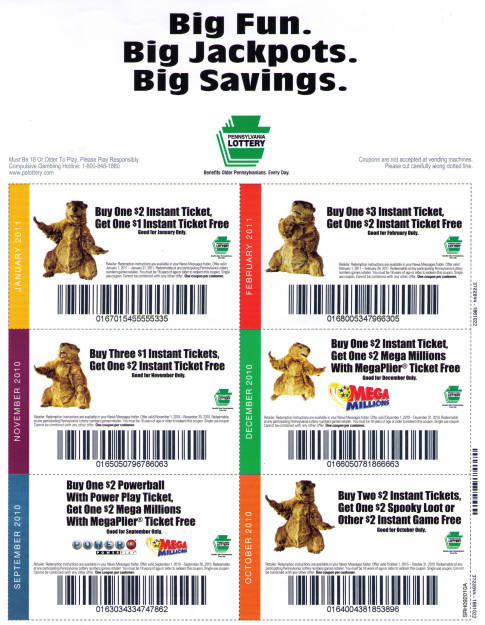
       I pulled this out of our mail the other day:


PA Lottery Coupons


       Seriously? Someone at the Pennsylvania Lottery must be playing a joke. Big Savings? Let me get this straight. You’re going to use a coupon to buy a lottery ticket, and that’s going to bring you big savings? Let’s think about this just a bit.

What Are Your Chances of Winning?

       Let’s use the September coupon for our example. This coupon gives you one $2 Mega Millions with MegaPlier ticket for free if you buy one $2 Powerball with Power Play ticket. Basically, this is just one set of numbers because a regular ticket costs $1 for one play and the Power Play (or MegaPlier) doubles the cost of the ticket.

       The Pennsylvania Lottery’s website says your overall chances of winning a prize with a Powerball ticket are 1 in 35.11.

       We can figure out your chances for winning any of the specific prizes with some simple math. If your chances of winning a prize are 1 in 35.11, that means you have a 2.8482% chance ((1/35.11)*100) of winning every time you play Powerball. (Not very good, huh?) Basically, you can only expect to win something once out of every 35 tickets you buy. But that doesn’t tell us how much the ticket is really worth because your prize can range from $3 to $14,000,000 (or $6 to $14,000,000 if you buy the Power Play option) given the current jackpot. To figure out the value of your ticket, we’ll need to do a little more math.

What’s Your Ticket Really Worth?

       By using the odds given for each specific prize level, we can figure out the average prize for a winning ticket. Overall, you have a 2.8482% chance to win on any given ticket. You can use the same process to figure out your chances of winning a given prize. For example, the Pennsylvania Lottery website says you have a 1 in 61.73 chance of winning the lowest prize of $3. That’s a 1.61996% chance ((1/61.73)*100) of winning $3 on any given ticket. Since you have a 2.8482% chance of winning any prize, you’d expect a little more than half of your winning tickets to have a $3 prize. (The math is simple: 1.61996/2.8482 = 0.568766 * 100 = 56.8766%.)

       Continuing this process for each prize level, we can figure out your chances of winning a specific prize any time you have a winning ticket. This table shows those chances for a regular Powerball winning ticket.

Match Prize Chance of Winning This Prize on a Winning Ticket
5 Numbers + Powerball Jackpot (currently $14,000,000) 0.000018%
5 Numbers $200,000 0.0006833%
4 Numbers + Powerball $10,000 0.0048552%
4 Numbers $100 0.1845%
3 Numbers + Powerball $100 0.2573%
3 Numbers $7 9.7787%
2 Numbers + Powerball $7 4.4604%
1 Number + Powerball $4 28.4363%
Powerball Only $3 56.8772%


       Now we can figure out the value of a winning ticket simply by multiplying the prize by your chance of getting that prize on any given winner. Doing that tells us that the average winning ticket for regular Powerball is worth $7.65 ($8.65 – $1.00 for playing). Adding the Power Play to the mix changes the prize values, so the average winning ticket for Powerball plus Power Play is worth $24.04 ($26.04 – $2 for playing). (And technically, it would be worth a little less than that because there’s always the chance you might have to split the jackpot with someone else. But I don’t feel like finding the stats on that or doing the math.)

       That leads us to the next question. If the average winning ticket is worth $7.65 (or $24.04 for Power Play), then what is the average ticket worth? You only have a 2.8482% chance of winning that $7.65 (or $24.04). We need to take into account the cost of your losing tickets, which you’ll have 97.1518% of the time. Remember, you have to buy 35.11 tickets before you can expect to have a winning ticket (based on the odds). That leaves you with 34.11 losing tickets. If you’re playing regular Powerball, you’ll need to spend (that is, lose) $34.11 to win $7.65. If you’re playing Powerball with Power Play, you’re looking at a cost of $68.22 to win $24.04.

       Our last bit of math will tell us the average value of any given ticket. Let’s check regular Powerball first. On average, you’ll spend $34.11 to win $7.65 leaving you with an overall loss of $26.46. Divide that by the total number of tickets you had to buy (35.11) and you’ll find that the average regular Powerball ticket is worth -$0.75. To put it another way, instead of buying a $1 Powerball ticket you might as well throw three quarters in the trash. (Oh wait, I forgot…the Pennsylvania lottery benefits older residents – every day. So maybe you should just donate the three quarters instead.)

       What about Powerball plus Power Play? It certainly looks like a more attractive value proposition at first glance since the average winning ticket is worth so much more. On average, you’ll spend $68.22 to win $24.04 leaving you with an overall loss of $44.18. So that means the average Powerball plus Power Play ticket is worth -$1.26. This time, instead of donating three quarters rather than buy a Powerball plus Power Play ticket you should donate five quarters! In terms of absolute dollars, you lose more with Power Play but the % loss is better than regular Powerball. (In regular Powerball, you lose 75% of your money forever. With Power Play, it’s “only” 63%. Granted, it starts looking a little better when the jackpot is very large, but your chances of splitting the prize increase as more people buy tickets. This means the lottery is always going to be a losing bet.)

       Let’s put this all into a little perspective. Buying a Powerball lottery ticket would be the equivalent of getting a $10,000 gift, going out into your back yard, and then proceeding to burn $7,500 of it for “fun”. Big Fun – according to the Pennsylvania Lottery.

You Want Big Savings? I’ll Show You Big Savings.

       I’m not going to take the time to prove that the lottery (in any form) is a waste of your money. You can simply look at the July 2009 – June 2010 annual income and expense report from the Pennsylvania Lottery to see that they only end up paying out about 61% of their total sales to winners. Talk about a great business! I’d take a 30% net profit margin any day. (The other 9% goes to other expenses.)

       Looking at those numbers from the other end, we see that lottery players as a whole are buying something with a guaranteed return of -39%! You want big savings? Here’s a thought. Stop paying the poor people’s tax.

Don’t play the lottery!


How to Get Out of Debt: Step 10 – Don’t Get Trapped Again!


       This is the final article in a ten part series on how to get out of debt. If you haven’t already, you should check out the previous articles:


Step 10 – Don’t Get Trapped Again!

       You’ve finally paid off the debts that have been dragging you down. You’ve topped off your emergency fund so you don’t have to rely on credit cards when things go wrong. You feel like you can rest easy. But your journey isn’t quite over.

       It’s taken a lot of work to get here. The last thing you want to do is go back to the patterns that got you into debt in the first place! I’ll be the first to congratulate you for reaching your goal, but the true measure of your success will be your ability to continue using the skills you’ve learned in this process. If you get back into overspending and not preparing for emergencies, you’ll have to do this all over again. I don’t think you want to go there.

       So to make sure you don’t get trapped by debt again, let’s take a few moments to consider what you’ll need to do to retain this success. My hope is that the process of paying off your debt has changed your habits so that you’ll maintain them for the rest of your life. But you’ll have to keep your eyes open so you never fall into the pits of debt again.

  • Limit Your Use of Debt – Debt can be useful for some situations, but using a credit card because you don’t have the money isn’t one of them. Limit your use of debt so that you only consider it as an option when it is wise. Buying a home, getting an education, or starting/expanding a business can be good reasons for using debt (but not always). There may be times when debt appears to be your only option, but make sure it’s your choice of last resort and that you absolutely need whatever it is you’re paying for.
  •  

  • Continue to Track and Optimize Your Spending – The single best way to make sure you prevent overspending is to keep an eye on what you’re spending and review it regularly. The simple action of tracking your spending will naturally lead you to spend less because you’re consciously thinking about every dollar that leaves your hands. You can also use the information you collect to find the areas where you can cut back on things that aren’t important to you.
  •  

  • Look for Ways to Earn More – If you’ve been in debt for a while, it’s likely you’re a bit behind on saving for retirement and other financial goals. To catch up you not only need to decrease your spending but you also need to increase your earnings. Combining those strategies will leave you with the money you need to save and reach your goals. Advance your career, earn some money on the side, or start your own business – there are many ways to increase your income.
  •  

  • Keep Your Emergency Fund Stocked Up – If you have to use your emergency fund, be sure to replenish those savings as soon as possible so you’ll be ready for the next Murphy’s Law event. Also, don’t look at that money as your “spend on anything” fund. It’s there for a purpose. Only use it for that purpose!
  •  

  • Have a Plan and Save for the Future – You got into debt because you didn’t have a plan. Fail to make a plan now and you’ll probably end up in debt again. Make a plan, choose your goals, and figure out how you’ll get there. Save for those goals so you won’t be tempted to use debt on a whim.
  •  

  • Learn to Find Contentment – Finally, seek contentment in all things. Comparing ourselves to others, wanting what “they” have, and not being happy with our situation all lead us to living beyond our means. And living beyond our means leads to debt. Discover what’s truly important in your life, eliminate what isn’t, and set your own standards for success and happiness rather than letting others do it for you.


       That’s it for this series! As I mentioned in the last part of this series, my plan is to combine these ten steps with some valuable resources to help make getting out of debt achievable and easier. Make sure you’ve signed up for free updates to Provident Planning so you don’t miss out when I release this invaluable package! If you’ve signed up for free updates, you’ll be sure to see it as soon as it’s available.

       Have you gotten out of debt and stayed out of debt? How did you do it? What has been key to your success? Let me know in the comments below!

Carnival of Personal Finance #271 – The Secret to a Successful Budget eBook Edition

The Secret to a Successful Budget eBook
 
       Welcome to the Carnival of Personal Finance #271 – The Secret to a Successful Budget eBook Edition! My friend Craig Ford at Money Help for Christians is launching a new eBook today. It’s designed to help you discover the secrets to successful budgeting.

       I think it’s a great resource for anyone who’s ever struggled with budgeting, so I’ve included some quotes from his eBook throughout this carnival. You can get the book for 30% off if you buy before midnight (EDT) August 31st, 2010. Be sure to read through to the end of this carnival because I’ll be giving away two FREE copies to two lucky winners!

Editor’s Choice

       Here are my top picks from the submissions this week:

  • Mike Piper from Oblivious Investor presents Dealing with Investment Confusion, and says, “What’s the best approach to dealing with the confusion that comes from being a new investor?” – [Mike shares some good advice for people who are confused about investing. It won't immediately cure your confusion, but applying this strategy over and over will help you make informed decisions you can stick to.]
  • Briana Ford from Go Banking Rates presents Why Americans Can’t Afford to Die [Infographic], and says, “If you never thought about this problem before, take a look at how expensive funerals really are. You may discover you, like many Americans, simply can’t afford to die.” – [What can I say? I'm a sucker for infographics.]
  • Len from Len Penzo dot Com presents A Simple Trick to Get Your Credit Card Interest Charges Waived. – [I wish more people realized the power of Len's simple trick!]
  • Lauren from Richly Reasonable presents 4 Bad Deals, and says, “The term “Bad Deal” is relative. Not only is Necessity the mother of Invention, she is also the mother of many a Bad Deal. Necessity has a TON of children.” – [Funny, smart, and witty - and likely to open a few eyes at least!]
  • Jacob A. Irwin from My Personal Finance Journey presents Adjusting My Monthly Budget to Account for Home Ownership, and says, “A look at the steps I have recently taken to adjust my personal budget to account for the various elements of home ownership.” – [At our current rent rate owning a home just doesn't make sense. Just look at all the costs involved!]

       Congratulations to the editor’s choice picks! Here are the rest of the articles from this week’s submissions.

Money Management

  • MD from Studenomics presents Quick College Students Guide To Personal Finance.
  • Jason from One Money Design presents How Do You Live Well on Less Pay?, and says, “There are plenty of people that don’t make a lot of money and have trouble covering basic expenses each month. There are 5 essential tips to follow to live well on less pay.”
  • Revanche from A Gai Shan Life presents Shopping for the single life .
  • ispf from Grad Money Matters presents The American Dream of Home Ownership: 10 Things You Can Do as a Student.
  • Jim from Wanderlust Journey presents Royal Caribbean Cruise Lines Shareholder Benefits.
  • Jason from Live Real, Now presents Check Your Bills, and says, “Can you automate your finances too far?”
  • Elle from Couple Money presents Financial Tips for College Success, and says, “Many college students are surprised to see how easy it is to build a financial foundation for themselves. Learn how to set up bank accounts, pay your bills, and start a graduation fund.”
  • DE(a)BTh from Murder Your Debt presents Your Wasted Life, and says, “You thought financing a house and a fast car meant freedom. That an expensive education would lead you to a rewarding career where you could earn lots of money. You were wrong, weren’t you? You hate your career but you’re stuck. You’re stuck because you swallowed the lies you were sold. The lies that material possessions bring success. The lies that more money means more happiness. And now what? You’ve got it all; the cars, the house with the huge yard, the sexy outfits and shiny shoes. But you’re STILL not happy!”
  • vh from Funny about Money presents Social Security’s Bizarre Rules, and says, “Social Security’s restrictive rules make it impossible to get out of poverty when unemployment forces one into early retirement and stock-market losses militate against retirement fund drawdowns.”
  • J. Money from Budgets Are Sexy presents What would you do with an extra $1,000?, and says, “Montel Williams wants to know ;)
  • Bob from Christian Finances presents How to spend unexpected income: 3 questions to ask, and says, “It can be tough to know what to do when you receive a large sum of cash – this article will give you some questions to help you figure out what to do with it…”
  • Mr. GoTo from Go To Retirement presents How Much Long Term Care Insurance Should You Have?, and says, “Insuring against a long term care event is part of personal risk management. Estimating the amount of long term care coverage to obtain requires careful consideration of several factors.”


If you are working 40 or more hours a week to earn your money, don’t you think it is worth an hour or two to set up a budget?

Isn’t it worth spending about an hour every week to manage the money you work so hard to earn? It is always better to manage what you have than to work yourself crazy trying to get more money.

- from page 21 of The Secret to a Successful Budget by Craig Ford


Finance


Investing

  • Dividend Growth Investor from Dividend Growth Investor presents 33 Dividend Champions to Consider, and says, “Dividend investor David Fish has created a list of dividend stocks which have raised distributions for 25 consecutive years and has named it the dividend champions list. His list includes 100 companies, which is more than twice the size of the Dividend Aristocrats. I ran a screen on the list in order to identify stocks for further research.”
  • Mike from The Financial Blogger presents Use the Loonie’s Strength to Invest in the Eagle Market, and says, “Canadian dollar is strong compared to the US dollar at this time. Use this as an opportunity to invest in US stocks.”
  • Div Guy from The Dividend Guy Blog presents Dividend Investing with Less Than $1,000 Part 3: How to Pick Your ETFs and/or Dividend Funds, and says, “Starting to invest is quite motivating but as a young investor, you must put greed and hype aside and start by looking for sound investments.”
  • Squirrelers presents Small Stocks = High Return and High Volatility, and says, “Small stocks, particularly those in the lowest deciles, have performed very well over the long-term. They can be an important part of your asset allocation, provided you can stomach the associated risks.”
  • D4L from Dividends Value presents My Top 6 Performing Dividend Stocks Just Might Surprise You, and says, “As I have stated many times, my goal is to create an ever growing income stream from dividend stocks. Secondarily, it is my desire to beat the S&P 500 over time. With that said, I rarely look at the capital performance of individual stocks. However, I recently sorted my portfolio by Total Gain % (total gain/basis) and was mildly surprised at the top performers.”
  • ElizabethG (Modern Gal) from Modern Gal presents Investing for Inflation in 2010.
  • DSO from High Dividend Stocks presents Big GE and it’s big dividend, and says, “One of America’s oldest and most prestigious companies has become an accidental high yielder.”


Budgeting in and of itself is useless.

Budgeting is part of a larger financial plan.

- from page 9 of The Secret to a Successful Budget by Craig Ford


Budgeting


Saving


Frugality


You need to focus your finances on accomplishing one major task at a time.

If you don’t, the danger is that every dollar will be diluted to a point that it makes little impact helping you reach your goals.

- from page 9 of The Secret to a Successful Budget by Craig Ford


Debt


Credit


The goal of the budget is to help you spend less than you earn.

Therefore, this becomes the single criteria for an effective budget – does it help you spend less than you earn?

- from page 12 of The Secret to a Successful Budget by Craig Ford


Reviews

  • PT from PT Money presents Free Prepaid Credit Cards, and says, “A thorough, original review of the best free prepaid credit cards, including those that are free of activation and monthly fees. These cards are great for those who need to avoid debt, or those that can’t get a traditional bank account.”
  • Silicon Valley Blogger from The Digerati Life presents Citi Dividend Platinum Select MasterCard Review, and says, “Here’s a review of a credit card I actually like.”


Real Estate

  • FMF from Free Money Finance presents How to Hire a Home Inspector, and says, “When you buy a home, you need to be sure you hire a good home inspector to identify any potential problems. This post gives tips on how to do this.”
  • Jeff Rose from Good Financial Cents presents Should You Upgrade to a Larger Home”, and says, ”
    In many markets, home owners are looking at homes in the next price range up as good buys, since foreclosures and a slow market are resulting in good deals. But, as tempting as it is to upgrade to a larger home, is it really a good idea? Here are some things to consider before upgrading to a larger home.”
  • Rob from Two Wise Acres presents 3 Things to Avoid When Buying a Home, and says, “When buying a home, it’s critical that you avoid these three credit mistakes.”
  • ctreit from Money Obedience presents Do renters really save money in the end?.


Taxes

  • pkamp3 from Don’t Quit Your Day Job… presents Tax Incidence, and says, “Who really pays for a tax when it is enacted? If the government enacts a new tax on washing machines, is the entire tax on Maytag? The consumer? Cameron Daniels breaks down the details.”


A budget lets your spouse see your values and priorities in a tangible way.

A budget forces you to communicate not just about your life goals, but also about your daily financial preferences.

- from page 16 of The Secret to a Successful Budget by Craig Ford


Career

  • Kristina from Dinks Finance presents A DINK in The Office, and says, “As a married or unmarried employee with no children, are you treated differently than your colleagues with kids?”
  • Nicole from Nicole and Maggie: Grumpy Rumblings presents Why did you go to graduate school?, and says, “Nicole and Maggie discuss reasons for graduate school and how sometimes we’re directed into a career for the right reasons and sometimes we fall into it for the wrong reasons. But it turns out OK anyway (or maybe it doesn’t, but you can always change your mind).”


Economy

  • Bret from Hope to Prosper presents Trillion Dollar Public Pension Shortfall, and says, “An article in the New York Times stated that there is a $1 Trillion dollar public pension shortfall. Despite repeated denials from PERS and public employee unions, public pensions are in big trouble.”
  • JLP from AllFinancialMatters.com presents Democrats, Republicans, and the Federal Debt Since 1979, and says, “Though the title may suggest it, this is not a “political” post.”


Budgeting is a process, not an event.

You won’t wake up tomorrow with an effective budget. Instead, you will start with a decent budget that later becomes a good budget. Eventually, it is a great budget.

- from page 16 of The Secret to a Successful Budget by Craig Ford


Other


The Secret to a Successful Budget eBook Giveaway!

       As promised, I’m giving away two free copies of The Secret to a Successful Budget courtesy of Craig. To enter, all you need to do is leave a comment on this post telling me how budgeting has helped you OR your biggest struggle with budgeting. I’ll use random.org to select two winners tomorrow evening (August 24, 2010) at 5:00 PM EDT so be sure to enter by then!!! I’ll update this post to announce the winners, but use a valid email address when you comment so I can reach you if you win. Good luck!

[Update: Laura has won a free copy of The Secret to a Successful Budget! Congratulations!!!]


The Secret to a Successful Budget eBook


This article contains affiliate links. Read my ad policy here.

Personal Finance in the Bible: Proverbs 21:20

Bible with Cross Shadow by knowhimonline on Flickr       Today’s Personal Finance Bible Scripture comes from Proverbs 21:20.


   20 In the house of the wise are stores of choice food and oil,
       but a foolish man devours all he has.

Proverbs 21:20 (NIV)


       Same verse but in the New Living Translation:

   20 The wise have wealth and luxury,
       but fools spend whatever they get.

Proverbs 21:20 (NLT)


       I chose two translations because I think together they clearly tell us what this verse is saying. The wise save up some of their earnings, but fools spend everything they get.

       When talking about contentment and giving in the Bible, I’ve had people ask me if Christians should even save up money for emergencies or retirement. If we save, aren’t we relying on ourselves or our money instead of God? But, as with many things, it really depends on the motives in our hearts.

       If we’re saving up because we don’t think God can provide or we don’t trust in God’s provision, then we’re obviously serving money and not God. But God clearly tells us several times in the Bible that the wise save up some of their money. The wise do not spend everything they get, and the wise prepare for trouble they see coming ahead.

       God can take care of us in any situation, but He teaches us that it is wise to save up when we see that we’ll have a need in the future. This is why I don’t think God is against us having emergency funds or saving for a time in our lives when we won’t be able to work for pay. I’m not sure God wants us saving for things that don’t glorify Him, like a retirement where we golf every day or travel around the world purely for pleasure. It’s the same with anything really. If it doesn’t glorify God, there’s probably a good chance we should rethink it.

       The next time you want to spend all of your paycheck or when the money in your pocket catches fire, remember that the wise person saves but the foolish person spends everything.


Where to Keep Your Money While Saving Up a Down Payment for a Home

       $30,000. That’s the minimum you should have saved to buy a $150,000 home – and that just covers your 20% down payment! That’s a lot of money. Saving for a down payment on a home can take a long time. The last thing you want to happen is to see your savings drained by a stupid mistake. Putting your savings in the wrong investment option can destroy your dreams of home ownership. Here’s what you need to know so you don’t take on too much risk.

How Long Do You Have?

       When it comes to choosing an investment option, you need to consider your time horizon – how long you have until you need the money. This is true of any financial goal. The longer you have, the more risk you can afford to take (and the higher your return might be). Once you know your time horizon, you can start considering your investment options.

Cash – Time Horizon: 0 – 5 Days

       Think cash is king? Not when it comes to savings options. Cash may seem like the safest option, but you’ll lose money to inflation. The only reason you should have your down payment in cash is because you need it within a week. Though I wouldn’t walk into a closing with that much cash! A checking account is the equivalent of cash because it usually yields no interest, so just take a check instead.

High-Yield Online Savings Accounts – Time Horizon: 5 Days – 2 Years

       I skipped regular savings accounts because the interest they offer is pitiful compared to high-yield online savings accounts (like ING Direct). High-yield savings accounts offer a decent short-term interest rate and are backed by FDIC insurance. This means they’re risk free up to the insurance limits. If you have less than two years until you need the money, this could be your best option.

Certificates of Deposit (CDs) – Time Horizon: 2 Years – 5 Years

       CDs are a good option if you have a longer time horizon because they’ll let you lock in a fixed rate for a specific number of years. There are three problems here though. First, there is often a minimum purchase amount for CDs – usually $1,000. Since you can’t add on to a CD you already own, you’ll have to buy a new one every time you have the money.

       Second, CDs can take some managing if you don’t keep them all at the same bank. If you’re chasing the highest rates, you’ll probably have to utilize several different banks. This means having several accounts in different places – and that’s not necessarily a good thing.

       And third, putting your money in a CD means it is locked up. You generally can’t get to it early without penalties. This is why I recommend using a high-yield online savings account if you’ve got less than two years. You can pull your money out of there at any time with no penalty.

       If CDs don’t sound like something you’d want to try, I’d recommend looking at short-term government bond mutual funds. Vanguard offers VSGBX and VFISX which both have an investment minimum of $3,000. However, you can make additional investments of only $100 (or $50 if you use automatic deposits) after that point. You can avoid the $20 service fee by signing up for electronic delivery of your statements and other documents. These funds are quite stable and low risk while generally offering slightly higher rates than CDs.

Intermediate-Term Bond Funds – Time Horizon: 5 Years – 10 Years

       Intermediate-term bond mutual funds offer slightly higher returns than the other options but with slightly more risk. You should only consider them if you have five to ten years until you’ll be buying your home. Again, Vanguard is a good choice here. The same minimums apply, but you’ll want to look at funds with the ticker symbols VIPSX, VBIIX, VFITX, VFICX, or VBMFX. You won’t get stellar returns with these options, but they’ll pay you more than enough to beat the other choices and keep up with inflation.

Conservative Stock/Bond Portfolio – Time Horizon: 10 Years – 20 Years

       If you have a good long time until you’ll be buying a house, consider looking at a conservative mix of stocks and bonds for your savings. A good target would be 20-30% in stocks and 70-80% in bonds. A mix like this will give you a reasonable chance of outperforming other options for your savings, but your longer time horizon will decrease the risk of losing money. If you need help figuring out how you should allocate your investments, check out my free portfolio allocation calculator.

Moderate Stock/Bond Portfolio – Time Horizon: 20 Years +

       Finally, if you’re not planning to buy a home for at least twenty years or more, you might consider using a moderate mix of stocks and bonds. In this case, somewhere between 40-60% in stocks and 40-60% in bonds would be a reasonable choice. Again, the long time horizon will help ensure you minimize your chances of losing money, but the more aggressive investment choices will give you the chance of higher profits. See the above link to my free calculator if you’d like to see what a sample portfolio would look like.

Your Thoughts

       What savings options would you use and why? What advice would you give to those who are saving for a house? Share your thoughts in the comments below!

How to Get Out of Debt: Step 9 – Top Off Your Emergency Fund


       This article is the ninth in a series on how to get out of debt. If you haven’t already, you should check out the previous articles:


Step 9 – Top Off Your Emergency Fund

       You’ve reached your final milestone. You’ve paid off your debts. Congratulations!!! Enjoy the moment and celebrate the fact that you’ve come so far. You’ve accomplished your goal and you should be joyful.

       But if you want to avoid sinking into debt again, you’re going to have to apply everything you’ve learned along the way and take a couple extra steps to protect yourself. The last two parts of this series will deal with the follow-through.

       After paying off your debt, your next goal should be to bolster your savings so that no emergency will force you into debt again. In Step 5, you built a starter emergency fund that equaled one month’s worth of your living expenses. Now it’s time to top off that fund depending on your circumstances.

       To figure out how much you should have in your emergency fund, think of it in terms of levels of risk. Some people have a very stable situation and may not need as large of a fund. Others will have much more risk in their situation and should consider saving more. These are not hard and fast rules. They’re simply a guideline to help you think about what works for your situation.

Level 1: Three Months of Living Expenses

       Once you’ve got your debt under control, your next emergency fund goal should be three months worth of living expenses. This gives you a large enough cushion to withstand a job loss if you can find another job quickly. It will also help you cover car repairs, some medical bills, and other small to medium sized emergencies. If you’re married and you both have stable jobs, you might feel comfortable stopping here. If you’re single, married with one income, self-employed, or have an unstable job, you’ll want to keep going.

Level 2: Six Months of Living Expenses

       An emergency fund with six months worth of living expenses should be large enough for most people. You’ll have plenty of time to find a new job in most scenarios. However, you might want a larger emergency fund if the economy looks bleak or if you are single or married with one income and you have an unstable job or you are self-employed. In those cases, I’d recommend going for a larger emergency fund.

Level 3: Twelve Months of Living Expenses

       If you’re self-employed or have an unstable job and you rely on only one income, you’re going to want to play it safe and save up twelve months of living expenses in your emergency fund. This will help you make it through rough patches in your career when profits are down or you lose your job. This would also be a great idea if you or your children have medical needs that require large payments at unpredictable intervals.

Adjust for Your Situation

       If you feel that your situation doesn’t fall into one of these specific categories, then use these as guidelines and save what you feel you’ll need. This guide should help most people get close to the right-sized emergency fund for them. Don’t get discouraged if you feel like it’s a lot. Attack this goal in small steps and you’ll quickly make progress. If you have questions, just leave them in the comments and I’ll try to help!

       This series is almost finished! In the last step, I’m going to talk about a couple others things you should consider to help you stay out of debt. This isn’t to say you’ll never use debt again. But the next time you do, it will be a conscious choice based on good and sound reasons. Make sure you’ve signed up for free updates to Provident Planning so you don’t miss out on this important last step! Plus, I’ll be bundling this series with helpful resources and calculators in the future. It’ll be a valuable guide for getting out of debt. If you’ve signed up for free updates, you’ll be sure to see it as soon as it’s available.

       Have you topped off your emergency fund yet? How long did it take, and how did you do it? What level did you choose and why? Let me know in the comments below!


       P.S. Here are some other articles about emergency funds if you’d like to read more:


Advice to a Young Professional

Benjamin Franklin by cliff1066TM on Flickr       In 1748, Benjamin Franklin wrote a great little letter entitled Advice to a Young Tradesman. It’s packed with wise advice, but the language is outdated for most readers today. So without much ado, here’s an updated version of Ben Franklin’s “Advice to a Young Tradesman”.

TO MY FRIEND, Y.P.:

       You asked me for my advice, so I’ve written these tips for you. They worked well for me, and they’ll work for you if you’ll follow them.

       Don’t forget, time is money. Let’s say you can earn $200/day. Now if you sit and watch TV for half the day, you can’t count the $3 you spent for cable as your only expense. You’ve really spent – actually, you wasted – $100 besides that.

       Don’t forget, credit is money. If a man is late collecting the money I owe him, he’s giving me the interest that can be earned on it. This extra interest can add up if we’re talking about a lot of money.

       Don’t forget, money can compound. Money can give birth to money, and its babies can give birth to more, and so on. A hundred dollars used well can become two hundred. That two hundred can become four hundred, and so on until you have ten thousand dollars. The more money you have, the more you can make each time you use it well. Then your profits will increase faster and faster. But if you kill the goose that lays the golden eggs, you destroy all the eggs you would have gotten in the future. If you murder a hundred dollars, you destroy all that it might have produced, even ten thousand dollars.

       Don’t forget, that $1,825 a year is only $5 a day. For that small amount (which you can easily waste in time or money) a man with good credit could cover the interest on a personal loan of $20,000. That much money put to quick work by a diligent man gives a great head start.

       Remember this saying, “The man who pays his loans on time owns another man’s bank account.” If you always pay on time and as you promised, you’ll never have trouble borrowing more money. This can be very useful. After hard work and frugality, nothing brings more success to a young man than punctuality and justice in all he does. So never keep borrowed money an hour longer than you promised. A bad mark on your credit history could close the bank for a long time.

       Pay attention to even the smallest things that can affect your credit. If your creditor knows you’re working hard, he’ll give you a break. But if he sees that you’re being lazy and not trying to pay him back, he’ll be demanding you pay him back all of his money tomorrow.

       Your diligent work and long hours will show that you remember what you owe. It also makes you appear to be a careful and honest man, and that will improve your credit as well.

       Don’t live like everything you have belongs to you. Too many people with a credit card make this mistake. To avoid it, carefully track your income and expenses for several months. If you take the time at the beginning to track even the smallest things, you’ll have great results. Here’s why. You’ll see how tiny amounts pile up into larger amounts of money. Then you’ll know where you’ve wasted money and how you can save it in the future with very little inconvenience.

       Here’s what it boils down to. The way to wealth, if you really want to know it, is as clear as the way to Target. It depends mainly on just two things – diligent work and frugality. Waste neither time nor money. Make the best use of both. Without hard work and frugality you’ll get nowhere. But with them, you can go anywhere. The man who gets all he can honestly and saves all he gets (except what he needs to live) will definitely become rich. Provided, of course, that God (whom everyone should ask for blessing on their honest work) doesn’t have other plans for that man.

An Old Pro